
The Moment American Motherhood Changed
Dr. Spock's Radical Case for Patience in Ladies' Home Journal, February 1957
In February 1957, millions of American mothers opened their mailboxes to find a magazine that would quietly rewrite the rules of parenthood.
Tucked between Carter's clothing advertisements and Vicks VapoRub spreads, Dr. Benjamin Spock—the most trusted pediatrician in mid-century America—posed a deceptively simple question in Ladies' Home Journal: "What Is the Best Time for Toilet Training?"
The answer would upend decades of rigid, discipline-first child-rearing and validate the anxieties of an entire generation navigating the chaotic early years of the baby boom. For the first time, a major women's magazine was telling mothers that patience—not speed, not control, not adherence to a strict schedule—was the measure of good parenting.
This wasn't advice. It was permission.
The Pressure Cooker of the Baby Boom
By 1957, the United States was in the grip of the largest population surge in its history. More than four million babies were born annually, and the cultural machinery of postwar America scrambled to keep pace. Parenting advice was no longer a niche concern—it was a national obsession.
Ladies' Home Journal, already one of the most widely read magazines in the country, understood its role: it wasn't just reporting on family life. It was shaping it.
But the advice available to mothers in the early 1950s was often punishing. Traditional toilet training methods favored early intervention—sometimes before a child's first birthday—rooted in a Victorian-era belief that discipline and order should be imposed as soon as physically possible. The child's readiness was secondary. The parent's authority was paramount.
Spock saw the damage this approach was causing. By 1957, he had spent more than a decade watching families struggle with power struggles, setbacks, and the emotional wreckage of trying to force developmental milestones. His Ladies' Home Journal article wasn't just a corrective—it was a manifesto for a new kind of childhood.
Historical Context
Historical Figure: Dr. Benjamin Spock, pediatrician and author
Issue Date: February 1957
Archive Source: Ladies' Home Journal
Article Title: "What Is the Best Time for Toilet Training?"
Subheading: "Dr. Spock Talks with Mothers"
Authority Wrapped in Empathy: How the Article Was Presented
The editors of Ladies' Home Journal knew their readers weren't looking for academic treatises. They needed reassurance delivered with warmth, science delivered with accessibility.
The February 1957 issue framed Spock's article with surgical precision:
The headline—"What Is the Best Time for Toilet Training?"—asked the question every mother had whispered to herself in moments of frustration.
The subheading—"Dr. Spock Talks with Mothers"—signaled trust. This wasn't a lecture. It was a conversation with someone who understood.
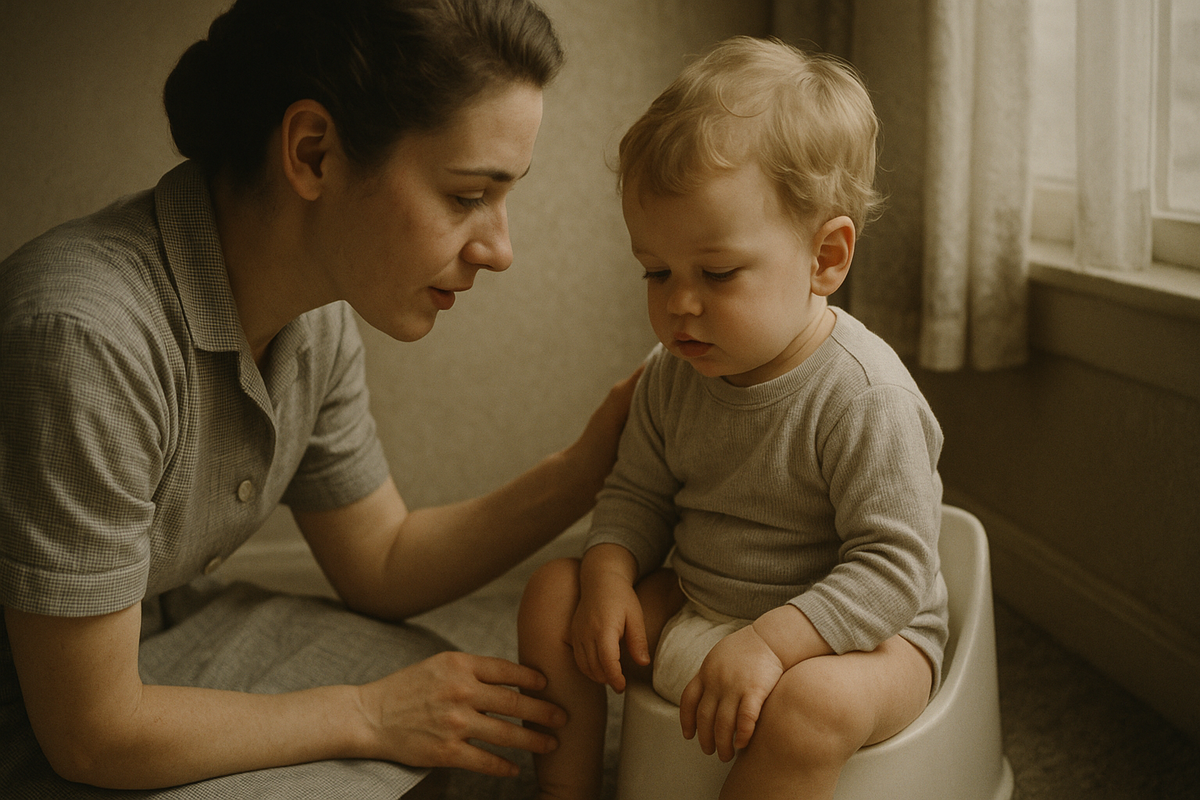
The photographs emphasized gentleness: a mother leaning close to her toddler, the image soft and patient. The visual language reinforced the message: toilet training was about guidance, not coercion.
For many families, this was the first time they encountered expert advice that didn't make them feel like failures. It was science, yes—but it was also grace.
The Core Argument: Readiness Over Rigidity
Spock's article wove pediatric research with an almost radical empathy for both parent and child. His central themes were clear:
This combination of medical authority and psychological insight was revolutionary. Spock wasn't telling mothers what to do. He was telling them what to stop doing—and why.
Why This Issue Became a Cultural Artifact
Six decades later, the February 1957 issue of Ladies' Home Journal remains a prized collectible, and the reasons extend far beyond nostalgia.
Spock's influence was seismic. As one of the defining voices in 20th-century parenting, his work fundamentally altered how American families understood childhood. Articles like this—appearing in mass-market publications—are tangible proof of how expert knowledge migrated from medical journals to kitchen tables.
It captures a generational turning point. The baby boom wasn't just a demographic phenomenon—it was a cultural experiment. This issue documents the anxieties, aspirations, and evolving philosophies of an entire generation of parents.
The advertisements tell a parallel story. Flip through the pages and you'll find Clearasil, Vicks, and Carter's—products that framed family life in the vocabulary of 1950s consumer culture. The magazine isn't just an article. It's a time capsule.
It's women's history in print. Ladies' Home Journal was more than a magazine. It was a forum where women's roles, responsibilities, and identities were debated, codified, and challenged. Spock's article sits at the intersection of those tensions—acknowledging the labor of motherhood while advocating for a less punishing approach.
To hold this issue is to hold a moment when American culture was still deciding what kind of childhood it wanted to build.
The Legacy: Why Spock's Message Still Resonates
Spock's 1957 argument—that patience, empathy, and respect for a child's developmental timeline produce better outcomes than rigidity and control—sounds obvious now. But that's only because his ideas won.
In 1957, they were controversial. They asked mothers to trust their instincts over inherited wisdom. They suggested that developmental science mattered more than generational tradition. They reframed parenting as a relationship rather than a hierarchy.
The echoes are everywhere in modern pediatric advice: wait for readiness cues, avoid power struggles, respect individuality. Spock didn't invent these ideas, but he made them accessible—and Ladies' Home Journal made them mainstream.
For readers in 1957, the article was relief and validation. For readers today, it's a reminder that the struggles of early parenthood are timeless, even if the cultural scripts have changed.
For Collectors: A Magazine Worth Preserving
As one of the most influential parenting voices of the 20th century, articles like this are highly sought after by historians and collectors documenting the evolution of American childhood.
The issue reflects the anxieties and aspirations of the baby boom generation, making it a powerful artifact of mid-century American family life.
Period advertisements for Vicks VapoRub, Clearasil, and Carter's children's clothing frame the article in the context of 1950s consumer culture.
Ladies' Home Journal was a mirror of women's roles, responsibilities, and shifting identities in postwar America—making this a vital document of social history.
If you value women's history, the evolution of child psychology, or the material culture of mid-century America, the February 1957 issue of Ladies' Home Journal is an exceptional acquisition.
It documents a philosophical shift that reshaped millions of families. It captures the visual and editorial language of an era. And it stands as proof that the everyday concerns of ordinary people—sleepless nights, stubborn toddlers, the fear of doing it wrong—are as worthy of preservation as any battlefield or political summit.
The Front Lines of Family Life
Just as Life Magazine sent photographers to battlefields to capture the courage of soldiers under fire, Ladies' Home Journal documented a different kind of courage: the patience, persistence, and quiet determination of mothers navigating the front lines of family life.
Dr. Spock's February 1957 article remains a landmark—not because it solved every problem, but because it validated the right to struggle, the need for support, and the radical idea that children deserved to be met where they were.
For collectors, historians, and anyone who understands that cultural change happens in living rooms as much as legislatures, this issue isn't just a magazine.
It's evidence that the most profound revolutions often begin with a simple question: What if we tried being kinder?
Explore the Complete Archive
From the 1930s through the 1970s, these issues trace decades of fashion, domestic ideals, literature, and cultural transformation—each one a living artifact of its time.
Browse Ladies' Home Journal Magazine Collection