
The Crown That Changed Everything
Before there was a Miss Teen USA pageant. Before there were Instagram influencers or TikTok stars. Before teenage girls became a billion-dollar demographic with their own consumer power and cultural cachet, there was a single magazine issue that dared to ask: What if we crowned one of them queen?
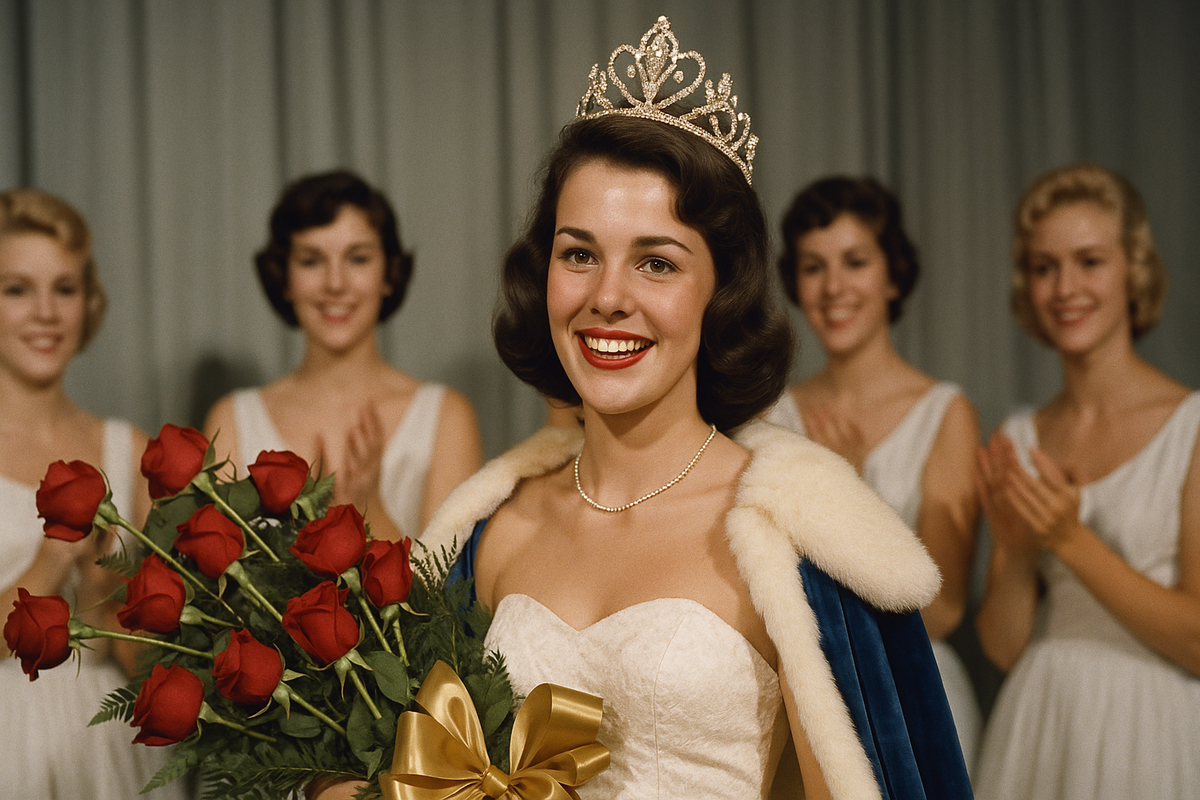
July 1959. Teen Magazine didn't just publish a beauty contest—it created a cultural inflection point. When Peggy Collings of Lake Charles, Louisiana, appeared on that cover as "the prettiest teenager in the U.S.A.," she became the first girl to wear a crown designed not for women, but for adolescents. This wasn't Miss America's younger sister. This was something new entirely: the teenager as her own category of aspiration, beauty, and national identity.
For collectors of mid-century Americana, this issue isn't merely rare—it's foundational. It captures the exact moment youth culture stopped being a footnote to adult life and became the main event.
Archive Details
Featured Subject: Peggy Collings, First Miss Teen U.S.A.
Publication: Teen Magazine, July 1959
Historical Significance: Debut of the first national teenage beauty pageant
Archive Source: Original Magazines Collection
The Invention of the Teenager
Context matters here, and the timing was no accident.
In 1959, "teenager" was still a new word in the American lexicon. The concept barely existed before World War II. But by the late 1950s, postwar prosperity had created something unprecedented: a generation with disposable income, leisure time, and their own cultural products. Rock 'n' roll blared from transistor radios. Hollywood churned out Gidget and A Summer Place. Television gave teens their own stars, their own shows, their own commercials.
Teen Magazine understood what was happening. While Miss America remained the domain of college-age women competing for scholarships and respectability, Teen saw an opening: Why not crown someone who actually looked like the girls reading the magazine?
The Miss Teen U.S.A. Contest of 1959 wasn't just pageantry. It was recognition—official, national, printed—that teenage girls had become central to American culture, not peripheral to it. They deserved their own stars, their own standards, their own moment in the spotlight.
Peggy Collings: The Archetype
The magazine's portrait of Peggy Collings reads like a specification sheet for the idealized 1950s teen: 5'5½", 117 pounds, measurements of 36"-24"-35½". Dark shiny hair. Brown eyes. Creamy complexion. The language is clinical, almost technical—this was an era that treated beauty as measurable, quantifiable, achievable through the right proportions.
But Teen was careful to add dimension beyond the numbers. Peggy played violin in the Lake Charles city orchestra. She maintained a B average at La Grange High School. She'd won local titles before, but this was her first national crown. The subtext: beauty pageants rewarded talent and academics, not just looks. (Whether that was true is another question. That it needed to be said reveals everything about 1950s anxieties around femininity and intelligence.)
The prize package tells us what mattered in 1959: a week in Hollywood, an appearance on national television, an interview for a possible screen test. Not college scholarships. Not career opportunities in the traditional sense. Hollywood. Television. Stardom. The promise was transformation—that a girl from a small Louisiana town could become a household name, that ordinariness could be polished into celebrity.
For teenage readers, Peggy wasn't aspirational because she was unattainable. She was aspirational because she'd been attainable—until the crown changed everything.
The Princesses: Regional Identity as Strategy
Teen understood something crucial about national contests: they needed to feel nationwide. The four runners-up weren't chosen randomly. They were geography made visible.
Carole Spivock (17, Detroit, Michigan) represented the industrial Midwest—petite, brunette, classic features. Joyce Ventling (17, Corydon, Iowa) embodied heartland wholesomeness, blonde and approachable. Rona Fein (17, Bayside, New York) brought East Coast sophistication, tall and slim with theatrical ambitions. Teri Janssen (16, Los Angeles, California) was already a working model, the California dream personified.
Each "princess" served as a mirror for regional readers. A girl in Iowa could see herself in Joyce. A New Yorker could imagine Rona's path. The contest wasn't just about one winner—it was about representing every corner of postwar America, from factory towns to suburbs to the edge of the Pacific.
This was deliberate branding. Teen Magazine wanted every reader, regardless of zip code, to feel included in this new vision of teenage royalty.
The Finalists: A Cross-Section of 1959
The gallery of 24 finalists reads like a sociological document. Each girl appears with her age, school, and hometown—details that ground glamour in the everyday reality of American high schools.
Some names demand attention for what they represent:
Stella Louise Reid (17), Kansas School for the Deaf, Olathe, Kansas. Her inclusion—photographed alongside hearing contestants, treated with identical reverence—marks a quiet moment of barrier-breaking. Pageants in 1959 rarely acknowledged disability. Teen did.
Gladys Cruz (18), Waimea High School, Hawaii. She competed just months after Hawaiian statehood, making her one of the first representatives of America's 50th state in a national youth contest. Her presence signaled expansion, modernity, the bleeding edge of American identity.
Elaine Newman (17), Reseda High School, California. Reseda, a San Fernando Valley suburb, was the epicenter of the postwar suburban boom—tract homes, shopping malls, car culture. Newman represented the future most American families were building.
Maryann Dominica (18), Ridgefield Park High School, New Jersey. Jerilyn Jane Oliver (16), Williamsburg High School, Iowa. Each one a data point in the map of teenage America.
The portraits themselves were styled like yearbook photos—black-and-white, approachable, intimate. This wasn't Hollywood glamour. This was the girl who sat two rows over in algebra class. The genius of Teen was making stars out of the familiar, not the distant.
Visual Language: Schoolgirl Meets Starlet
The issue's design strategy is worth studying. Peggy Collings received the full Hollywood treatment: a full-page color portrait framed in blue, lighting and composition worthy of a studio headshot. She looks like she belongs on a movie poster.
The runners-up and finalists, by contrast, appear in simple black-and-white. No elaborate styling. No dramatic lighting. Just clean, honest portraits that could've been pulled from any high school in America.
And then: a photograph of the crown and tiara itself, glittering and ornate, the physical symbol of transformation.
This visual hierarchy was intentional. The winner got the starlet treatment. Everyone else remained relatable, accessible—which meant every reader could imagine herself making that leap. The crown was the bridge between the two worlds.
Why This Issue Endures
It's a First
The debut of the Miss Teen U.S.A. contest makes this a cornerstone issue in the history of youth pageantry and teen media.
It's a Time Capsule
The measurements, language, and beauty standards freeze a moment that would be unrecognizable a decade later.
It's a Record of Names
Twenty-nine teenage girls appear with documented identities—invaluable for genealogists and local historians.
It's Visually Striking
The mix of yearbook intimacy and Hollywood glamour creates a unique aesthetic that defined Teen at its peak.
It's Scarce
Teen magazines were ephemeral. Issues in good condition have survival rates measured in the low hundreds.
It's Foundational
Every subsequent teen beauty contest traces its lineage to this moment in July 1959.
For collectors of pageant history, teen culture artifacts, or vintage fashion documentation, this issue is non-negotiable. It's the Rosetta Stone of teenage beauty culture in America.
The Significance Now
We live in an age where teenagers command global audiences through social media, where a 16-year-old's selfie can reach millions in minutes. The mechanics have changed beyond recognition. But the impulse Teen Magazine tapped in 1959—the desire to see girls like yourself elevated, celebrated, made significant—hasn't changed at all.
What makes this issue valuable isn't nostalgia. It's archaeology. It shows us the first time American media looked at teenage girls and said: You are the main character. Not your mother. Not your older sister. You.
That was radical in 1959. The fact that it feels obvious now is a measure of how completely Teen succeeded.
Collector Significance
For those seeking vintage Teen Magazine issues—whether for personal collections, academic research, or cultural documentation—the July 1959 edition represents a peak acquisition. Original copies surface infrequently at auctions and through specialized dealers in mid-century ephemera.
Authentication Markers
The distinctive blue-framed cover portrait of Peggy Collings, the 24-finalist gallery spread, and the contest announcement copy serve as key identifiers.
Condition Variables
Spine integrity, page browning, and cover gloss retention significantly impact value. Issues in excellent condition command premium prices.
Historical Context
This issue belongs alongside other defining moments: Life's first issue (1936), Playboy's Marilyn Monroe debut (1953), Rolling Stone's first cover (1967).
Each represents a seismic shift in how media reflected—and shaped—American identity. The July 1959 Teen Magazine is no exception.
Explore the Archive
Browse the complete Teen Magazine collection and discover the full chronicle of youth culture from the 1950s through the 1980s—from beauty standards to music revolutions to the birth of modern adolescence.
Browse Teen Magazine Collection