
Cyndi Lauper, The Goonies, and the Rock 'n' Wrestling Explosion
When Wrestlers Took Over MTV and Saturday Morning Cartoons
Professional wrestling died in 1985.
At least, the old version did—the regional circuit version, the smoke-filled arena version, the version where wrestlers stayed in their lane and never crossed into the glittering world of pop music, Hollywood blockbusters, or children's television.
What replaced it was something far more audacious: a full-scale entertainment empire that turned bodyslammers into MTV stars, heel promos into cartoon dialogue, and a music manager named Cyndi Lauper into one of wrestling's most unlikely architects.
The August/September 1985 issue of WWF Magazine captured this transformation mid-flight. Its feature, "Cyndi's 'Goonies' Video! WWF Wrestlers 'R Good Enough," wasn't just reporting on a music video. It was documenting a cultural coup—the moment wrestling stopped asking permission to enter mainstream entertainment and simply kicked down the door.
Archive Details
Publication: WWF Magazine
Issue: August/September 1985
Featured Wrestlers: Roddy Piper, The Iron Sheik, Nikolai Volkoff, The Fabulous Moolah, Captain Lou Albano, Wendi Richter, Hulk Hogan, Junkyard Dog
Cultural Context: Rock 'n' Wrestling Connection Era
Archive Source: Original Magazines Collection
The Triple Threat: WrestleMania, MTV, and Saturday Morning Television
By summer 1985, the World Wrestling Federation had executed a coordinated assault on American pop culture across three fronts.
In March, the first WrestleMania fused wrestling with celebrity spectacle, packing Madison Square Garden with Muhammad Ali, Mr. T, Billy Martin, and Liberace alongside Hulk Hogan and Roddy Piper. It wasn't just a wrestling card—it was closed-circuit theater, broadcast to arenas nationwide and proving that wrestling could command Hollywood-scale attention.
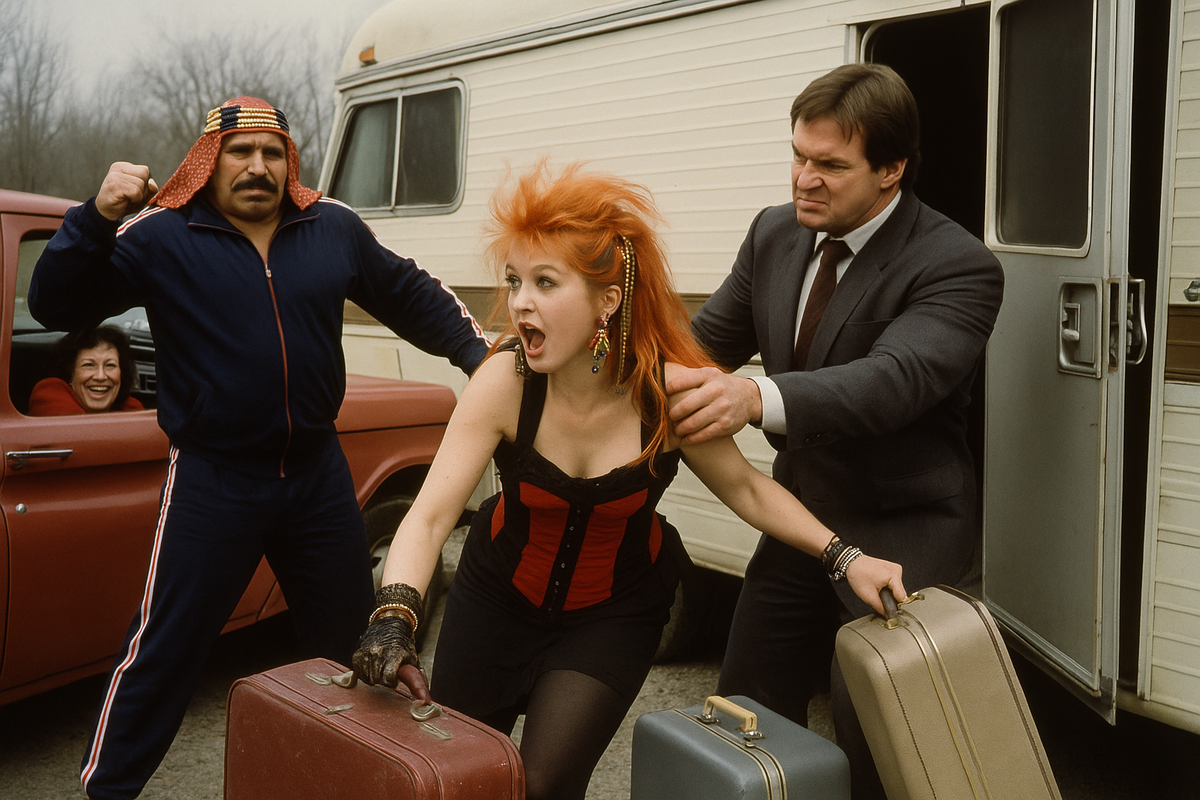
That summer, Cyndi Lauper released "The Goonies 'R Good Enough," a music video directly tied to Steven Spielberg's blockbuster film. But Lauper didn't cast actors or dancers. She cast WWF superstars—Roddy Piper, The Iron Sheik, Nikolai Volkoff, The Fabulous Moolah, Captain Lou Albano, and Wendi Richter—turning the video into a cinematic extension of wrestling storylines. Produced by Lorne Michaels and directed by Richard Coker, the video aired in heavy rotation on MTV, placing wrestling personas in front of millions who'd never watched a match.
By September, CBS launched Hulk Hogan's Rock 'n' Wrestling, an animated series with a $100,000-per-week budget that reimagined WWF stars as Saturday morning cartoon heroes and villains. Hogan, Junkyard Dog, and Hillbilly Jim battled Piper, Volkoff, and Moolah in animated form—ensuring that children who watched wrestling on weekend broadcasts could also watch it over cereal on Saturday mornings.
This WWF Magazine issue tied all three threads together. It gave fans behind-the-scenes access to the Goonies video production, previewed the cartoon series, and confirmed what many suspected: wrestling had become the centerpiece of 1980s youth culture.
WWF Magazine as Cultural Witness
By 1985, WWF Magazine had evolved beyond match coverage. It served as the official chronicle of wrestling's expansion—a glossy, full-color bridge between the ring and the living room, offering fans the kind of insider access that wouldn't become commonplace until the internet era.
The "Cyndi's Goonies Video" feature delivered exactly what fans craved:
Cinematic production stills showing The Iron Sheik posing beside a car in a tracksuit, then transformed into full wrestling gear. Roddy Piper evicting Lauper with suitcases in hand. The Fabulous Moolah behind the wheel of a red truck, grinning with mischievous authority.
Behind-the-scenes glimpses of film crews, outdoor sets, and extras—proof that wrestling had crossed into legitimate Hollywood production territory.
Comic-style captions like "The Sheik before… and after" and "You're evicted, says Piper!" that echoed the exaggerated humor of WWF promos and made the video feel like an extension of televised storylines.
The article emphasized the video's uniqueness. David Wolff, Lauper's manager, called it the first music video where wrestlers played integral, scripted roles rather than cameo appearances. The connection to The Goonies gave it box-office credibility. The MTV rotation gave it mass exposure. And the magazine gave fans the details they couldn't get anywhere else.
Elsewhere in the issue, the preview of Hulk Hogan's Rock 'n' Wrestling reinforced the message: WWF wasn't dabbling in mainstream entertainment—it was colonizing it. The cartoon's six-figure weekly budget signaled serious ambition, and the article made clear that animated Hogan wasn't just a marketing gimmick. It was a strategic play to own Saturday mornings the way MTV owned weeknights.
Together, these features made the magazine an essential artifact. It didn't just report on wrestling's expansion—it served as the official record of how it happened.
The Players: Wrestlers as Actors, Villains, and Cartoon Characters
The brilliance of the Goonies video and the Rock 'n' Wrestling cartoon lay in how they leveraged existing WWF personas. Fans didn't need backstory. They already knew the characters.
Roddy Piper as Antagonist
Played the sneering villain in the video, tossing Lauper's belongings onto the street with the same contempt he showed opponents in the ring. His role required no acting—Piper simply transported his heel persona from arenas to film sets.
The Iron Sheik's Transformation
Appeared in a playful photo sequence showing him transitioning from tracksuit-clad traveler to full wrestling regalia, capturing the blend of humor and menace that defined his character.
The Fabulous Moolah
Drove a red truck through the video with the same no-nonsense authority she brought to the women's division, reinforcing her reputation as wrestling's toughest female heel.
Albano and Richter
Captain Lou Albano and Wendi Richter continued their real-life alliance with Lauper, extending the storyline that had made Richter a champion and Albano a crossover star.
Nikolai Volkoff and Junkyard Dog rounded out the cast, ensuring the video featured both heels and babyfaces in a way that mirrored traditional wrestling match structure.
The cartoon took this further. Hogan, Hillbilly Jim, and Junkyard Dog became animated heroes. Piper, Volkoff, and Moolah became animated villains. The same rivalries that filled arenas now played out in two-dimensional cells on CBS, targeting an audience too young for live events but old enough to recognize their heroes.
Each appearance—whether in music videos or cartoons—expanded WWF personas beyond the ring and into the broader cultural imagination. These weren't just wrestlers anymore. They were multimedia entertainers.
The Legacy of the Rock 'n' Wrestling Era
WWF's 1985 magazines endure because they chronicle more than matches. They document a media strategy that redefined how wrestling marketed itself—not as a sport, but as a total entertainment experience.
The Rock 'n' Wrestling Connection proved that wrestling could thrive in music videos, that it could dominate Saturday morning television, and that its larger-than-life characters could function in scripted Hollywood productions. Vince McMahon didn't just expand wrestling's audience—he repositioned it as the soundtrack, the spectacle, and the storyline for an entire generation.
In an era before the internet, these magazines were how fans kept the narrative alive between broadcasts. Today, they remain among the most collectible wrestling publications because they are original witnesses to that transformation. They didn't report history after the fact. They reported it as it unfolded.
Why This Issue Matters to Collectors
Historical Timing
Released just months after WrestleMania I, it documents WWF's explosion into mainstream entertainment in real time. This wasn't retrospective analysis. It was happening now, and the magazine served as the official chronicle.
Star Ensemble
Features Roddy Piper, The Iron Sheik, Nikolai Volkoff, Junkyard Dog, Wendi Richter, Captain Lou Albano, and The Fabulous Moolah—a rare convergence of top-tier talent in a single feature, all playing roles outside traditional wrestling coverage.
Cyndi Lauper's Crossover Influence
Lauper's role as both pop icon and storyline manager for Wendi Richter gives the issue appeal far beyond wrestling fandom. Music collectors, 1980s pop culture enthusiasts, and MTV historians all have reason to seek this publication.
Cartoon Documentation
The preview of Hulk Hogan's Rock 'n' Wrestling adds collectible value for anyone interested in 1980s children's television, animation history, or the merchandising strategies that defined the era.
Design and Photography
The bold colors, staged comedic photos, and production stills capture the visual language of 1980s entertainment—garish, energetic, and unapologetically excessive.
Cultural Intersection
This issue sits at a rare intersection of wrestling, music, film, and television—making it one of the most significant issues of the decade for collectors seeking comprehensive 1980s pop culture documentation.
Holding this issue today means holding a time capsule from the exact moment wrestling stopped being a niche spectacle and became a dominant force in American popular culture. It's not just a magazine. It's evidence of a revolution.
Own the Moment Wrestling Conquered Mainstream America
If you want to experience the Rock 'n' Wrestling Era as fans first encountered it—when Cyndi Lauper's music video felt revolutionary, when Hulk Hogan's cartoon debut signaled wrestling's arrival, and when Roddy Piper could evict a pop star on MTV without breaking character—the August/September 1985 WWF Magazine is essential.
Browse WWF MagazinesWhether you're a lifelong wrestling historian, a nostalgic fan of Hulkamania, or a collector seeking authentic vintage WWF publications, these magazines offer a direct connection to the unforgettable 1980s.
When you hold this issue, you're not flipping through pages. You're holding the story of how wrestling kicked down the door to mainstream entertainment—with Cyndi Lauper, Roddy Piper, and the entire Rock 'n' Wrestling cast leading the charge.