
The Week the War Turned: Inside Life's June 12, 1944 Issue
When Rome fell and D-Day launched, one magazine delivered history to millions of American homes
On June 12, 1944, Americans opened their mailboxes to find history still warm to the touch.
The issue of Life Magazine that arrived that Monday morning carried photographs of events barely a week old—the fall of Rome on June 4, the Allied invasion of Normandy on June 6. No television broadcast existed to show these moments in real time. No internet delivered instant updates. For millions of families with sons, husbands, and brothers overseas, this magazine was the first chance to see what those men were facing. And what they saw changed everything.
This wasn't news. It was proof that Europe could be liberated.
Issue Archive
Publication: Life Magazine
Issue Date: June 12, 1944
Cover Subject: General Dwight D. Eisenhower and Allied commanders at Supreme Headquarters
Historic Context: Published six days after D-Day and eight days after the fall of Rome
Significance: First visual documentation for American home front of the war's turning point in Europe
The Convergence of Two Victories
By early June 1944, the war had consumed nearly five years of the world's life. American forces had been fighting since Pearl Harbor dragged the nation into combat in December 1941. The Pacific theater consumed divisions; the Italian campaign had ground forward since 1943. But Rome—the first Axis capital to fall—represented something unprecedented. When American tanks rolled into the Eternal City on June 4, they weren't just capturing territory. They were breaking the myth of Fascist invincibility.
Two days later, the largest amphibious assault in human history launched on the beaches of Normandy. D-Day opened the second front that Stalin had demanded, that Churchill had delayed, that Eisenhower had spent two years planning. Together, these events announced what had seemed impossible in 1940: the Allies were no longer containing the Axis powers. They were destroying them.
Life's June 12 issue didn't just report these victories. It made Americans witnesses to them.
Why Life Mattered in 1944
Since its 1936 debut, Life had built an empire on a radical premise: that photographs could communicate what prose could not. During wartime, that conviction became a lifeline. By June 1944, nearly every American household had someone in uniform. Wives waited. Parents scanned casualty lists. Children grew up with rationing and war bond drives and empty chairs at dinner tables.
Life gave them something newspapers couldn't—immersion. Where the New York Times offered columns of battlefield dispatches, Life delivered photo spreads that put readers on those beaches. Aerial reconnaissance images showed invasion routes. On-the-ground photographs captured jubilant Roman crowds. Illustrations reconstructed German coastal fortifications with technical precision. This wasn't journalism from a distance. It was embedded storytelling that erased the gap between home front and battlefield.
The Cover: Command at the Edge of History
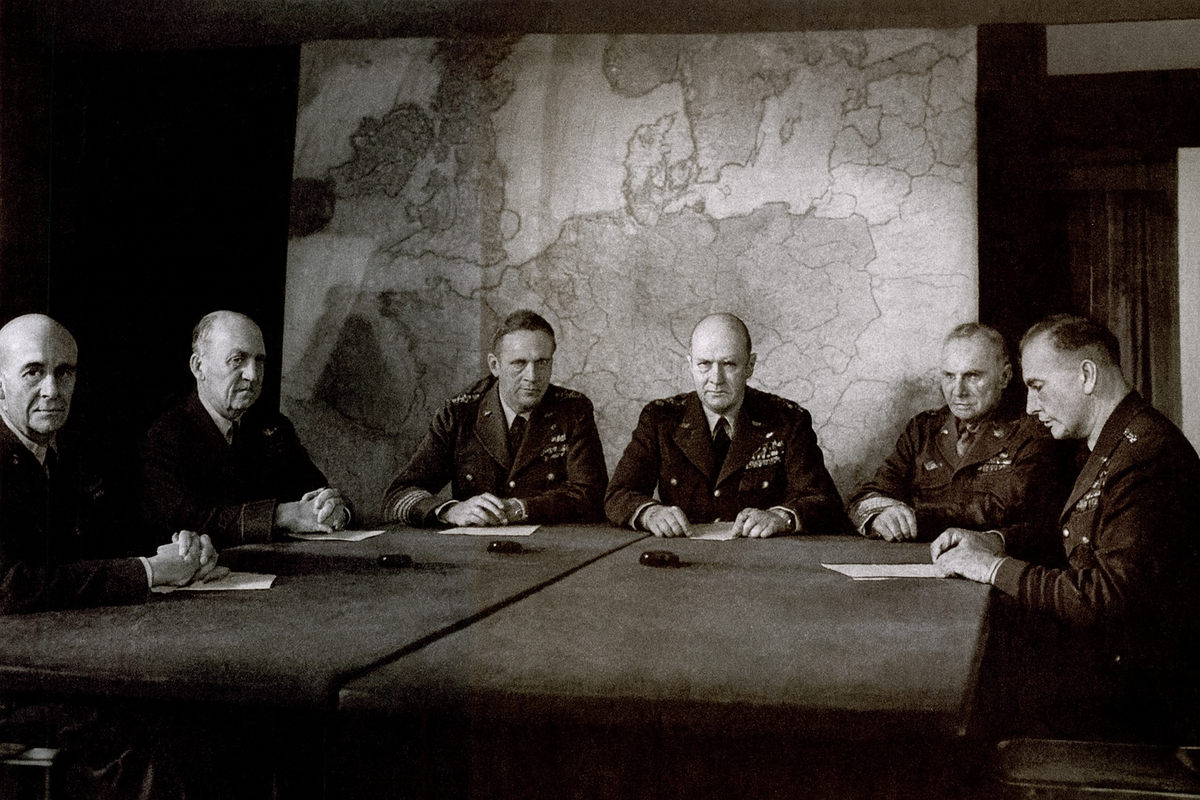
The June 12 cover shows no combat, no beaches, no ruins. Instead: General Dwight D. Eisenhower and his commanders seated around a map of Europe at Supreme Headquarters Allied Expeditionary Force. British Field Marshal Bernard Montgomery sits to one side. General Omar Bradley to the other. The image is stark—no heroics, no drama. Just men studying a map, deciding whether to launch the most complex military operation ever conceived.
That restraint was the point. This photograph said: These are the men who sent your sons to France. This is how it happened. The gravity in their faces matched the gravity in American living rooms.
Inside: Invasion as Visual Narrative
Life's Normandy coverage married photography with illustration in ways that anticipated modern multimedia reporting. Dramatic drawings showed bomber formations crossing the English Channel, paratroopers dropping behind enemy lines at night, naval vessels disgorging tanks onto sand. Captions described "the greatest mine-sweeping operation in history" as Allied engineers cleared paths through German defenses. Artists reconstructed the Atlantic Wall—pillboxes, minefields, Czech hedgehogs—and showed how infantry breached it.
These weren't propaganda posters. They were explanatory journalism. Most Americans in 1944 had never seen an LST landing craft or a German bunker. Life's illustrators gave them the visual grammar to understand what "amphibious assault" actually meant.
Photographs from Normandy itself were still limited—combat photographers were still shooting film under fire—but what Life included was devastating. Smokescreens rolling across beaches. Paratroopers boarding planes before dawn. Eisenhower speaking with the 101st Airborne hours before they jumped into darkness. These weren't generic war images. They were this invasion, these men, this week.
Rome: Liberation in Piazza Venezia
The Rome coverage offered what Normandy couldn't yet provide: aftermath. Photographs showed American tanks moving through narrow streets under sniper fire. Infantry advancing past the Colosseum. And then—release. Civilians flooding Piazza Venezia, the same square where Mussolini had delivered his bombastic speeches promising a new Roman Empire. Now crowds mobbed American GIs, handing them flowers, kissing their cheeks, weeping with relief.
One photograph captures a child offering a bouquet to a soldier who looks about nineteen. The contrast Life drew was deliberate: years of Fascist oppression ended by boys from Iowa and Brooklyn and Alabama. St. Peter's Basilica stood in the background of one shot, framing the moment as something more than military victory. This was civilization reclaiming itself.
What This Issue Contained
Eisenhower's Command
The cover photograph showing General Eisenhower, Field Marshal Montgomery, and General Bradley at Supreme Headquarters planning the invasion.
Invasion Illustrations
Detailed reconstructions of bombers crossing the Channel, paratroopers dropping behind lines, and naval forces breaching the Atlantic Wall.
Mine-Sweeping Operations
Coverage of what Life called "the greatest mine-sweeping operation in history" clearing paths for Allied landings.
Airborne Operations
Photographs of Eisenhower with the 101st Airborne before their jump, and illustrations of gliders towed by C-47s carrying paratroopers into France.
Beach Landings
Images showing smokescreens protecting the landings and the earliest photographs from Normandy beaches.
Rome's Liberation
Photo spreads of American tanks entering Rome, infantry under sniper fire, and jubilant crowds in Piazza Venezia celebrating freedom.
Cultural Symbolism
Imagery framing liberation against iconic Roman landmarks—St. Peter's Basilica and the Colosseum as backdrops to Allied triumph.
Human Stories
Intimate photographs of Italian children offering flowers to American soldiers, capturing the personal dimension of liberation.
What Made This Issue Essential Reading
Life didn't just document Rome and Normandy—it interpreted their meaning. The magazine positioned these twin victories as the turning point everyone had waited for since 1940. Articles explained how the invasions coordinated, how Normandy opened the western front while Italy drained German reserves, how each success accelerated the other. Maps showed readers the strategic geometry. Timelines connected the dots.
For families in 1944, this context mattered desperately. It meant their sons weren't dying in isolated battles. They were part of a plan that was working.
Why Collectors Prize This Issue
Historical Timing
This issue arrived while D-Day's outcome remained uncertain. Families read these pages not knowing whether Normandy would succeed or become another Dunkirk. That anxiety permeates every photograph, every caption. Later issues would report victory. This one reported hope.
Iconic Imagery
The Eisenhower command photo has been reproduced in countless histories. The Rome liberation shots defined how Americans remember Italy's liberation. These aren't archival curiosities—they're the primary visual record of the war's turning point.
Tangible Witness
Digital archives can reproduce the images, but they can't replicate holding the actual pages that Americans held in June 1944. The paper quality, the original printing, the advertisements for war bonds and Camel cigarettes—all of it anchors the magazine in its moment. This is what victory looked like when it was still fragile.
Generational Memory
For the families who lived through World War II, these magazines aren't collectibles. They're memory made physical. For historians and collectors, they're primary sources that capture not just events but how those events were understood as they happened.
Life magazines from major wartime moments—Pearl Harbor, Midway, D-Day, Hiroshima—consistently command premium interest. But the June 12, 1944 issue occupies a special category. It captured the week when the war's outcome shifted from question to probability.
The Artifact and the Archive
Modern news vanishes into digital streams. A story breaks, trends, disappears. But Life's wartime issues remain—physical objects that refuse obsolescence. The June 12, 1944 edition represents something increasingly rare: journalism as durable record. The urgency that Life's editors felt in June 1944 hasn't dissipated. It's preserved in every photograph, every caption, every advertisement for war bonds.
To page through this issue is to experience the war as Americans experienced it—incomplete, unresolved, terrifying, and suddenly, improbably, winnable.
Explore the Collection
This June 1944 issue represents one entry in Life's extraordinary wartime archive. From the magazine's 1936 founding through the 1970s, Life chronicled every seismic shift in American and global culture. Whether you collect for historical research, family connection, or the simple pleasure of holding authentic cultural artifacts, these magazines offer something irreplaceable: history before it knew its own ending.
Browse Life Magazines CollectionThe June 12, 1944 issue of Life Magazine remains a masterwork of wartime journalism—not because it predicted victory, but because it made millions of Americans believe victory was possible. Through photography, illustration, and narrative clarity, Life transformed distant battles into shared national experience. For collectors and historians today, it stands as both artifact and testament: the week when Europe's liberation began, captured in ink and paper that has outlasted the war itself.