
When Time Magazine Crowned David Bowie King of the World
How the July 18, 1983 issue captured the moment pop music became a geopolitical force
The mailboxes of Middle America received an unusual dispatch on July 18, 1983. Tucked between grocery circulars and electric bills sat that week's Time Magazine—and on its cover, David Bowie clutched a globe like a conquering emperor of sound.
This wasn't rock journalism. This was coronation.
For a publication that typically reserved its cover real estate for presidents and CEOs, the choice was deliberate. Time wasn't documenting a concert tour. It was chronicling the moment pop music became a geopolitical force—and Bowie, the alien who'd spent a decade shape-shifting through glam rock's margins, had emerged as its ambassador to the planet.
Archive Details
Historical Figure: David Bowie
Issue Date: July 18, 1983
Archive Source: Time Magazine
Cultural Context: Serious Moonlight Tour, Let's Dance era
The Summer Everything Changed
By mid-1983, the machinery of popular culture had fundamentally rewired itself. MTV, barely two years old, had transformed music videos from afterthoughts into primary texts. Stadium tours had evolved from amplified concerts into architectural spectacles. And David Bowie—always the artist most attuned to shifts in the zeitgeist—had released Let's Dance, an album that obliterated the line between avant-garde credibility and commercial dominance.
Produced by Nile Rodgers of Chic, Let's Dance delivered instant anthems: "China Girl," "Modern Love," tracks engineered for both dancefloors and stadiums. But the album's true achievement was strategic. Bowie had spent the 1970s as rock's most cerebral chameleon—Ziggy Stardust, the Thin White Duke, the Berlin experimentalist. Now he'd weaponized that artistic credibility for mass conquest, proving that stadium-sized success didn't require dumbing down.
The Serious Moonlight Tour was his victory lap. Sharp suits replaced glitter. Broadway staging replaced art-rock austerity. And hundreds of thousands of fans—many too young to remember Ziggy—packed outdoor venues to watch Bowie conduct his greatest performance yet: the transformation of bohemian outsider into global statesman.
Time's Institutional Blessing
What made Time's coverage extraordinary wasn't its length or detail—the magazine had profiled musicians before. It was the framing.
The July 18 feature, titled "David Bowie Rockets Onward," positioned Bowie not as entertainer but as institution. The editorial voice—sober, analytical, devoid of fan-magazine breathlessness—assessed Bowie the way it might assess a Fortune 500 CEO or a candidate for high office. His decades of reinvention were presented as business strategy. His theatrical instincts were management acumen. His ability to read cultural shifts became a form of statecraft.
For suburban readers flipping through Time over breakfast, this was revelation. Many had never attended a Bowie concert, never owned a Bowie album. But Time translated his significance into a language Middle America understood: success, influence, market dominance. Bowie wasn't asking for acceptance. He'd already won.
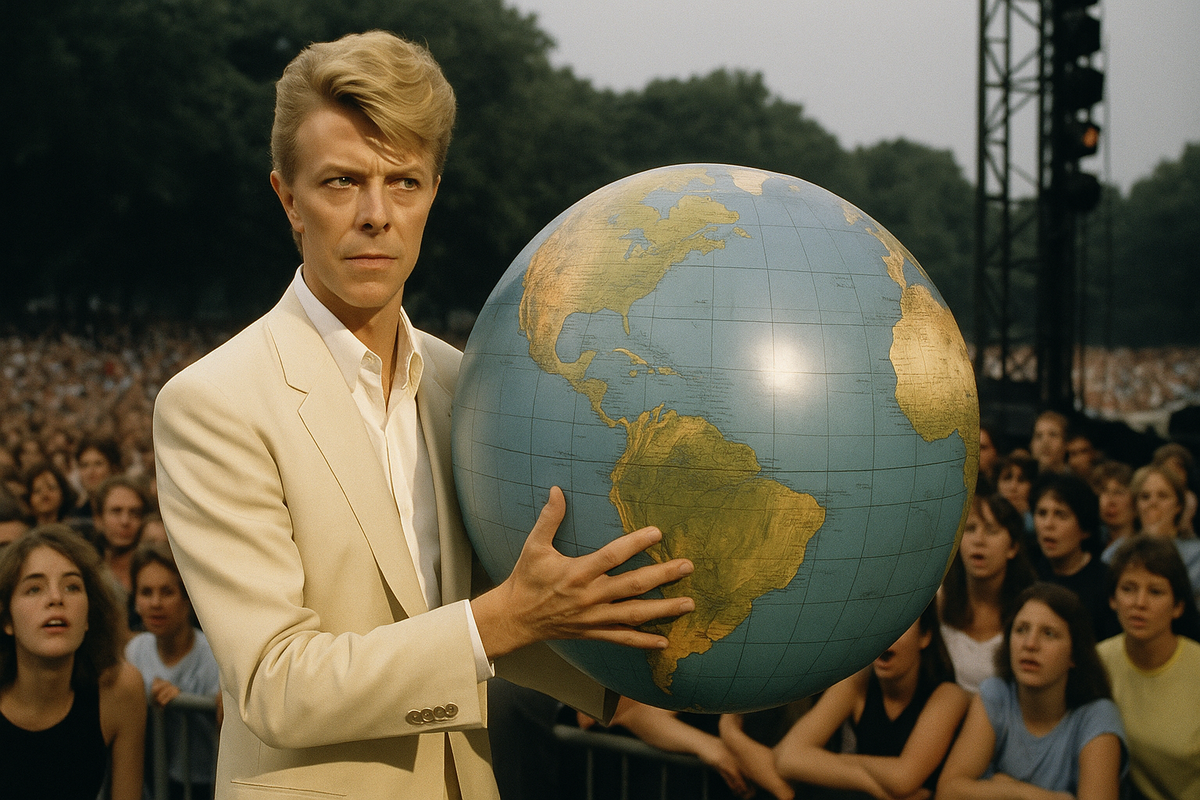
The photography amplified this coronation. One image showed Bowie onstage with a massive inflatable globe, a visual metaphor so unsubtle it bordered on propaganda. Another offered a gallery of his past incarnations—Ziggy's flame-colored hair, the Duke's icy stare, the suited 1983 model—each persona proof of his unmatched capacity for self-invention. Crowd shots captured young fans pressed against barriers, their faces reflecting not mere fandom but something closer to religious ecstasy.
Unlike Rolling Stone or Creem, which spoke to the already-converted, Time had a different mandate: to explain cultural earthquakes to those who hadn't felt the ground shift. And in July 1983, the message was unmistakable. David Bowie wasn't just a rock star. He was the blueprint for what global celebrity would become.
The Architecture of the Article
Time's editors structured the piece as both biography and cultural analysis, moving fluidly between Bowie's past and the industry he was reshaping:
This wasn't hagiography. It was Time doing what Time did best—identifying the moment a cultural phenomenon became a historical fact.
Why This Issue Endures
For collectors of vintage magazines, the July 18, 1983 Time occupies rare territory. It's not simply documentation of a tour or an album cycle. It's the artifact that marks when mainstream American media acknowledged that pop music—specifically Bowie's brand of intelligent, theatrical pop—had become as culturally significant as politics or economics.
Owning this issue means possessing the physical evidence of a specific cultural moment—when David Bowie stopped being a cult figure and became, in Time's own framing, a king.
The Artifact Speaks
Nearly four decades later, the July 18, 1983 Time Magazine stands as one of the most revealing documents of its era. Not because it predicted Bowie's longevity (though it did). Not because it perfectly captured his artistry (though the photography came close). But because it showed how thoroughly pop music had colonized the center of American culture.
Thanks to Time's reportage and editorial vision, millions of readers who might never have listened to "Scary Monsters" or "Heroes" understood why Bowie mattered. He wasn't a British eccentric or a glam rock relic. He was the prototype for a new kind of global figure—one who could command stadiums, move markets, and reshape identity itself.
For today's collectors, this issue is more than memorabilia. It's a fragment of the moment when music, media, and global ambition fused into something unprecedented.
And David Bowie, as always, was there first.
For Collectors and Cultural Historians
Explore thousands of original Time magazines—including this landmark July 18, 1983 David Bowie issue—in our collection.
Browse Time Magazine CollectionVintage magazines aren't just reading material. They're primary sources—the unfiltered voices and images that shaped an era, preserved in ink and paper.