
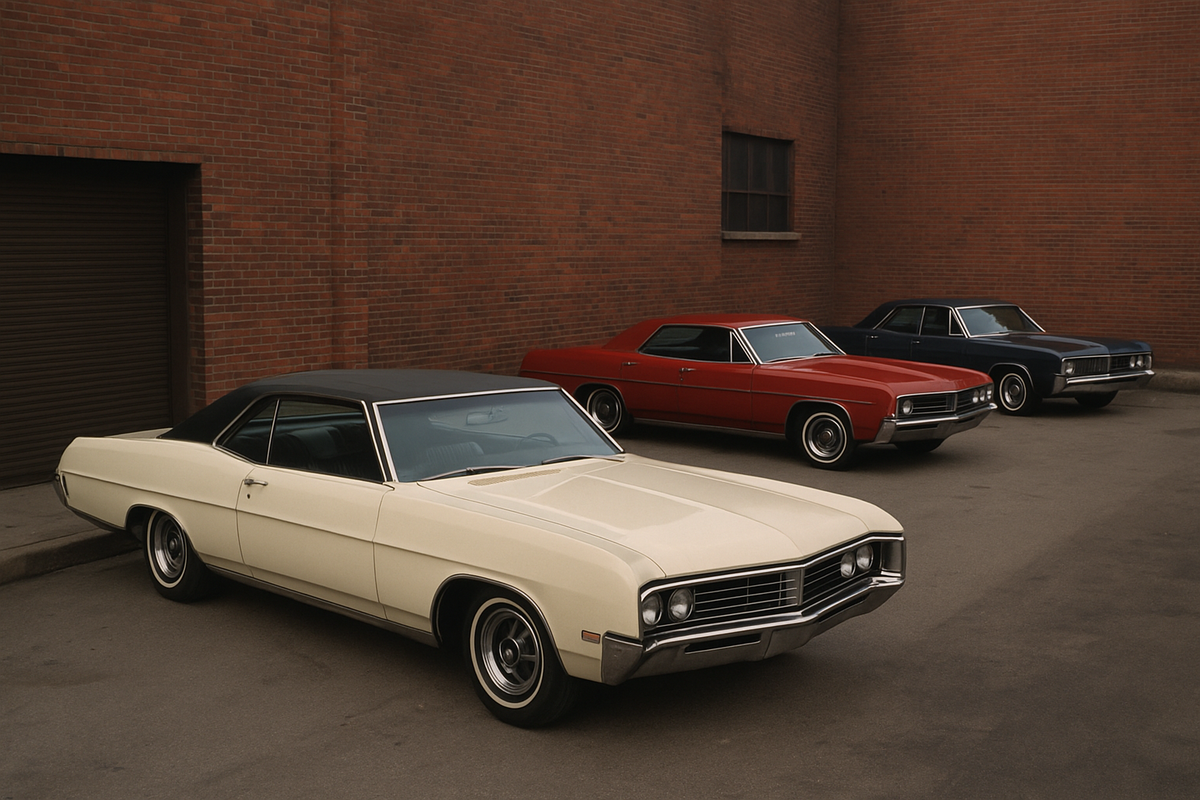
When GM Was Bigger Than 175 Countries
Inside Forbes' Last Portrait of Detroit Before the Fall
On New Year's Day 1969, General Motors posted sales of $22.4 billion—a figure that exceeded the entire gross national product of more than 175 sovereign nations. Yet buried in the January 1st issue of Forbes Magazine, beneath the charts tracking this staggering dominance, ran a quieter, more unsettling truth: the American auto industry ranked only 11th out of 23 industries in profitability, and 19th in growth.
Something was wrong at the peak.
That issue—titled "Automotive Products"—stands today as one of the most prophetic business documents of the late 20th century. It captured Detroit's Big Three at the apex of their global influence, yet recorded the precise moment when cracks began appearing in the foundation. Forbes didn't just report numbers. It documented the transformation of an empire that had ruled American manufacturing for half a century, now facing inflationary pressures, overseas competition, and the realization that building cars alone would no longer be enough.
For anyone who understands that the best business intelligence often reads like prophecy, this issue deserves a second look.
Archive Details
Publication: Forbes Magazine
Issue Date: January 1, 1969
Feature: "Automotive Products" — Annual Industry Report
Historical Context: Final year of the 1960s boom, before oil shocks and stagflation
The Landscape: American Industry at Full Throttle—and Overheating
The late 1960s economy was a paradox. Unemployment remained low. Consumer demand stayed strong. Yet beneath the surface, American industry was overextending. The postwar boom had created giants, but those giants were discovering that size alone couldn't guarantee survival.
The automotive sector embodied this tension perfectly. General Motors, Ford, and Chrysler—the Big Three—still commanded nearly 90% of their revenues from automotive products. Chrysler had reached $14 billion in sales. Ford wasn't far behind. Together, they employed hundreds of thousands of workers and anchored entire regional economies.
But the margins were tightening. Forbes didn't soften the diagnosis: automotive ranked 11th in profitability among major industries. The companies were massive, but they weren't necessarily winning.
Diversification became the strategic obsession. GM experimented with aviation, shipping, and chemicals. Ford invested in motor homes and tractors. Chrysler dipped into boat manufacturing. Caterpillar, Deere, White Motor, and International Harvester pushed aggressively into construction machinery and heavy-duty trucks, hedging against the cyclical vulnerabilities of their core markets.
The article captured this pivot in stark, unromantic terms: the Big Three still defined American industrial power, but specialized suppliers—Timken, Dana, J.I. Case—were quietly outperforming them in return on equity. Focus and efficiency, it turned out, could sometimes beat scale.
Why Forbes Told This Story Better Than Anyone Else
By 1969, Forbes had earned its reputation as the ruthless auditor of American capitalism. The magazine believed that numbers, when properly arranged, revealed truths that narratives alone could not. Its editors trusted comparative tables more than executive interviews. They preferred balance sheets to press releases.
The "Automotive Products" feature exemplified this philosophy. Readers encountered:
Yardsticks of Management Performance—comparative tables ranking 26 companies by profitability and growth, stripping away corporate rhetoric to expose who actually delivered returns.
Industrial photography—images of Caterpillar dump trucks, White Motor graders, and Case loaders, visually documenting the literal machinery of diversification.
Editorial clarity—explanations that didn't just present statistics, but interpreted what they meant for the future of American manufacturing.
For executives and investors reading Forbes in 1969, this wasn't entertainment. It was intelligence. The magazine functioned as a strategic tool, offering context that could shape capital allocation decisions worth millions.
The Hierarchies Hidden in Plain Sight
The issue laid bare several uncomfortable truths about Detroit's hierarchy:
The Visual Archive: Design as Editorial Statement
Forbes in this era didn't rely on splashy graphics or attention-grabbing covers. Its design philosophy reflected its editorial values: restraint, authority, credibility. The magazine's power came from the weight of its analysis, not the flash of its presentation.
Inside the "Automotive Products" feature, the visual strategy reinforced the reporting:
Hard financial data paired with long-term projections. Cross-company comparisons that gave readers immediate context. Balanced coverage spanning GM's empire down to mid-sized specialists like TRW and Timken.
The industrial photography wasn't decorative. Those images of construction equipment and trucks served as evidence—proof that diversification wasn't just a strategy memo, but a physical reality reshaping American manufacturing.
Forbes understood that for its audience, clarity was more valuable than glamour. The magazine built trust through precision, not pageantry.
The Permanence of Annual Industry Reports
Forbes' annual industry reports endure because they were built differently than daily journalism. These weren't reactive pieces chasing headlines. They were constructed as time capsules—comprehensive assessments meant to be studied, quoted, and referenced long after publication.
Executives studied them in boardrooms. Analysts cited them in financial reports. Historians now treat them as primary sources for understanding how business leaders interpreted their own moment.
That durability is precisely why vintage Forbes magazines retain their value. They weren't disposable. They were designed to last.
Why Collectors and Historians Prize This Issue
Owning this issue means possessing a piece of material evidence from a moment when American industrial dominance seemed permanent—and when the first signs of vulnerability were becoming visible to those who knew how to read the numbers.
Conclusion: Prophecy Disguised as Reporting
The January 1, 1969 issue of Forbes Magazine remains one of the most important business publications of its decade—not because it predicted the future, but because it documented the precise moment when that future became inevitable.
Its coverage of "Automotive Products" revealed the Big Three's dominance, the surprising profitability of specialized suppliers, and the industry's first tentative steps toward diversification. But more than that, it captured the contradictions: unprecedented scale paired with tightening margins, global influence shadowed by emerging vulnerabilities.
Holding this issue today means holding the last clear portrait of Detroit before the fall—a moment when American automotive power stood at its peak, even as the forces that would dismantle it were already gathering strength.
Thanks to Forbes' unmatched reporting, we can revisit those dynamics not as distant history, but as a case study still relevant in today's global economy. For anyone who values business history, vintage Forbes magazines aren't just reading material. They're living artifacts of industrial power, economic transformation, and the moments when empires begin their slow, inevitable turn.
Access the Archive
Thousands of original Forbes magazines—spanning the 1940s through the 1980s—are available in our collection. These issues allow you to trace entire decades of business strategy, entrepreneurship, and global commerce as they unfolded in real time, reported by the journalists who witnessed them firsthand.
Browse Forbes Magazine CollectionWhether you're an investor studying historical market patterns, a historian researching industrial America, or a collector preserving business journalism at its peak, these magazines offer something increasingly rare: a chance to see business history as it was first recorded.