
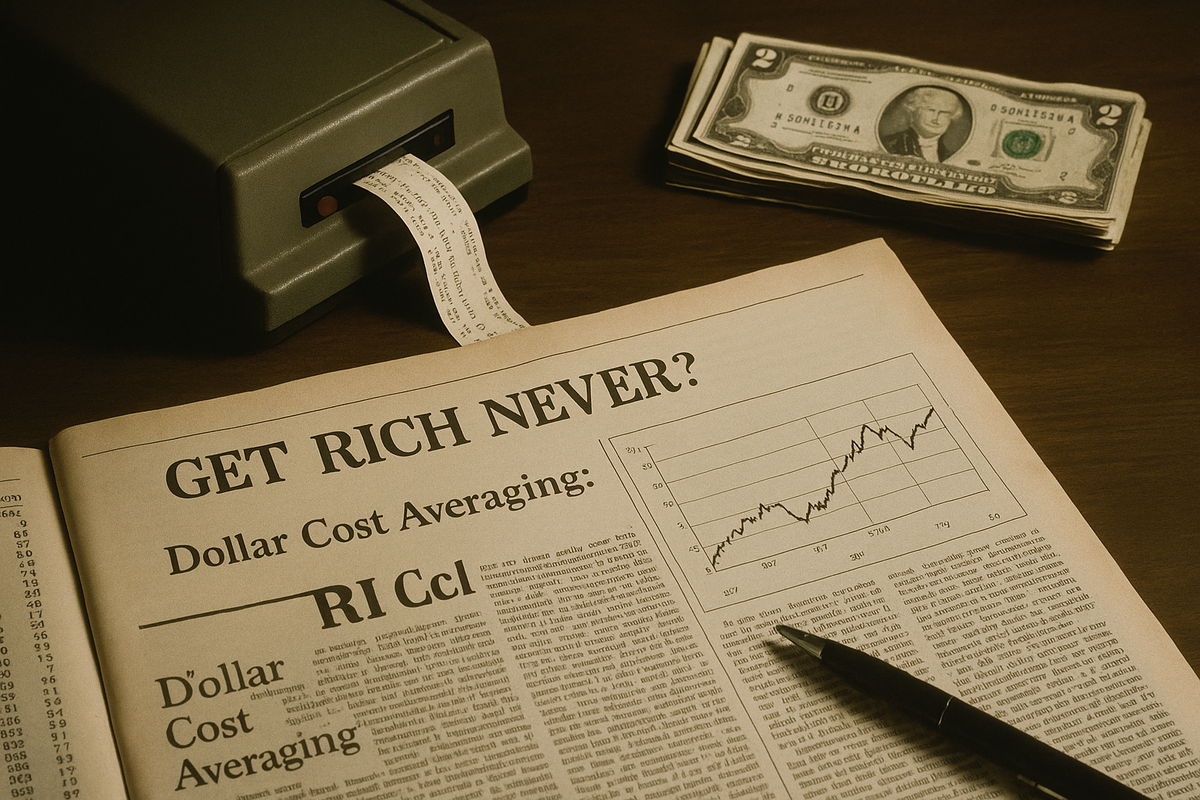
The Magazine That Warned Wall Street Three Months Before the Crash
On July 1, 1973, Forbes Magazine published a mathematical autopsy of America's most trusted investment strategy. By October, the stock market would begin its worst collapse since the Great Depression.
The timing was not prophetic—it was surgical. While investors clung to the comforting rhythm of dollar cost averaging, Forbes was already dissecting its corpse with spreadsheets and skepticism. The article asked a question that still reverberates through trading floors today: "Dollar Cost Averaging: Get Rich Slow? Or Get Rich Never?"
The answer, backed by five years of data across twelve blue-chip giants, was more unsettling than anyone expected.
Archive Details
Publication: Forbes Magazine
Issue Date: July 1, 1973
Featured Article: "Dollar Cost Averaging: Get Rich Slow? Or Get Rich Never?"
Historical Context: Published three months before the 1973–74 stock market crash
Archive Source: Original Forbes Magazine Collection
The Economic Pressure Cooker of 1973
America was financially unmoored. Two years earlier, the Bretton Woods system had collapsed, severing the dollar's anchor to gold and casting the currency into uncharted waters of floating exchange rates. Inflation gnawed at purchasing power while Vietnam War spending hemorrhaged the federal budget. By summer, the first tremors of the coming oil embargo were rumbling beneath the surface.
Wall Street's response was predictable: seek shelter in formula. The bull market of the 1960s had evaporated into volatility and stagnation. Dollar cost averaging—the practice of investing fixed amounts at regular intervals regardless of price—promised mechanical safety in an age of chaos. Invest the same $100 every month. Buy more shares when prices drop, fewer when they rise. Watch your average cost shrink through arithmetic inevitability.
Forbes Magazine did what Forbes did best: it ran the numbers.
The Methodology Behind the Skepticism
Forbes didn't theorize. It tested. The magazine selected twelve corporate titans that defined American business—AT&T, IBM, Exxon, Coca-Cola, General Motors, General Electric, Procter & Gamble, Xerox—and tracked 21 hypothetical purchases across five turbulent years (1967–1972). Each simulation invested a fixed sum at regular intervals, the textbook execution of dollar cost averaging.
The results shattered the myth. For eight of the twelve stocks studied, the average cost achieved through DCA exceeded the median market price. Translation: investors following this supposedly foolproof strategy would have done better buying shares at random moments across the same period.
This wasn't a marginal difference. This was mathematics exposing wishful thinking.
The article laid bare additional friction: transaction fees compounded the underperformance, shaving returns with every automatic purchase. Even household names—IBM trading at heights it would not see again for years, Xerox riding the crest of technology optimism—could not rescue DCA from its own limitations.
Forbes concluded with characteristic bluntness: discipline mattered more than formulas. No system could replace judgment, patience, and awareness of market cycles. The emperor of safe investing had no clothes.
The Mathematics of DCA
By investing fixed sums regularly, investors theoretically buy more shares when prices are low and fewer when prices are high, lowering average cost.
The Test Period
Forbes tracked 21 hypothetical purchases across leading stocks between 1967–1972, a volatile five-year stretch.
The Sobering Results
For eight of the twelve stocks tested, the average cost using DCA exceeded the median market price. Random buying would have performed better.
The Illusion of Safety
While DCA softened the emotional blow of market swings, it did not consistently deliver superior returns.
Corporate Giants Studied
AT&T, Coca-Cola, General Electric, IBM, and Xerox were central to the study—proving even blue-chip stocks weren't immune.
The Commission Problem
Transaction fees ate into DCA's supposed advantages, further weakening its long-term performance.
Why Forbes Could Publish What Others Wouldn't
By 1973, Forbes had carved out editorial territory that competitors avoided: unflinching, data-driven contrarianism. While other financial publications trafficked in optimism or deferred to conventional wisdom, Forbes specialized in stripping away comforting narratives to reveal uncomfortable truths.
The magazine's design philosophy reinforced this ethos. No flashy photography. No breathless headlines. The July 1973 cover presented itself with understated authority—text-driven, serious, credible. Inside, the DCA article deployed tables and charts with clinical precision, making complex analysis accessible without diluting its rigor.
This was financial journalism as intellectual investigation, not promotional content. Forbes positioned itself as the voice investors turned to when they wanted reality, not reassurance.
The Historical Aftershock
Three months after this issue hit newsstands, the 1973–74 bear market began its savage descent. The oil embargo struck in October. The Dow Jones would lose nearly half its value by December 1974. Inflation would surge into double digits.
Forbes had not predicted the crash—but it had documented the mindset of investors standing at the precipice. The article captured American capital at its most vulnerable: seeking safety through mechanical formulas while economic foundations crumbled beneath the surface.
Reading this issue today is an exercise in dramatic irony. Every discussion of "five-year periods" and "volatile stretches" reads differently when you know what came next. The stocks analyzed—AT&T's monopoly soon to be shattered, IBM's dominance soon to be challenged, Xerox's innovation soon to stagnate—were themselves standing at inflection points.
The Legacy of Skeptical Journalism
Great financial journalism does not age because markets always return to the same emotional terrain: fear, greed, the desperate search for control over uncertainty.
The July 1, 1973 issue of Forbes endures because it refused to comfort readers with false hope. It examined a sacred investment strategy and found it wanting. It reminded an anxious public that arithmetic alone could not conquer risk.
Today, with algorithmic trading and artificial intelligence reshaping Wall Street, the lesson remains sharp: discipline trumps formulas. Judgment matters. No system is foolproof.
For anyone who values the evolution of investment thought—or who simply wants to hold a moment when America stood at the edge of economic upheaval—this issue is essential.
Why Collectors Pursue This Issue
Historical Proximity
Published months before the crash, it preserves the pre-crisis mindset with forensic clarity—investor caution mixed with residual optimism, faith in blue-chip stability, reliance on systematic strategies.
Corporate Archaeology
The companies profiled—AT&T, IBM, Coca-Cola, Exxon—were shaping global business in ways that still echo today. This issue tracks their trajectories at a pivotal juncture.
Evergreen Relevance
The debate Forbes initiated—formulaic safety versus active judgment, passive indexing versus tactical positioning—still dominates investment discourse. Modern arguments over robo-advisors and ETFs are descendants of this 1973 analysis.
Artifact Scarcity
Forbes magazines from transitional economic periods command collector attention. They are valued not only for financial insight but as original evidence of how markets and mindsets evolve.
Explore the Original Forbes Archive
From the boom years of the 1960s to the turbulence of the 1970s and beyond, Forbes documented not just numbers, but the nerve endings of American capitalism itself.
Browse Forbes Magazine Collection