
Dorothy Dandridge, June 1962: When Ebony Claimed the Space Hollywood Refused to Give
How one magazine cover became an act of cultural resistance—and why this issue remains essential to understanding American entertainment history
The cover alone was an act of defiance.
When Dorothy Dandridge stared out from the June 1962 issue of Ebony Magazine, she wasn't just another Hollywood starlet gracing a glossy masthead. She was a Oscar-nominated actress who couldn't get cast. A box-office draw who couldn't live where she chose. A woman whose face sold magazines but whose talent was systematically wasted by an industry that saw her beauty as exotic and her ambition as inconvenient.
Ebony didn't flinch from that contradiction. In "The Private World of Dorothy Dandridge," writer Louie Robinson and the magazine's photographers did what no mainstream publication would: they presented Dandridge as she deserved to be seen—glamorous, intellectually serious, emotionally complex, and unapologetically proud. This wasn't puff-piece celebrity journalism. It was cultural warfare disguised as a lifestyle feature.
For readers in 1962, the issue arrived at a flashpoint. The Freedom Rides had challenged segregation on interstate buses the year before. James Meredith had just become the first Black student admitted to the University of Mississippi, requiring federal marshals to protect him from white mobs. America was convulsing toward change—but Hollywood remained a fortress of exclusion.
And there was Dorothy Dandridge: trapped inside.
Archive Details
Historical Figure: Dorothy Dandridge (1922–1965)
Issue Date: June 1962
Archive Source: Ebony Magazine
Feature: "The Private World of Dorothy Dandridge" by Louie Robinson
Historical Context: Civil Rights Movement, post-Carmen Jones era, height of Hollywood racial barriers
The Performer Hollywood Couldn't Categorize
Dandridge's career had always defied easy classification. She began as a child performer in The Wonder Children, touring with her sister Vivian through churches and conventions under the direction of their mother, Ruby Dandridge. By the 1950s, she had transformed herself into a leading lady—a rarity for Black actresses in an era when most were confined to maid roles or musical interludes.
Then came Carmen Jones in 1954. Directed by Otto Preminger, the film adaptation of Bizet's opera cast Dandridge in the title role and made her the first Black woman nominated for the Academy Award for Best Actress. The nomination should have opened doors. Instead, it revealed how tightly those doors were locked.
Hollywood had no interest in Dorothy Dandridge the versatile actress. It wanted Dorothy Dandridge the tragic seductress, the exotic outsider, the sultry temptress who could be safely contained within racial stereotypes. After Carmen Jones, she was offered variations on the same theme: Island in the Sun, Tamango, Porgy and Bess. Roles that exoticized her beauty rather than explored her range.
Robinson's Ebony profile captured her frustration plainly: Dandridge wanted roles beyond "Negro parts," but the industry refused to imagine her in them. She could play Carmen, but not Cleopatra. She could play a "native girl," but not a lawyer, a journalist, or a woman simply living her life without racial coding.
This wasn't just professional disappointment. It was artistic suffocation.
Ebony's Counter-Narrative: Glamour as Resistance
What makes the June 1962 issue so significant is how Ebony refused to accept Hollywood's limitations as the final word.
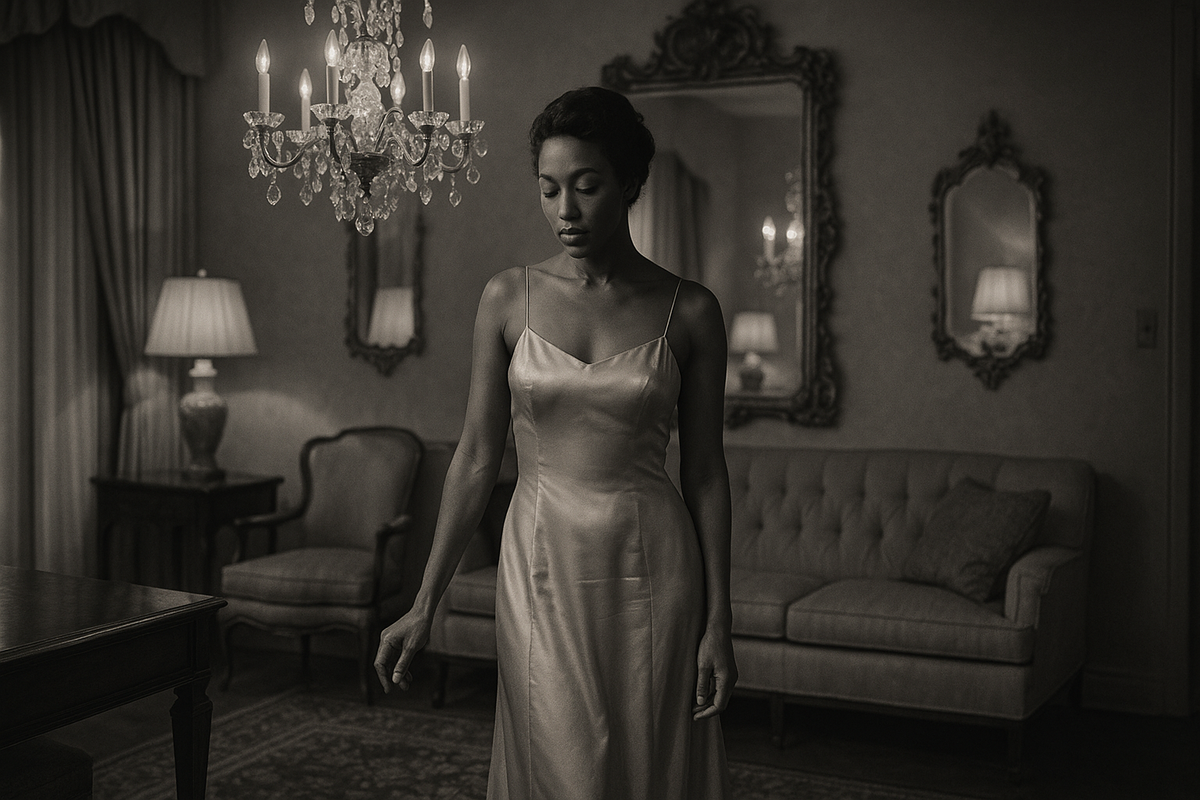
The magazine's photographers descended on Dandridge's Hollywood Hills home and shot her with the same reverence that Life or Vogue might afford Elizabeth Taylor or Grace Kelly. The images are stunning: Dandridge in a pink negligee beneath crystal chandeliers, reading in a study lined with books and records, standing beside gilt mirrors in rooms that radiated European elegance. One photograph showed her with Jack Denison, her husband at the time, framed against sweeping Los Angeles views—though the marriage was already fracturing. (They would divorce later that year, and Denison would later be implicated in financial and emotional abuse.)
The photographs weren't just beautiful. They were political.
In 1962, mainstream magazines rarely showed Black women in aspirational domestic settings. When they appeared at all, it was as subjects of sociological study or civil rights conflict—not as figures of leisure, taste, and refinement. Ebony rejected that visual apartheid. By photographing Dandridge's home with the same sophistication afforded to white stars, the magazine insisted that Black glamour, Black domesticity, and Black artistry deserved equal space in the American imagination.
This was Ebony's genius. Founded by John H. Johnson in 1945, the magazine documented African American life in its fullness—politics, fashion, business, arts, family milestones—without apology or qualification. It didn't ask permission to celebrate Black achievement. It simply did so, month after month, creating an alternative archive of American culture that mainstream outlets ignored.
The Woman Behind the Image
Robinson's text matched the ambition of the photography. He constructed a portrait that honored Dandridge's complexity without flattening her into symbol or victim.
The profile revealed her relentless discipline: a strict daily routine of exercise, script study, and intellectual engagement. She read Freud and Langston Hughes. She maintained her weight with precision. She approached her craft with the seriousness of someone who understood that every performance was a referendum on Black talent.
But Robinson also captured her wounds. Dandridge spoke openly about her absent father and the lasting pain of that abandonment. She described a childhood filled with invasive questioning from adults, which had left her wary of interviews and protective of her inner life. The profile mentioned her daughter, Harolyn Nicholas, who had been born with severe brain damage—a private tragedy that Dandridge carried throughout her career.
These revelations humanized her without diminishing her. Ebony presented Dandridge as both Hollywood goddess and vulnerable woman, both cultural pioneer and person shaped by loss. The magazine understood that Black achievement didn't require erasing Black struggle—it required showing both at once.
This balance was Ebony's signature move: celebrating progress while documenting the barriers that still remained. Every profile was a counter-narrative, proving that African Americans shaped American culture at the highest levels, even when mainstream institutions refused to acknowledge it.
The Oscar Barrier
First Black woman nominated for Best Actress, but the nomination didn't translate to career opportunities—revealing Hollywood's systemic limits.
Visual Politics
Ebony photographed Dandridge's home with the same sophistication as white stars, claiming space mainstream magazines refused to grant.
Personal Discipline
Robinson documented her rigorous daily routine—reading Freud and Hughes, script study, physical training—showing the work behind the glamour.
Private Tragedy
The profile addressed her absent father, troubled marriage, and daughter's disability—humanizing the star without exploitation.
The Historical Crossroads
Dandridge would be dead within three years. On September 8, 1965, she was found unresponsive in her West Hollywood apartment, victim of an overdose of antidepressants. She was 42 years old. The official ruling was accidental death, though questions lingered.
Her career had collapsed in the years after the Ebony profile. No major roles materialized. Financial troubles mounted. The promise of Carmen Jones had curdled into obsolescence.
This makes the June 1962 issue all the more haunting. It captured Dandridge at a pivot point—Oscar-nominated but underemployed, glamorous but struggling, celebrated in Black media but ignored by Hollywood's gatekeepers. The magazine gave her what the film industry would not: recognition as a complete artist.
For Ebony's readers in 1962, the feature wasn't just entertainment journalism. It was cultural affirmation. Seeing Dandridge's home, career, and inner life validated Black beauty, artistry, and resilience during an era of ongoing segregation and exclusion. It said: We see you. We honor you. Your story matters.
That remains true today.
Why This Issue Endures
The Dandridge Cover
Groundbreaking entertainers always command collector interest, but Dandridge's story carries particular weight. She was a trailblazer whose legacy was nearly erased, making every archival trace of her life valuable.
Civil Rights Era Context
Published at the height of the movement, the issue reflects both the triumphs and barriers of Black America. It exists in conversation with Meredith's integration of Ole Miss and the gathering momentum toward the March on Washington.
Rare Biographical Detail
The home photography and Robinson's interview provide glimpses into Dandridge's private world that exist almost nowhere else. For researchers, these pages are irreplaceable.
Media Representation History
The issue is a case study in how Black publications created counter-narratives to mainstream exclusion. It demonstrates Ebony's editorial sophistication and its role as cultural chronicler.
Crossover Appeal
Collectors of Hollywood history, African American history, and vintage lifestyle journalism all seek this issue. It sits at the intersection of multiple collecting traditions.
Artifact of Representation
Owning this magazine isn't just acquiring paper and ink. It's preserving witness to a moment when representation was revolution.
Explore the Larger Archive
The Dorothy Dandridge issue is one chapter in a much larger story. From the 1940s through the 1980s, Ebony documented every facet of African American life: civil rights battles, family milestones, political breakthroughs, entertainment legends, cultural icons. Each issue is both time capsule and living artifact.
Browse Ebony Magazine CollectionHolding History
The June 1962 issue of Ebony Magazine remains one of the most significant publications of its era. Through photography and narrative, it captured the contradictions of Dorothy Dandridge's life—extraordinary talent and limited opportunity, dazzling beauty and personal pain, public glamour and private struggle.
For Ebony's readers in 1962, it was revelation. For us today, it's a reminder that media shapes memory, that representation matters, and that figures like Dorothy Dandridge paved the way for every Black performer who followed.
Holding this issue in your hands means holding more than a magazine. It means holding a piece of cultural resistance, a celebration of artistry, and a mirror of a nation in transition.
For anyone interested in history, cinema, or African American culture, this Ebony issue isn't just collectible. It's essential.