
The Day America Saw the Coffins
Time Magazine's February 19, 1965 Issue and the Photographs That Changed Vietnam
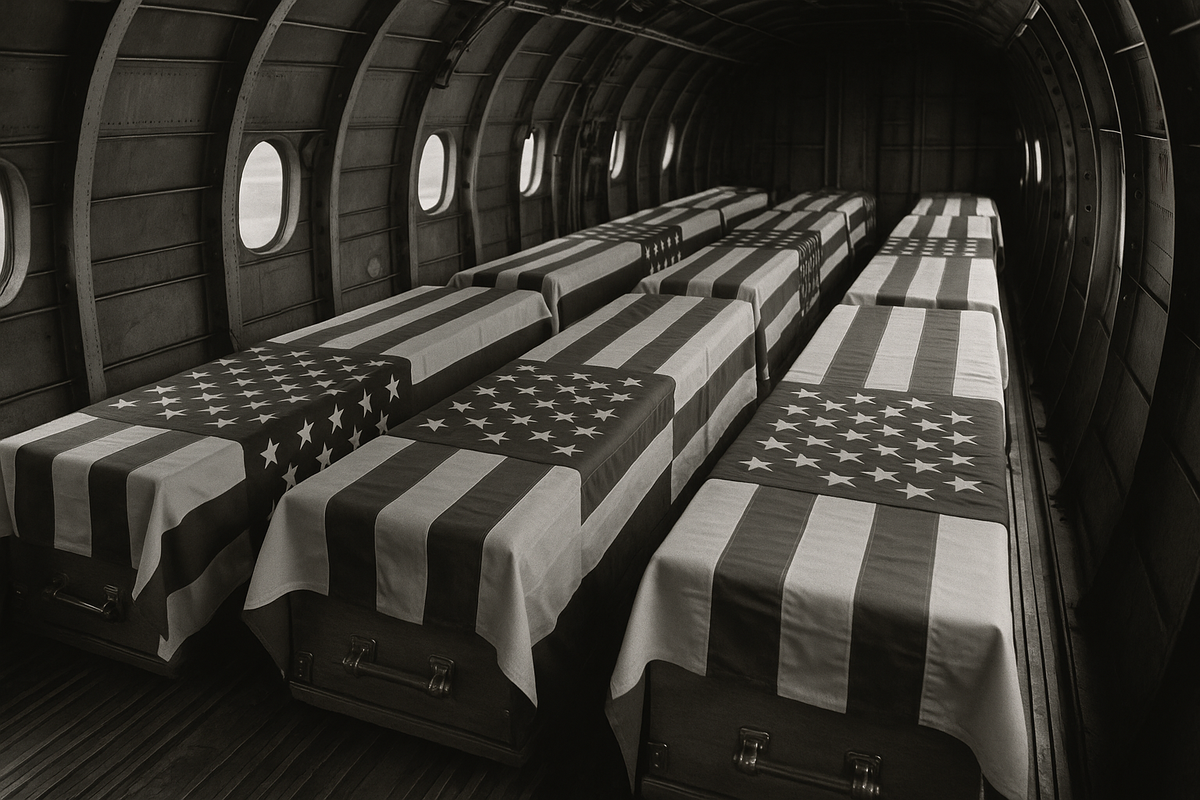
The Pentagon would eventually ban them. But on February 19, 1965, Americans opening their mailboxes found something the government would later decide they shouldn't see: photographs of flag-draped coffins being loaded onto military transports, published in full color across the pages of Time Magazine.
Eight Americans had died at Pleiku. Over a hundred more lay wounded. And President Johnson had just authorized the bombing of North Vietnam. The war that Washington had been quietly managing for years was now thundering into American living rooms—not through policy speeches or Pentagon briefings, but through images that made escalation visceral, immediate, and irreversible.
This wasn't the first time Time had covered Vietnam. But it was the first time the magazine made Americans feel what escalation meant.
Pleiku: The Attack That Tipped the Scales
The Viet Cong struck the U.S. compound at Pleiku in the early hours of February 7, 1965. Guerrillas fired mortars into the base, killing eight servicemen, wounding 126 others, and destroying ten aircraft. The attack was tactically modest. Strategically, it detonated years of Washington's cautious deliberation.
Within hours, President Lyndon B. Johnson convened his national security team. The debate over "how far to go" in Southeast Asia—a debate that had consumed the Kennedy and early Johnson administrations—collapsed. Johnson ordered immediate retaliation. Operation Flaming Dart launched airstrikes against North Vietnamese targets. Days later, Operation Rolling Thunder began: a sustained bombing campaign that would continue, with brief pauses, for three years.
Pleiku didn't start the Vietnam War. But it ended American restraint.
Historical Context
Publication: Time Magazine
Issue Date: February 19, 1965
Historical Significance: Documents the immediate aftermath of the Pleiku attack and the beginning of Operation Rolling Thunder
Cover Feature: U.S. F-100 Super Sabre fighter jets launching from Da Nang Air Base
Archive Importance: Contains photographs of flag-draped coffins—imagery later restricted by Pentagon policy
Time Magazine as Cold War Witness
By 1965, Time had established itself as the voice that translated global chaos into American understanding. Founded by Henry Luce—a man who believed fervently in American exceptionalism and the moral imperative of opposing communism—Time didn't simply report the Cold War. It argued for it, framed it, and made it comprehensible to millions of subscribers who trusted the magazine to tell them what mattered.
The February 19 issue arrived as something more than weekly journalism. It was evidence. The coverage combined military maps marking Viet Cong strongholds and U.S. bombing routes, battlefield photography that showed destroyed bunks and shattered aircraft, and the images that would define the issue: dependents evacuating Da Nang, and coffins awaiting transport home.
Time's editors understood that Vietnam required a different kind of storytelling. This wasn't Europe in 1944, where the enemy and the mission were clear. Vietnam was jungle warfare, guerrilla tactics, and a murky political landscape that resisted easy narrative. So Time did what it did best: it made the abstract concrete. It gave readers maps to study, faces to remember, and consequences to measure.
The Cover That Announced a New War
The February 19 cover featured U.S. F-100 Super Sabre fighter jets streaking off the runway at Da Nang Air Base. No illustration, no artistic interpretation—just raw documentation of American airpower entering the fight. The single word "ESCALATION" dominated the frame.
That choice mattered. Time had moved away from painted covers years earlier, embracing photojournalism as the language of authority. What the camera captured became what Americans believed. And what they saw on February 19 was unambiguous: the United States was no longer advising. It was attacking.
Inside, the feature unfolded across multiple pages. Readers encountered detailed maps showing the geography of conflict—Hanoi, Haiphong, the demilitarized zone, and the locations of recent attacks. They saw photographs of GIs inspecting damage at Pleiku, the twisted metal and splintered wood of barracks hit by mortars. They watched wives and children boarding evacuation flights, carrying whatever they could salvage from lives interrupted by war.
And then they saw the coffins.
The Photographs the Pentagon Would Later Forbid
The images of flag-draped coffins being loaded onto transport aircraft were not gratuitous. They were matter-of-fact, almost clinical in their presentation. But their impact was profound. This was the cost of escalation made visible—not as a statistic, not as a policy debate, but as aluminum caskets lined up on a tarmac.
Time's decision to publish these photographs reflected both journalistic duty and Cold War conviction. The magazine wasn't protesting the war; it was documenting sacrifice in service of what it believed was a necessary fight against communist expansion. The coffins were proof that Americans were dying for something that mattered.
Decades later, during the Iraq War, the Pentagon would ban media coverage of coffins returning to Dover Air Force Base, citing respect for families. But in 1965, these images circulated freely. Americans were meant to see what their government was asking of them. Time made certain they did.
What the Magazine Revealed About Cold War Logic
Time's coverage of Pleiku and its aftermath operated within a larger framework that defined American foreign policy in 1965: the domino theory. If South Vietnam fell to communism, the reasoning went, Laos, Cambodia, Thailand, and eventually all of Southeast Asia would follow. Containing communism wasn't just a regional interest—it was existential.
The February 19 issue reinforced this logic at every turn. Articles didn't question whether escalation was necessary; they explained how it would unfold and what it would require. Maps showed the proximity of communist China and the strategic importance of the South China Sea. Commentary framed Pleiku not as an isolated attack but as part of a coordinated communist offensive designed to test American resolve.
This wasn't neutral reporting. Time, under Luce's influence, had always positioned itself as an advocate for American leadership in the world. Vietnam was the latest battleground in that mission. And in February 1965, Time's message was clear: America had crossed the threshold. There was no turning back.
Key Elements of the February 19, 1965 Issue
The Endurance of Print in the Age of Disappearing News
There's a reason historians return to magazines like Time rather than television transcripts or radio broadcasts. Print endures. It can be held, reread, and studied. The February 19, 1965 issue still exists as a physical object, unchanged since it left the press nearly six decades ago.
In an era when digital news evaporates within hours, replaced by the next crisis or controversy, vintage magazines offer something increasingly rare: permanence. They preserve not just facts but context—the advertisements, the letters to the editor, the adjacent stories that reveal what else mattered that week. Together, these elements create a composite image of a specific moment in American life.
The escalation issue of Time doesn't just tell you what happened at Pleiku. It shows you how Americans were asked to understand it, what they were told to fear, and what they were expected to sacrifice. That layered record is what makes the magazine invaluable to anyone studying Vietnam, Cold War media, or the intersection of journalism and national policy.
Why Collectors Seek This Issue
Published within days of Pleiku and the launch of Rolling Thunder, it captured escalation as it happened, not in retrospect.
Photographs of coffins and evacuations represent imagery that would later become restricted, making this one of the last times such images appeared without controversy.
Millions of Americans read this issue in real time. It shaped how a generation understood the war they were entering.
Well-preserved copies with intact covers and original inserts are increasingly scarce. The issue was read, discussed, and often discarded.
Vietnam War milestone issues—particularly those marking escalation, Tet, or the fall of Saigon—anchor serious collections of 20th-century journalism. This one stands among the most consequential.
Explore the Archive
Thousands of original Time magazines—from World War II through the Cold War, from civil rights to space exploration—are preserved in our collection. Each issue represents history as it was first reported.
Browse Time Magazine CollectionA Threshold Crossed
The February 19, 1965 issue of Time Magazine remains essential reading for anyone seeking to understand how America entered its longest war. Pleiku, Rolling Thunder, the evacuated dependents, the flag-draped coffins—these weren't just news stories. They were the components of a decision that would define a decade and fracture a nation.
Time gave Americans the tools to comprehend that decision: maps, photographs, and prose that made escalation seem not just inevitable but necessary. And for those who hold this issue today, it offers something more: a window into the moment when Cold War logic and battlefield reality collided, and the United States committed itself to a conflict from which there would be no easy exit.
History doesn't often announce itself. But sometimes, it arrives in the mail on a Friday, wrapped in a magazine cover, demanding to be seen.