
When an Emperor's Prayer Landed in America's Mailboxes
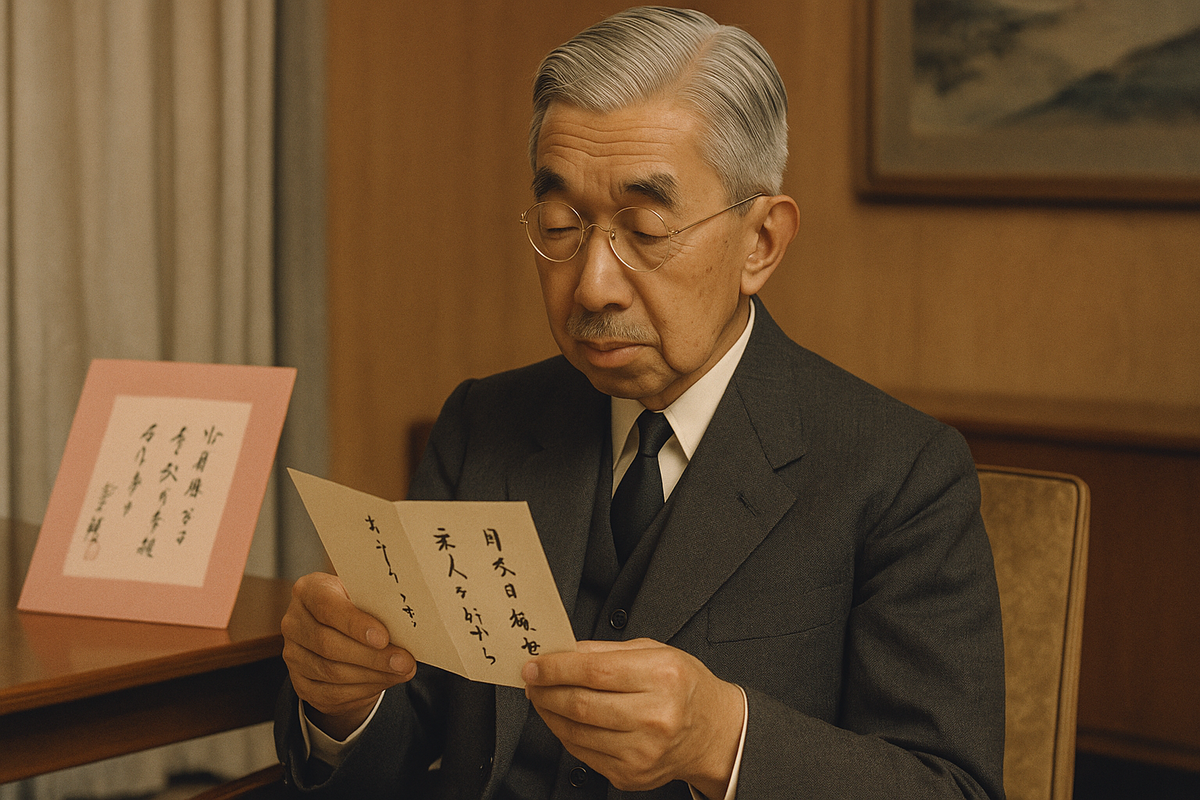
Emperor Hirohito's handwritten New Year's poem in Esquire's December 1959 issue—a cultural bridge between former enemies
December 1959. A nation of American men opened their monthly Esquire to find something extraordinary tucked between the Christmas essays and the latest fiction: the handwritten calligraphy of Emperor Hirohito, praying for friendship between East and West.
Not a photograph of it. Not a facsimile. The actual brushwork, reproduced on soft pink paper, facing its English translation across the spine. In an era when most Americans still remembered Pearl Harbor, Japan's sovereign had just delivered a New Year's poem directly into their living rooms.
This wasn't diplomacy. This was something quieter, and perhaps more daring.
Archive Details
Historical Figure: Emperor Hirohito of Japan
Issue Date: December 1959
Archive Source: Esquire Magazine
Contribution: "Nishi Higashi" (East and West) — New Year's poem in original calligraphy with English translation
The Weight of 1959
The timing mattered. Japan was fourteen years past surrender, racing toward economic resurrection while the world split into Cold War camps. Emperor Hirohito—once the face of Japan's wartime empire, now a constitutional figurehead stripped of political power—had spent those years navigating an impossible transformation. His nation needed allies. His role demanded symbols, not speeches.
The U.S.–Japan Security Treaty was up for renewal in 1960. Military pacts and trade negotiations would handle the machinery of alliance. But Hirohito understood what governments sometimes forget: trust isn't built in conference rooms alone.
So he sent a poem.
"May all East and West, / Making friends with each other, / Well may prosper, / Thus as offered a prayer / As the New Year commences."
The words were simple. The gesture was not. For American readers still processing the whiplash of turning mortal enemies into Cold War partners, this was reconciliation rendered in ink and rice paper—delivered not through state channels, but through a men's magazine known as much for its bourbon ads as its literary ambitions.
Esquire's Unlikely Diplomatic Pouch
By 1959, Esquire had evolved far beyond collar tips and cufflink recommendations. It had become a proving ground for serious writers, a visual laboratory for graphic designers, and a cultural bellwether that somehow balanced Ernest Hemingway with haberdashery advice.
The December issue exemplified this range: Thomas Mann and Alberto Moravia sharing pages with holiday reflections and seasonal style guides. Into this mix, the editors placed Emperor Hirohito's Nishi Higashi—not as a curiosity, but as the issue's emotional centerpiece.
The presentation was meticulous. One page carried the romanized Japanese text and English translation in clean Western typography. Turn the page: Hirohito's original calligraphy, each stroke preserved in reproduction, the characters flowing with the controlled spontaneity that defines Japanese brush art.
East and West, literally facing each other across a magazine spread.
The design choice was editorial genius. Readers weren't just reading about Japanese culture—they were encountering it directly, asked to appreciate an art form most had never seen outside museum glass. Esquire had turned a holiday issue into a cross-cultural primer, and it did so without condescension or exoticism. The poem stood on its own terms.
What the Prayer Actually Said
Strip away the geopolitical context for a moment. Nishi Higashi is a New Year's poem, part of a Japanese tradition where such verses mark transitions and express hopes for the coming year. In Japan, these poems (often written on decorative shikishi boards) aren't political documents—they're cultural ritual, personal and reflective.
Hirohito's choice to share his verse with an American audience reframed the tradition. The prayer for East-West friendship wasn't abstract philosophy. It was an emperor acknowledging that his nation's future depended on bonds with former adversaries. It was also an invitation: see us not as we were, but as we hope to become.
The title itself—Nishi Higashi, West and East—inverted the usual order. A small detail, perhaps, but one that suggested parity rather than hierarchy. This wasn't the West receiving homage from the East. It was two directions meeting as equals.
And Esquire's readers, many of whom had fought in the Pacific or lost friends there, were being asked to accept that meeting. Not through political argument, but through the quiet dignity of five lines of verse.
The Cultural Diplomacy Framework
The Winter Prayer for Peace
Hirohito's words framed the New Year as a moment for reconciliation, calling on East and West to seek friendship and prosperity together—a message that transcended seasonal sentiment.
A Japanese Tradition Shared
In Japan, New Year's poems (known as shikishi) had long been part of cultural ritual. Publishing one in Esquire introduced American readers to this tradition firsthand.
The Title's Symbolism
"Nishi Higashi" directly translates to "West and East," embodying the global divide of the Cold War—and the hope of bridging it through mutual respect.
Design as Message
The juxtaposition of English translation and Japanese brushwork symbolized cross-cultural dialogue in print—East and West literally facing each other across the spine.
What Mid-Century Esquire Understood
The magazine's enduring relevance stems from a philosophy that seems almost radical now: it believed its male readership could handle complexity. You could care about tailoring and Thomas Mann. You could appreciate a well-mixed martini and a Japanese emperor's calligraphy. Sophistication wasn't about choosing between style and substance—it was about refusing to see them as opposed.
The December 1959 issue embodies this ethos completely. It's a holiday magazine that prays for peace. It's a men's lifestyle publication that publishes foreign heads of state. It's a commercial product that functions as cultural ambassador.
Esquire didn't talk down to its audience, and it didn't apologize for taking them seriously. The magazine assumed its readers could sit with discomfort—former enemies becoming friends—and find meaning in that transition.
Why This Issue Commands Collector Attention
Documentary Proof of Soft Power
Long before "cultural diplomacy" became policy jargon, this issue demonstrated it in practice. No treaty was signed in these pages, but a message was delivered—one that couldn't have been sent through official channels without seeming calculated.
A Singular Editorial Gamble
What other American publication convinced a sitting monarch to contribute original handwritten work? The answer is functionally none. Esquire's editors secured something unrepeatable.
Design at Its Peak
The magazine's art direction in the late 1950s represented the apex of mid-century print design. The Nishi Higashi spread showcases why: restraint, respect for content, and the confidence to let a piece of art breathe on the page.
Historical Hinge Point
This issue landed months before the 1960 Security Treaty protests in Japan, which would test the U.S.-Japan alliance severely. Hirohito's poem reads differently knowing the turbulence that followed—a moment of hopeful gesture before political reality complicated the narrative.
Literary Company
Collectors prize context. Finding Hirohito alongside Thomas Mann and Alberto Moravia isn't just novelty—it's evidence of Esquire's editorial ambition. The magazine treated the emperor's contribution as literature, not spectacle.
The Artifact in Your Hands
When collectors pursue the December 1959 issue today, they're not just acquiring a magazine. They're securing a document that captures a specific historical breath: the moment when postwar reconciliation moved from policy to culture, when an emperor's brush became an olive branch, when a men's magazine became an unlikely stage for international détente.
Hold this issue and you hold contradiction resolved. Wartime memories and peacetime hopes. Japanese tradition and American publishing. High art and popular culture. All of it bound in print, preserved in pages that have survived sixty-five years because they mattered when they were new—and they matter still.
The poem's final line offers a prayer as the New Year commences. Esquire offered its readers something similar: the possibility that old wounds could heal, that prosperity could be shared, that East and West might actually prosper together.
In December 1959, that wasn't certainty. It was hope, printed on paper, delivered by mail.
For collectors, historians, and anyone who believes printed culture shapes how we understand our world, this issue remains essential. It's not just a magazine. It's evidence that reconciliation can arrive in unexpected forms—sometimes as policy, sometimes as poetry, and sometimes as both at once.
Explore the Full Archive
Decades of cultural history, preserved in print. These aren't reproductions or digital scans—they're the actual artifacts that shaped American culture, available to collectors who understand that some history is meant to be held.
Browse Esquire Magazine Collection