
Eva Braun's Album: When Life Magazine Opened Hitler's Private World to Postwar America
The July 21, 1947 issue that forced Americans to confront the suffocating intimacy of evil in repose
On July 21, 1947, American breakfast tables became crime scenes of a different sort.
Housewives in Cincinnati and GIs on the West Coast opened their mailboxes to find Life Magazine's latest issue—and with it, something no amount of newsreel footage or war reporting had prepared them for. There, spread across glossy pages still smelling of fresh ink, were photographs from Eva Braun's personal albums: Hitler laughing on a sofa. Eva in a swimsuit by an Alpine lake. Joseph Goebbels mugging for the camera like a vaudeville comic.
The Führer, it turned out, had lived like a man.
Two years after Germany's surrender, with the crematoria of Auschwitz barely cold and the Nuremberg gallows dismantled, Life delivered what prosecutors and historians could not: the suffocating intimacy of evil in repose. This wasn't propaganda. It wasn't military intelligence. It was something far more unsettling—a visual record of how history's most destructive regime spent its quiet hours.
For a nation still processing the war's moral wreckage, the July 21, 1947 issue became an artifact of profound discomfort. It remains one today.
Historical Document
Featured Subject: Eva Braun and Adolf Hitler
Publication Date: July 21, 1947
Archive Source: Life Magazine
Historical Context: Two years post-surrender, immediate postwar consciousness
The Postwar Moment: America's Hunger for Answers
By the summer of 1947, the machinery of postwar reconstruction was well underway. The Marshall Plan was pumping dollars into Europe's shattered cities. The Nuremberg Trials had concluded, their verdicts rendered. The Iron Curtain was descending as Cold War tensions calcified between Washington and Moscow.
Yet for ordinary Americans, the war's central questions remained maddeningly abstract. They had seen Hitler in newsreels—ranting from podiums, reviewing troops, embodying the stiff choreography of fascist spectacle. They knew the statistics of destruction: six million Jews murdered, entire cities reduced to ash, a continent bled dry.
What they had never seen was Hitler at rest. Hitler in love. Hitler as a man who took vacations.
Life Magazine recognized this void and filled it with Eva Braun's photographs. The albums had been seized by American forces in the war's final days, their provenance authenticated, their contents explosive. Life's editors understood that these images weren't merely biographical curiosities—they were evidence of a different kind. They proved that the architects of genocide had also enjoyed picnics, that propaganda ministers clowned for pretty women, that the machinery of the Final Solution ran parallel to bourgeois domesticity.
The cognitive dissonance was the point.
Life's Photojournalism Revolution: Seeing as Believing
In 1947, Life Magazine stood unchallenged as America's visual conscience. While newspapers trafficked in words and radio delivered voices, Life delivered irrefutable proof: photographs that demanded to be believed because they could be seen.
The Eva Braun feature exemplified this philosophy at its most potent. Readers encountered:
The Munich Years — Eva as a girl in costume with her sister, a middle-class childhood indistinguishable from millions of others. The ordinariness was chilling.
The Hoffmann Studio — Young Eva modeling evening gowns in Heinrich Hoffmann's photography shop, the place where she would first encounter Hitler. Fate photographed as a teenage modeling gig.
The Inner Circle — Eva flanked by Joseph Goebbels, who "clowned" for her camera. Martin Bormann hovering in backgrounds, ever-present, ever-watchful. The banality of Nazi social life rendered in black and white.
Vacation Idylls — Eva on diving boards. Eva sunbathing. Eva and Adolf by lakesides, their private leisure unfolding as Europe burned.
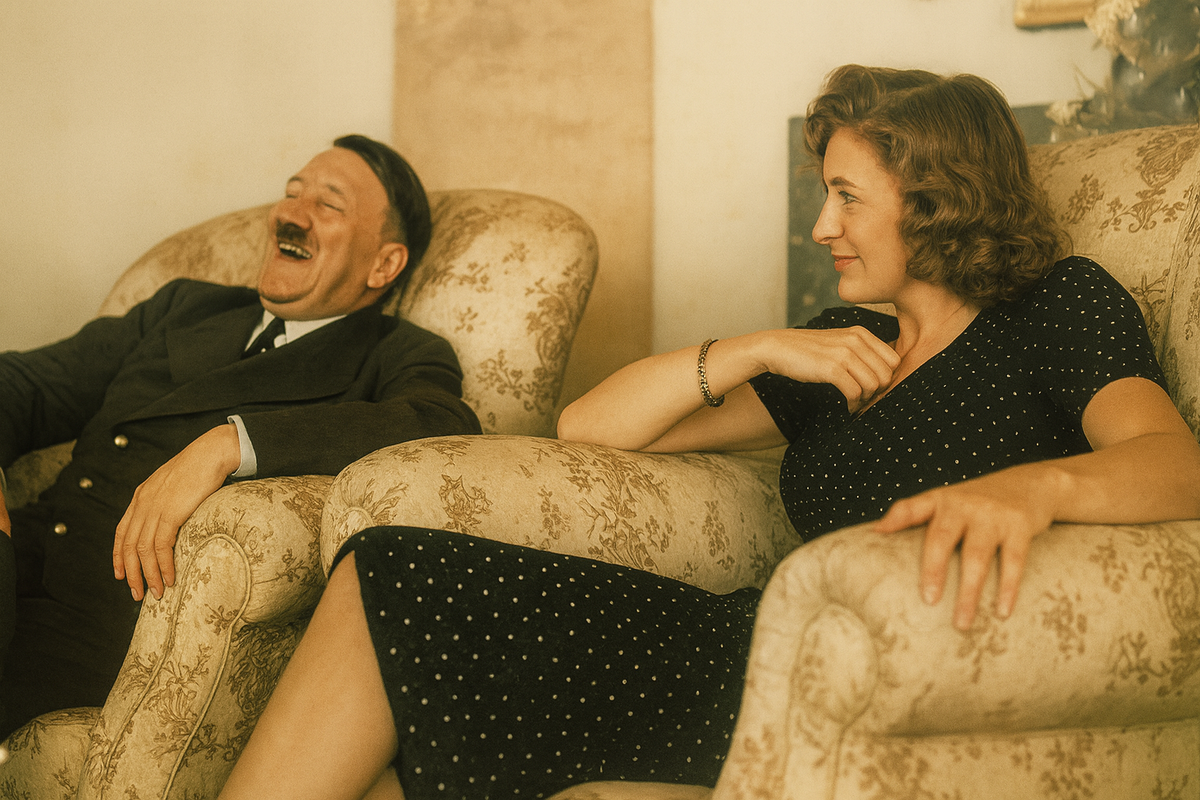
Hitler Unmasked — The Führer reclining, smiling, stripped of military uniform and public rage. A man at ease with his mistress, captured in moments that felt violently intimate.
Life's editors didn't sensationalize. They didn't need to. The photographs did the work, their captions clinical and precise. This wasn't scandal-mongering—it was documentary evidence presented with surgical care. The effect was devastating precisely because it was so restrained.
The Ten Threads: What the Albums Revealed
Eva Braun's photographs weren't random snapshots. They formed a narrative, one that Life's layout artists and editors carefully orchestrated:
Middle-Class Origins
Eva's Munich upbringing, documented in family portraits, established her as unremarkable. No aristocratic pretensions, no ideological fervor—just a shopkeeper's daughter.
Adolescent Ambition
Her modeling work and employment at Hoffmann's studio positioned her at the intersection of art, commerce, and politics in Weimar Germany.
The Nazi Social World
Repeated appearances of Goebbels, Bormann, and other high-ranking officials revealed how thoroughly integrated Eva became within Hitler's private sphere.
Leisure as Counterpoint
Images of swimming, hiking, and Alpine retreats created jarring contrast with the historical record of 1930s and 1940s Europe.
Hitler's Domestic Persona
Photographs of Hitler laughing, relaxed, companionable—states Americans had never witnessed—disrupted every propaganda image and newsreel.
Goebbels the Performer
The propaganda minister's documented "clowning" for Eva's camera demonstrated the informal dynamics within Hitler's household.
Bormann's Omnipresence
Hitler's private secretary appeared repeatedly, a shadow figure documenting the dictator's domestic life.
Political Absence
Life emphasized Eva's disinterest in ideology or governance. She was companion, not collaborator—a distinction that raised its own uncomfortable questions about complicity.
Evil's Ordinariness
The cumulative effect of domestic snapshots juxtaposed against known atrocities forced readers to confront what Hannah Arendt would later term the banality of evil.
Posthumous Fascination
With both subjects dead since April 1945, the albums became relics immediately—historical documents before they could become memories.
The Enduring Power of Print in the Digital Age
Life Magazine's wartime and postwar issues function as something the internet cannot replicate: artifacts that preserve not just information, but the experience of receiving that information.
Every page of the July 21, 1947 issue carries 1947 with it—the texture of the paper, the design language of midcentury photojournalism, the cultural assumptions embedded in captions and layout. These magazines documented history while simultaneously creating it, offering contemporary audiences a window into how their grandparents first encountered the intimate details of Hitler's life.
In an era when images appear and vanish in seconds, when digital files can be altered seamlessly, these printed pages stand as permanent record. They cannot be updated, fact-checked into oblivion, or memory-holed. They exist as they were, time capsules that refuse to negotiate with the present.
Why Collectors Pursue This Issue
Temporal Proximity
Published just twenty-six months after Hitler and Eva's suicide in the Führerbunker, it captures immediate postwar consciousness before nostalgia or revision could soften the edges.
Primary Source Material
Eva Braun's personal photographs remain cited in academic works, documentaries, and museum exhibitions. Owning this issue means possessing their first public presentation.
Cultural Barometer
The feature reveals how Americans processed the war's aftermath—shifting from combat coverage to psychological investigation of their enemies.
Market Demand
Life issues featuring Hitler, the Third Reich, or World War II leadership consistently command premium prices among collectors of vintage publications.
This isn't memorabilia. It's a historical document that shaped how a generation understood evil's human face.
For Collectors and Historians Alike
Whether you're building a collection of vintage publications or researching the cultural legacy of World War II, the July 21, 1947 issue represents essential acquisition. It bridges photojournalism and historiography, offering both visual evidence and cultural commentary.
From Life's founding in the 1930s through its transformation in the 1970s, the magazine chronicled American consciousness through world war, cold war, social upheaval, and cultural revolution. Each issue is a chapter. Some chapters, like this one, are impossible to skip.
Browse Life Magazine CollectionExplore decades of history as Americans first witnessed it—unfiltered, unrevised, and unforgettable.
Final Assessment
The July 21, 1947 Life Magazine endures because it refused easy answers. Its feature on Eva Braun's albums didn't demonize or excuse—it simply showed. In doing so, it created a document more disturbing than any editorial could achieve.
The photographs humanized Hitler in ways that remain profoundly uncomfortable. They proved that monsters take vacations, that genocide's engineers also fall in love, that evil doesn't announce itself with horns and pitchforks. It wears a smile. It poses for snapshots. It lives an ordinary private life while orchestrating extraordinary horror.
For Americans in 1947, still counting their war dead and processing revelations from liberated camps, this was essential testimony. For collectors and historians today, it remains exactly that—testimony preserved in ink and paper, evidence that refuses to fade.