
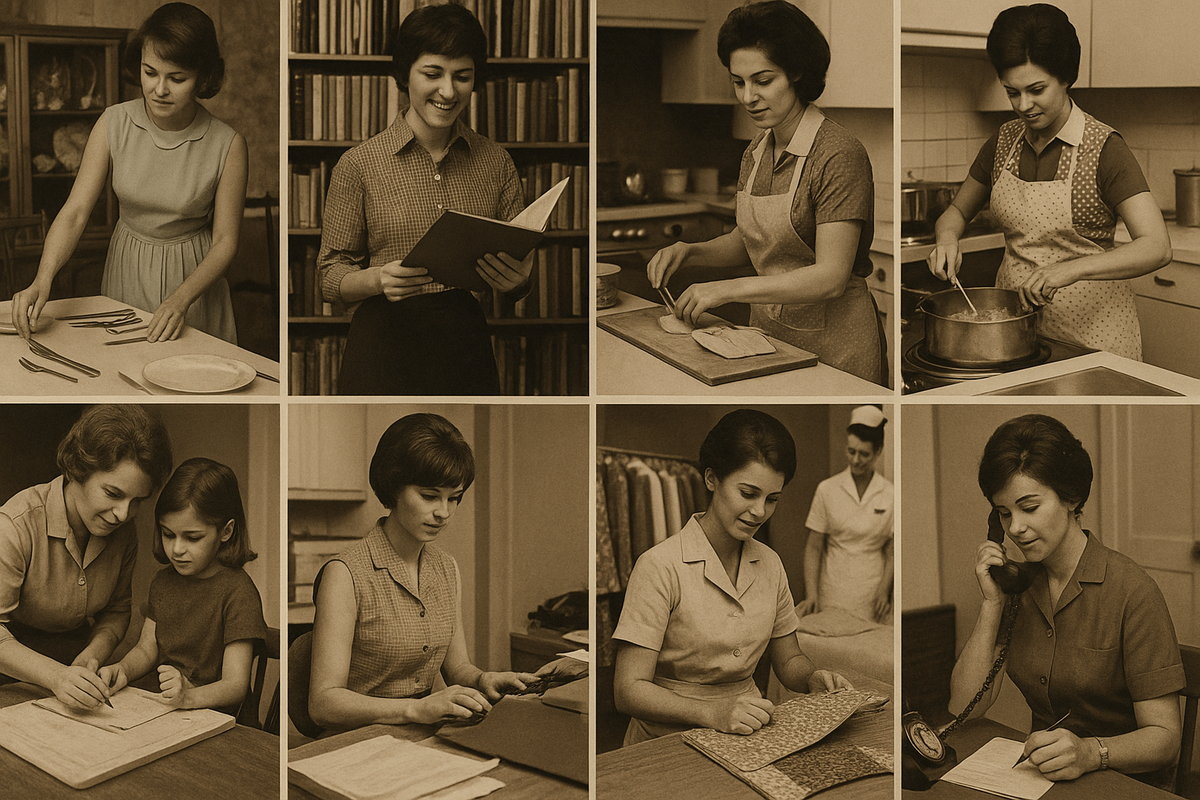
The Woman Who Could Work Without Leaving Home
Inside Ladies' Home Journal's Quiet Revolution of 1968
Ruth Lembeck's byline appeared on page 84 of the March 1968 Ladies' Home Journal above an article that would reach seven million American women. Most of them were married. Most stayed home with children. And most—whether they admitted it openly or only to themselves—wanted something more than another decade of carpools and casseroles.
"26 Exciting Part-Time Jobs for Women" wasn't a manifesto. It didn't quote Betty Friedan or mention the National Organization for Women, founded just two years earlier. It didn't need to. The article's very existence was the revolution: a major women's magazine acknowledging, in practical dollar amounts and step-by-step instructions, that homemakers might want paychecks.
This wasn't about liberation. Not yet. It was about permission.
Historical Context
Featured Writer: Ruth Lembeck
Issue Date: March 1968
Publication: Ladies' Home Journal
Circulation: 7 million monthly readers
Archive Source: Original magazine collection
The Domestic Bargain Breaks Down
By March 1968, the postwar consensus was cracking. The suburban housewife—that polished, cheerful figure who dominated advertising and television—remained the cultural ideal. But inflation was eating into single-income households. The Vietnam War was forcing families to reconsider what they'd been promised about American stability. And women who'd read The Feminine Mystique five years earlier were no longer content to dismiss their restlessness as neurosis.
The question wasn't whether women should work. Middle-class white women were asking whether they could—without sacrificing respectability, without neglecting children, without admitting that the domestic dream had failed them.
Ladies' Home Journal had spent nearly a century teaching women how to be better wives and mothers. Now it was teaching them how to earn money.
What the Magazine Understood
Founded in 1883, the Journal had survived wars, depressions, and cultural upheavals by recognizing what its readers needed before they fully articulated it themselves. By the 1960s, circulation topped seven million monthly. The magazine's tagline—"Never Underestimate the Power of a Woman"—carried both reassurance and challenge.
The March 1968 issue balanced tradition and transformation with surgical precision. Recipes for Pillsbury Apple Cinnamon Coffee Cake Mix appeared alongside Lembeck's job guide. Ads for Sudden Beauty Facial (promising to erase wrinkles in five minutes) faced pages discussing market research positions and real estate licensing. The message was unmistakable: you can earn money and remain the woman your family expects.
This wasn't hypocrisy. It was strategy. The Journal knew its audience was caught between two worlds, and it refused to force them to choose.
The Manual for Economic Independence
Lembeck's article functioned as an instruction manual, not an essay. Each of the 26 jobs included three critical elements:
What You Need – the skills, training, or equipment required
How Much You Can Earn – specific figures ranging from $1.80–$3.50 hourly for food service work to $10–$40 for wedding planning to $50 for private cooking lessons
How You Get Started – concrete steps including which organizations to contact, which licenses to pursue, how to leverage word-of-mouth networks
The jobs themselves revealed the boundaries of 1968's imagination. Many extended domestic skills into the marketplace: catering, childcare, needlecrafts, party planning. Others cracked open professional doors: laboratory work, real estate sales, medical assisting, market research telephone surveys.
What made the article radical wasn't the job list—it was the framing. Work was presented as:
- • Compatible with homemaking, not threatening to it
- • A source of family income and personal satisfaction
- • Achievable without abandoning children or neglecting husbands
The article never suggested women deserved careers equal to men's. That door remained closed. But another door—narrower, conditional, yet undeniably real—had opened.
The Economy of Respectability
The wage figures tell their own story. Nursing aides and dental assistants could expect steady hourly pay in medical settings—professional environments that conferred status. Real estate and insurance offered commission-based income that rewarded hustle without requiring full-time commitment. Market research and telephone soliciting brought women into business contexts, even if only via rotary dial.
Event planning capitalized on organizational skills women were already expected to possess. Writing greeting card messages turned sentiment into income. Shorthand reporting preserved a clerical skillset that wouldn't threaten male executives.
Each role was positioned as manageable. Flexible. Part-time. The unspoken promise: you won't have to choose between your family and your bank account.
But the article also planted seeds. Women reading about real estate licensing or laboratory work weren't just learning about supplemental income—they were learning that professional spaces might accept them. That knowledge would bear fruit in the 1970s, when "part-time" became "full-time" and "supplemental" became "primary."
Domestic Skills as Commerce
Catering, childcare, and party planning transformed housewife expertise into marketable services without challenging gender norms.
Professional Doorways
Laboratory work, real estate, and medical assisting offered access to credentialed, respectable professional environments.
The Flexibility Bargain
Part-time work preserved women's primary identity as homemakers while acknowledging economic necessity and personal ambition.
Wage Transparency
Specific dollar amounts ($1.80–$50 per job) gave women concrete data to evaluate opportunities—a radical departure from vague promises.
Why This Issue Matters Now
The March 1968 Ladies' Home Journal feels simultaneously distant and familiar. Distant because $3.50 an hour seems quaint, because "telephone soliciting" has become robocalls, because the assumption that women need permission to work now seems absurd.
Familiar because the negotiation continues. Women still navigate expectations about balancing career and family. Part-time work is still gendered, still paid less, still treated as supplemental rather than primary. The jobs that allowed women into professional spaces in 1968—nursing, teaching, real estate—remain female-dominated and undervalued.
Lembeck's article anticipated the explosion of women entering the workforce in subsequent decades. But it also captured something that got lost in later feminist discourse: the practical, incremental nature of how most women actually changed their lives. Not through manifestos or protests, but through want ads and night classes. Not by rejecting domesticity outright, but by proving they could manage both.
The Journal met women where they were. That's why seven million read it every month.
Collector Significance
Historical Pivot Point
Published during the height of second-wave feminism's emergence, the issue captures women navigating between the domestic 1950s and the liberated 1970s. Few artifacts document this transition so clearly.
Primary Source Evidence
Lembeck's article provides concrete data about women's economic opportunities, wage expectations, and social constraints in 1968. Researchers studying labor history, gender economics, or feminist movements treat these pages as evidence.
Advertising Archaeology
The juxtaposition of job listings with beauty product ads, convenience food promotions, and household goods creates an unintentional portrait of contradictory expectations. The Journal urged women to work while reminding them to stay young, attractive, and domestically competent.
Editorial Influence
With seven million readers monthly, the Journal shaped public opinion. What it validated became acceptable. What it ignored remained taboo. This issue validated women's economic ambitions—cautiously, conditionally, but unmistakably.
A Chapter Worth Holding
For historians documenting women's economic history, for collectors preserving mid-century media, for anyone tracing how social change actually unfolds in everyday life—this issue matters.
It's not just reading material. It's a primary source from the year American women began rewriting the terms of their own lives.
Explore the Archive
These aren't reproductions or digital scans. They're the original artifacts—pages women actually turned, articles they actually underlined, advertisements they actually believed might solve their problems.
Browse Ladies' Home Journal Magazine CollectionEach issue is a window into the daily calculations, small rebellions, and quiet transformations that reshaped a generation.
The March 1968 issue sits at the intersection of two Americas: one that believed women belonged at home, and one that couldn't afford to keep them there. Ruth Lembeck's article gave them a map for navigating between those worlds.
Sixty years later, we're still reading that map.