
The Archive Speaks: When Ebony Documented Richard Wright's Final Hours
February 1961—How the Black Press Preserved a Literary Giant's Last Chapter
The newsstand date was February 1961. Readers who picked up that month's Ebony expecting the usual fare—celebrity profiles, fashion spreads, progress reports from the movement—found themselves holding something else entirely: a eulogy for the conscience of Black American literature.
Richard Wright had died in Paris barely ten weeks earlier. He was fifty-two years old, felled by a heart attack in a city he'd chosen over his homeland. And while the mainstream press reduced his death to wire service copy, Ebony did what the Black press had always done—it told the whole story, in full color, with the gravity of a state funeral.
This wasn't journalism. It was preservation.
Archive Document
Historical Figure: Richard Wright (1908–1960)
Issue Date: February 1961
Archive Source: Ebony Magazine
Primary Contributors: Ollie Harrington, Langston Hughes
Cultural Context: Early Civil Rights Era, Black Expatriate Movement
The Death That Shocked Two Continents
November 28, 1960. The Mississippi-born author of Native Son and Black Boy—the man who had forced white America to see Bigger Thomas, to hear the rage and humanity of the dispossessed—was gone. The circumstances were sudden. The loss was seismic.
For Black readers in 1961, Wright's death carried a particular weight. This was the writer who had smashed through the literary establishment in 1940 with a novel so unflinching that it became a Book-of-the-Month Club selection despite depicting truths white America preferred to ignore. His 1945 autobiography had given language to the suffocating brutality of Jim Crow. He was, in the simplest terms, a founding voice.
Yet he'd spent his final thirteen years abroad, part of a growing exodus of Black intellectuals—James Baldwin, Chester Himes, jazz innovators like Miles Davis—who found in Paris what America wouldn't give them: the freedom to create without the constant press of racial surveillance. Wright had left in 1947, exhausted by American racism and hounded by Red Scare paranoia. He never came back.
When Ebony commissioned the February 1961 feature, it wasn't assigning an obituary. It was documenting history while the ink was still wet.
What the Black Press Understood
By 1961, Ebony had established itself as the most influential Black magazine in America—a publication that functioned simultaneously as mirror, megaphone, and historical record. Its mission was documentary and defiant: to show Black life in its full complexity, achievement, and struggle.
The Wright feature exemplified this mandate. Rather than a perfunctory death notice, Ebony delivered an expansive, photo-rich investigation written by two men who knew him intimately: Ollie Harrington, the expatriate cartoonist and Wright's close friend, and Langston Hughes, who had visited Wright's Paris apartment just days before his death.
What readers received was unprecedented access:
And then there was the revelation that stopped readers cold: among Wright's papers, more than a thousand haiku poems, most unpublished. The restless intellect had turned to Japanese poetry in his final years, compressing his vision into seventeen-syllable meditations. He died with unfinished work on his desk.
The February 1961 Context
The cover featured Ossie Davis and Ruby Dee, photographed as the embodiment of Black artistic partnership—love, activism, and cultural production unified. It wasn't coincidental. Davis and Dee represented the promise of Black cultural life flourishing within America; Wright's story inside represented the cost of leaving it behind. Together, they created a portrait of the Black artistic condition in 1961: brilliant, divided, fighting for space to breathe.
This was early 1961—freedom rides were coming, sit-ins were spreading, the movement was accelerating. Wright's death arrived at a moment when Black America was demanding visibility on its own terms. Ebony understood the assignment: give Wright the memorial he earned, documented by those who knew him, published for the community that had always claimed him.
The Details That Matter
Harrington's essay and Hughes's remembrance delivered specifics that remain historically irreplaceable:
Wright's attempt to secure a visa for England had been rejected—a reminder that even fame and genius couldn't guarantee a Black expatriate safe harbor.
His health had seemed robust weeks before his death. Hughes described him as frail but intellectually alive, still generating ideas, still restless with creative energy.
The Rue Regis apartment had become a salon for displaced artists, a Paris outpost of the Black intellectual diaspora.
The haiku discovery signaled something profound: Wright was still evolving, still experimenting, still refusing to be contained by what he'd already achieved.
His friends were stunned. Harrington wrote of exile's toll—the constant navigation between freedom abroad and separation from home, the surveillance that followed Wright even to Paris, the FBI files that grew thicker with each year overseas.
This wasn't hagiography. It was reportage that understood its subject was both a man and a symbol—someone whose choices, struggles, and death illuminated larger truths about what it meant to be a Black creator in mid-century America.
Why This Issue Endures
For collectors of vintage Ebony, the February 1961 issue occupies singular territory.
It was the first comprehensive account of Wright's death, published while memory was fresh and grief was raw. The combination of Harrington's insider narrative, Hughes's intimate remembrance, and photographs that ranged from celebratory to stark created a document without parallel.
Wright was—and remains—one of the most significant American writers of the twentieth century. Ebony's feature preserved his final chapter as told by his own community, on his community's terms. No mainstream publication came close to this depth, this care, this refusal to diminish.
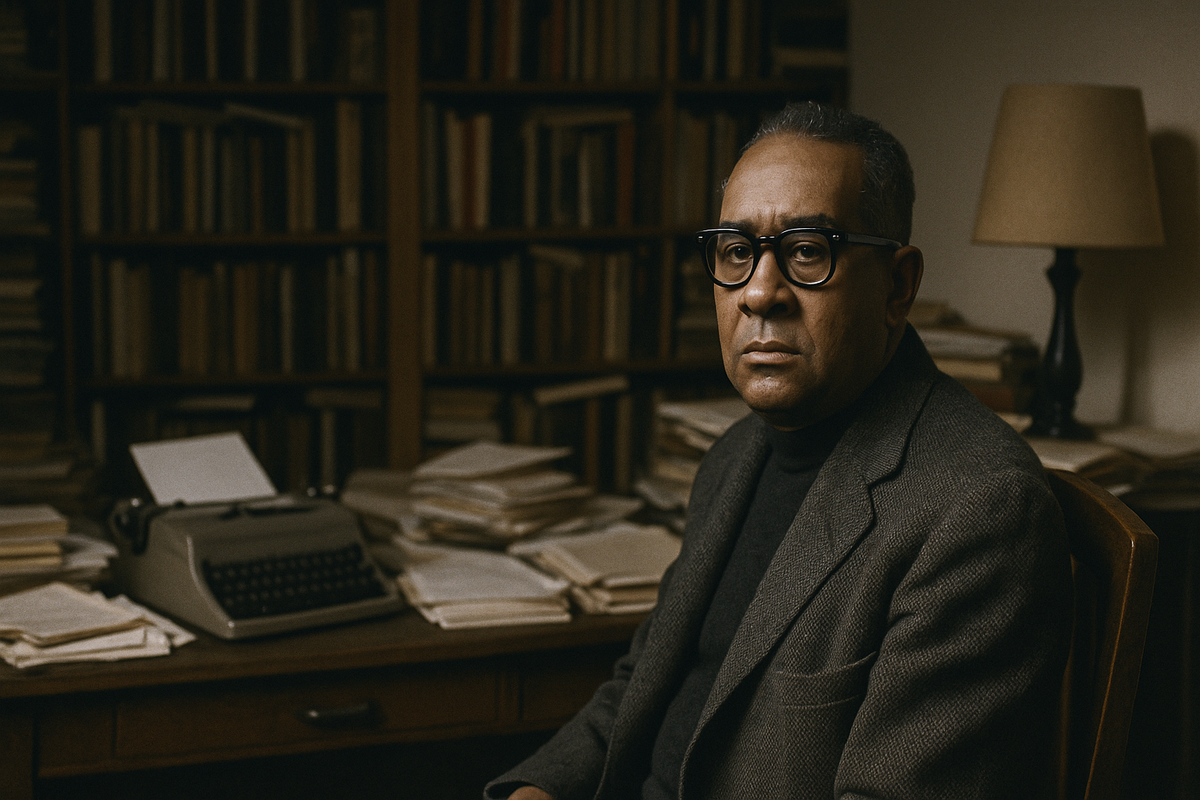
The photography alone makes the issue invaluable: family portraits, workspace documentation, the funeral procession, the gathering of expatriate artists. These images exist nowhere else in this form, with this context.
And then there's the broader significance: this issue demonstrates what the Black press achieved when it operated at full power. While white-owned media looked away or reduced complex lives to paragraph-length notices, Ebony created permanent records. It made archives. It ensured that when future generations asked what happened, who mattered, how stories were told—the evidence would exist.
Holding this issue means holding an original artifact of African American literary history. Not a reprint, not a digital scan—the actual object, printed and distributed in February 1961, that readers held while processing the loss of a giant.
The Legacy in Your Hands
Ebony's coverage of Wright's death remains a masterclass in what cultural journalism can achieve when it refuses to compromise. The magazine gave Wright the full treatment: investigative depth, photographic richness, multiple perspectives, and the space to examine not just what he accomplished but what his exile and death revealed about the Black experience in the mid-twentieth century.
This is why the Black press mattered. Why it still matters. These magazines weren't entertainment supplements—they were historical insurance policies, ensuring that when the dominant culture tried to forget or diminish, the record would survive.
For Collectors and Historians
If you're building a collection of African American cultural history, the February 1961 Ebony represents an essential acquisition. It sits at the intersection of literary history, civil rights documentation, and the evolution of Black media power.
Historical Timing
Published just weeks after Wright's death, offering the first in-depth account of his final days while memory was fresh and grief was immediate.
Exclusive Material
Harrington's insider essay, Hughes's personal remembrance, and photographs that exist nowhere else in this combination or context.
Cultural Documentation
Preserved Wright's legacy as told by his own community—a counter-narrative to mainstream media's reductive coverage.
Photographic Archive
From intimate family portraits to funeral documentation, these images are historically irreplaceable primary sources.
Whether you're a scholar researching the Black expatriate experience, a collector preserving twentieth-century media, or someone tracing family heritage through the magazines that documented it—this issue offers direct access to history as it was recorded, mourned, and memorialized by those who lived it.
The past is never really past. But sometimes, you can hold it in your hands.
Explore the Archive
Discover original Ebony magazines and other twentieth-century publications that documented African American culture, achievement, and resistance.
Browse Ebony Magazine Collection