
The Day Shirley Chisholm Declared War on American Fascism
How Jet Magazine's April 16, 1970 Issue Documented a Black Congresswoman's Stand Against the Emergency Detention Act
On April 16, 1970, a pocket-sized magazine hit newsstands with a yellow cover that refused to whisper. Congresswoman Shirley Chisholm—knit cap, glasses, unflinching smile—stared out from the front of Jet, framed by the U.S. Capitol. The headline: "Black Congresswoman Fights Detention Act."
Inside those pages, America's first Black congresswoman had done something remarkable. She had stood before the halls of power and named the unnameable: fascism wasn't a distant European horror or a Cold War bogeyman. It was already here. And she had the law to prove it.
Archive Details
Historical Figure: Congresswoman Shirley Chisholm
Issue Date: April 16, 1970
Archive Source: Jet Magazine
Legislative Focus: Emergency Detention Act (Title II of the McCarran Act)
Historical Context: Height of Civil Rights and Black Power Movements
The Law That Waited in Silence
The Emergency Detention Act—Title II of the McCarran Act—had been federal law since 1950. Born from Cold War hysteria, it granted the government sweeping authority to establish concentration camps and detain citizens without trial, without charges, simply on suspicion of being a "threat to national security." For two decades, it sat dormant in the legal code, a loaded weapon gathering dust.
But by 1970, the weapon was being eyed again.
America was fracturing. Martin Luther King Jr. and Robert Kennedy had been assassinated. Fred Hampton had been killed in a pre-dawn police raid in Chicago. The Black Panther Party faced systematic FBI infiltration and violence. Vietnam War protests convulsed campuses and city streets. In this climate of upheaval, many in Black communities feared the Detention Act could be resurrected—not against foreign enemies, but against them.
Shirley Chisholm refused to wait for that nightmare to materialize.
A Warning Written in Living Memory
Chisholm's testimony before Congress was not theoretical. It was visceral. She drew a direct line from one of America's most shameful chapters to a possible future: the internment of over 110,000 Japanese-Americans during World War II, most of them U.S. citizens, stripped of property and freedom based solely on ancestry.
The parallel was deliberate. Japanese-Americans had been caged while German- and Italian-Americans largely escaped such treatment. The law, Chisholm argued, had never been colorblind. It had always been a tool of racial control. And now, with Black activism surging, she warned that history's machinery of repression could easily turn toward African Americans.
Her words, reprinted in full by Jet, were unsparing:
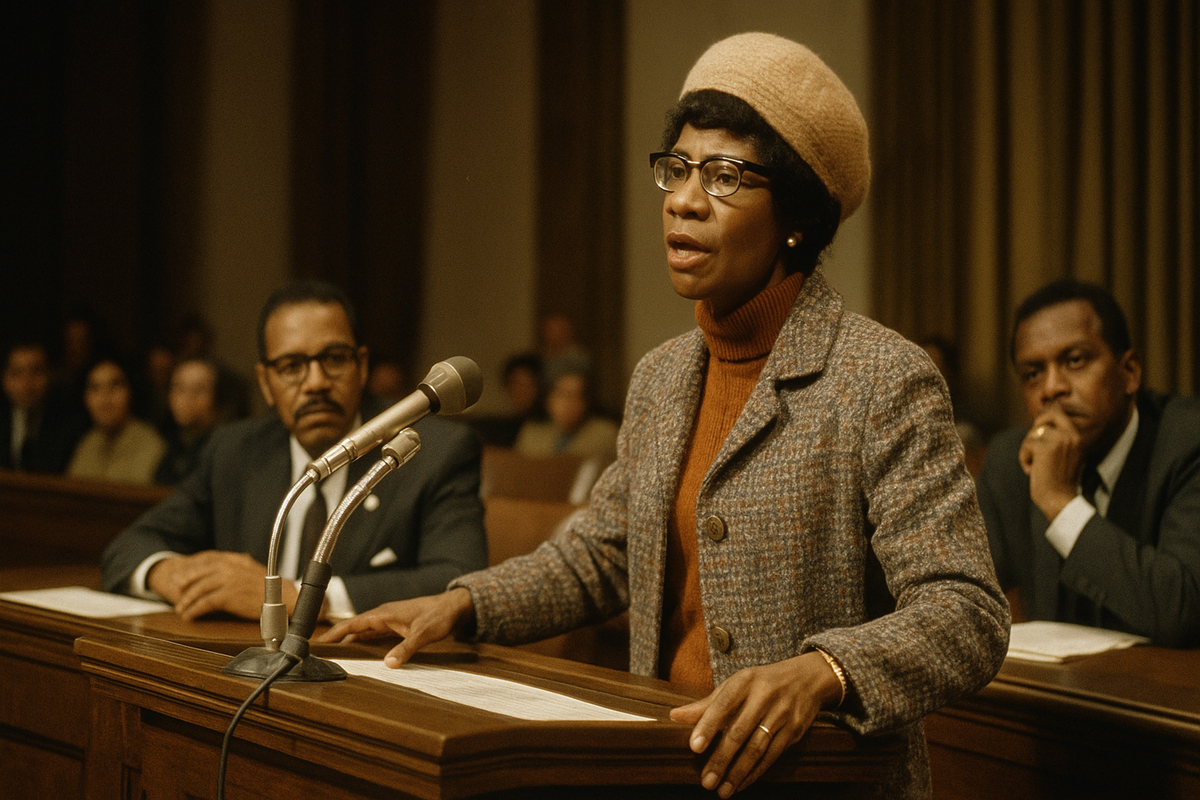
"I see democracy dying and it is not the Red-menace that is killing it. I see the roots of fascism rearing its ugly head in this country."
She went further, connecting centuries of Black experience into a single unbroken accusation:
"All Black people know what 'fascism' means, for we have lived with it for over one hundred and fifty years."
This was not congressional decorum. This was a declaration.
Why Jet Mattered
By 1970, Jet was more than a magazine—it was a lifeline. Where mainstream media sanitized or ignored Black voices, Jet amplified them. Its pages had carried the brutal photograph of Emmett Till's mutilated face in 1955, forcing white America to witness what it preferred to deny. It chronicled civil rights battles, celebrated cultural achievements, and warned of dangers that other outlets refused to name.
The April 16, 1970 issue followed that tradition. Jet didn't merely summarize Chisholm's testimony—it reproduced her exact words. Readers didn't get a filtered version from a white correspondent. They got Chisholm herself, unmediated and uncompromising.
The magazine paired her testimony with striking photographs: Chisholm standing firm at the witness table, Black congressmen like Charles Diggs and John Conyers flanking her in solidarity. The visual message was unmistakable—Black leadership was present in the halls of power, and it was unafraid.
"The Emergency Detention Act… its mere presence on the books is an offense, especially to Americans of color."
Jet made sure every reader understood what was at stake.
The Anatomy of a Threat
Chisholm's testimony dismantled the Detention Act piece by piece. She exposed its racist double standard: while Black activists faced surveillance, raids, and imprisonment, white supremacist groups like the Ku Klux Klan and the Minutemen operated with impunity, armed and unchecked. The law, she argued, was a scalpel designed to cut in only one direction.
She also challenged the fundamental premise of emergency powers in a democracy. "The action of those in authority to stifle dissenting voices… is the beginning of the fact that it can happen here," she warned. Fascism didn't announce itself with jackboots and torches. It arrived quietly, through legal mechanisms, through laws left on the books waiting for the right political moment.
Her testimony was prophetic. It anticipated the ways governments in crisis would reach for authoritarian tools, wrapping repression in the language of security.
Linking Japanese Internment to Black Oppression
Chisholm reminded Congress that Japanese-Americans had been caged in camps during WWII, while German- and Italian-Americans largely escaped. She warned that such racial double standards could easily be applied to Black citizens.
Warning of Fascism at Home
Her words were stark: "The action of those in authority to stifle dissenting voices… is the beginning of the fact that it can happen here." She framed the Detention Act not as hypothetical, but as a real step toward American fascism.
Exposing Hypocrisy in Law Enforcement
Chisholm noted that while Black activists faced surveillance and raids, right-wing vigilantes like the KKK and Minutemen roamed armed and unchecked. The law, she argued, was never neutral.
Speaking for the Black Experience
She declared: "All Black people know what 'fascism' means, for we have lived with it for over one hundred and fifty years." In one sentence, she tied slavery, Jim Crow, and modern repression into a single unbroken line of injustice.
A Time Capsule of Resistance
For collectors and historians today, the April 16, 1970 issue of Jet represents far more than a magazine. It is a primary source document of Black political resistance, capturing Shirley Chisholm at the beginning of what would become a historic career—two years before her groundbreaking 1972 presidential campaign.
The issue holds value on multiple levels. Historically, it documents a Black congresswoman directly confronting the federal government over civil liberties at the height of both the civil rights and Black Power movements. Culturally, it reflects a moment when Black-owned media served as the only consistent alarm system warning communities about government overreach. Politically, it preserves Chisholm's voice in her own words, before history could smooth her edges or soften her fury.
Issues of Jet tied to civil rights struggles, internment debates, and figures like Chisholm, King, Malcolm X, and the Panthers command particular attention among serious collectors. They are rare, increasingly fragile, and irreplaceable as firsthand records of how African Americans documented their own liberation struggles.
To hold this issue is to hold evidence—evidence that the fight for democracy was never guaranteed, that it required named enemies and named heroes, and that sometimes the most dangerous laws are the ones that sit quietly waiting.
The Echo Across Decades
Jet's coverage of Chisholm and the Detention Act endures because it refused polite evasion. While mainstream publications debated policy in abstract terms, Jet showed readers photographs of Black leaders testifying, printed bold headlines connecting Japanese internment to potential Black repression, and gave space to warnings that would have been dismissed as radical elsewhere.
In an era when digital news evaporates within hours, these printed issues stand as permanent witnesses. They remind us that debates over surveillance, detention, and executive power are not new. They have been fought before, by people who understood exactly what was at risk.
Chisholm's testimony, preserved in Jet, remains a blueprint for recognizing authoritarianism before it fully arrives—for seeing the threat not in distant enemies but in laws already written, waiting for the right emergency to activate them.
Collector Significance
Historical Timing
Published at the height of the civil rights and Black Power movements, it documents a Black congresswoman directly challenging the U.S. government on repression and civil liberties.
Iconic Leadership
Chisholm would go on to run for president in 1972, becoming a trailblazer in American politics. This issue captures her in the early, fiery years of her career.
Cultural Significance
The issue reflects a turning point when Black publications were the only media consistently warning communities about government overreach.
Primary Source Value
Issues tied to civil rights, internment, and figures like Chisholm, King, Malcolm X, and the Panthers are especially prized among historians and collectors.
Collecting History, Preserving Memory
For those who study the Black freedom struggle, collect vintage media, or simply believe that history should be held rather than merely read about, original issues of Jet magazine are essential artifacts.
From the 1950s through the 1980s, Jet chronicled the full spectrum of Black American life—from Montgomery to Memphis, from tragedy to triumph, from fear to defiance.
Browse Jet Magazine CollectionWhat Remains
The April 16, 1970 issue of Jet is one of the most significant political publications of its era. It captured Shirley Chisholm at her most fierce, gave Black readers the tools to recognize threats to their freedom, and documented a moment when a Black congresswoman stood in the Capitol and named American fascism as a present danger, not a distant possibility.
The photographs, the testimony, the unapologetic headlines—they are not relics of a settled past. They are evidence of battles still being fought. The Emergency Detention Act was eventually repealed in 1971, thanks in part to the pressure generated by voices like Chisholm's. But the impulse it represented—the desire of the state to detain its own citizens without due process during moments of crisis—never disappeared.
That impulse is why this issue of Jet remains vital. It teaches us what to watch for, what to name, and what to resist. And it reminds us that democracy's defenders have always known: freedom is not protected by silence. It is protected by people willing to stand up, speak plainly, and call fascism by its name.