
The Red Scare on Campus
When The Saturday Evening Post Investigated UCLA's "Communist Cell"
October 1950. Norman Rockwell painted a small-town football referee tossing a coin between oversized players—pure Americana, innocent as apple pie. But flip past that cover of The Saturday Evening Post, and middle-class readers found something else entirely: an exposé titled "U.C.L.A.'s Red Cell: Case History of College Communism."
Their children were on those campuses. And according to William L. Worden's investigation, some of those students weren't just protesting—they were being watched, tracked, and branded with what employers called the "Red tag."
This wasn't paranoia. It was 1950.
Archive Details
Publication: The Saturday Evening Post
Issue Date: October 21, 1950
Cover Artist: Norman Rockwell ("Coin Toss")
Featured Article: "U.C.L.A.'s Red Cell: Case History of College Communism" by William L. Worden
Historical Context: McCarthy Era, Korean War, Campus Anti-Communism Investigations
The Year America Turned Inward
Five years after V-J Day, the victory parades had given way to a different kind of vigilance. Soviet spies. Alger Hiss. The Rosenbergs. The Korean War had erupted that June, and Senator Joseph McCarthy was building his career on the premise that communists had infiltrated every corner of American life—Hollywood, government, and now, the universities.
For parents reading The Saturday Evening Post that autumn, Worden's article wasn't abstract political theater. It was personal. Could their son at Berkeley or their daughter at UCLA be recruited into something dangerous? Were student protests about civil rights—or Soviet agitation?
The article promised answers. It delivered alarm.
A Magazine That Spoke for—and To—Middle America
By 1950, The Saturday Evening Post had spent more than a century shaping American opinion. Its pages blended escapist fiction with hard-edged journalism, humor columns with social commentary. Millions of households subscribed. To appear in the Post was to enter the national conversation.
The October 21 issue was typical of that range: Arthur Gould's "Coed's Delight," Margaret Craven's "The Woman Who Meddled," Geoffrey Household's serialized Western. Readers could lose themselves in safe, familiar stories.
But they could also confront William L. Worden's warning that communism had established a "cell" at one of California's flagship universities. The magazine's genius was this juxtaposition—Rockwell's reassuring football scene on the cover, Cold War anxiety in the features. One reminded readers what America was. The other told them what threatened it.
Inside UCLA's "Case History"
Worden's reporting painted UCLA as a battleground. The details were specific, damning, and designed to resonate with parents nationwide:
The "Red Tag" Stigma
Students feared their UCLA diplomas would become liabilities. Worden quoted employers who said they'd avoid hiring graduates from a campus tainted by communist associations. For young people investing in their futures, the stakes were existential.
Protests Framed as Subversion
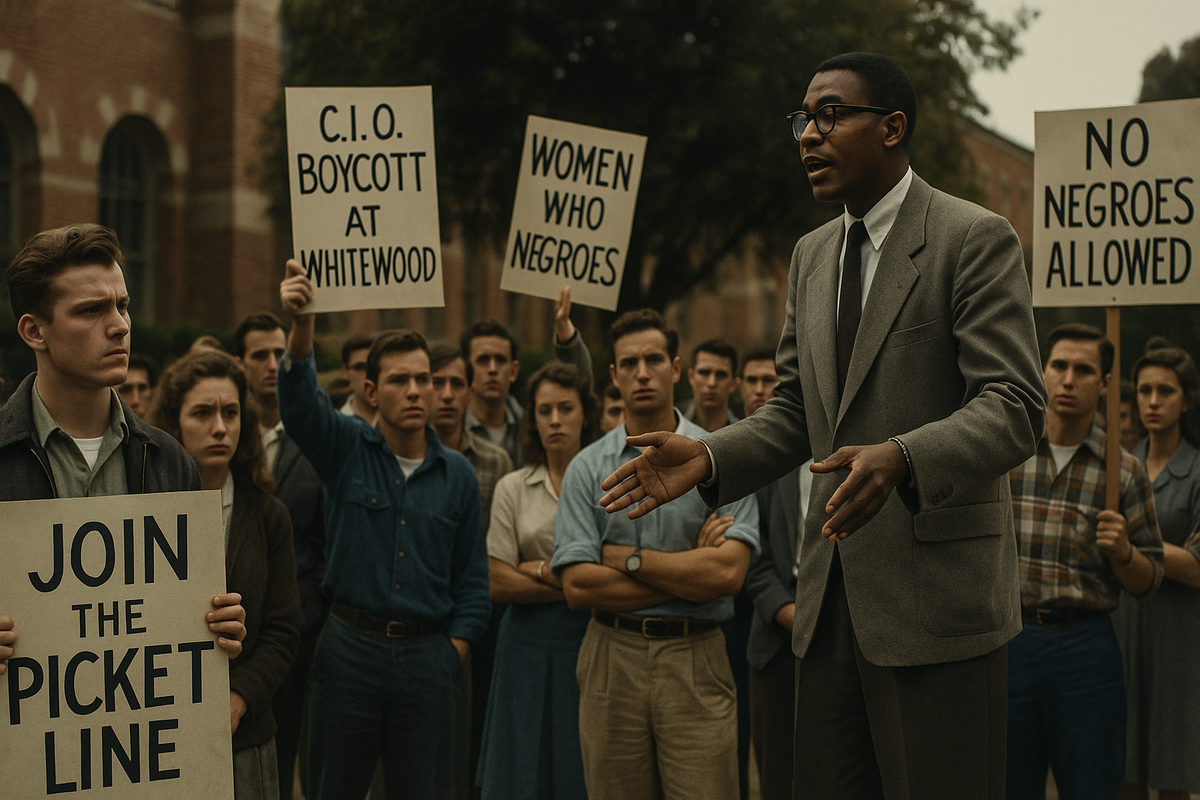
The article described picket lines at a barber shop, signs reading "No Negro Customers Allowed in My Shop" and "C.I.O. Boycott at Whitewood." These were civil rights demonstrations—students confronting racial discrimination. But Worden presented them through the lens of Cold War suspicion.
The Daily Bruin Under Scrutiny
UCLA's student newspaper faced accusations of harboring left-wing sympathies. In an era when editorial positions could end careers, even student journalism became dangerous ground.
Sherrill Luke's Double Bind
The African American student body president appeared in the article's photographs—leading meetings, advocating for racial equality. His prominence embodied both progress and peril. To conservative readers, Luke represented how communists might weaponize legitimate grievances.
The ordinary majority. Worden balanced the alarm with images of normalcy: students studying on sunlit lawns, women in dormitories, student government proceedings. Most UCLA students weren't radicals. But the article's architecture suggested that danger lurked even in those peaceful scenes—that recruitment happened quietly, that the young were vulnerable.
The message was clear: Your campus could be next.
Why Collectors Prize This Issue
Rockwell's "Coin Toss" Cover
The football illustration is vintage Rockwell—warm, humorous, technically superb. Collectors pursue his covers relentlessly, and this one captures small-town rituals at their most charming.
Cold War Documentation
Worden's article is a primary source from the McCarthy era's peak. Historians studying the Red Scare need access to these original texts—not summaries, not retrospectives, but the actual rhetoric that shaped public opinion in real time.
Civil Rights Intersection
The photographs of anti-segregation protests, the coverage of Sherrill Luke's leadership—these details place the issue at the crossroads of two defining 20th-century movements.
Cultural Time Capsule
Beyond the headline features, every page offers evidence of 1950 America: advertisements for Studebaker cars and Chesterfield cigarettes, fiction reflecting postwar anxieties, advice columns addressing domestic concerns.
Where the Story Leads
The October 21, 1950 Saturday Evening Post sits at a historical inflection point. Within a few years, McCarthy would be censured. The Civil Rights Movement would accelerate. Campus activism would intensify, culminating in the upheavals of the 1960s. But in autumn 1950, the outcome was uncertain. Parents worried. Students calculated risks. Universities struggled to balance academic freedom with political pressure.
Worden's article didn't predict what came next. It captured what was—the fear, the suspicion, the generational tension. Reading it now, we see not just UCLA's story but America's: a nation trying to defend itself while defining what, exactly, it stood for.
Explore the Archive
Original issues of The Saturday Evening Post offer unmediated access to these pivotal moments. Each magazine is an artifact—not a reproduction, not a digital scan, but the physical object that sat on coffee tables and sparked dinner table debates in 1950.
Browse The Saturday Evening Post Magazine Collection