
When History Came Home
The June 1973 Issue That Turned a President Into "Daddy"
January 22, 1973. Lyndon Baines Johnson died at his Texas ranch, four years after leaving the White House, his heart finally surrendering after decades of angina, pneumonia, and the weight of Vietnam. Five months later, his daughters did something no speechwriter or biographer could: they brought him back to life—not as a president, but as a father.
The June 1973 issue of Ladies' Home Journal opened with a double memoir titled "Remembering Daddy." No policy analysis. No Vietnam retrospectives. Just Lynda Robb and Luci Nugent, writing in their own voices, sharing handwritten letters their father sent to his granddaughter Lucinda, recounting his nightly prayers, his Christmas tractor rides, his final civil rights speech.
This wasn't mourning. This was reclamation.
And it appeared on newsstands sandwiched between Playtex tampon ads and La-Z-Boy recliners—which was exactly the point.
Archive Details
Historical Figures: Lyndon B. Johnson, Lynda Robb, Luci Nugent
Issue Date: June 1973
Archive Source: Ladies' Home Journal
Feature Title: "Remembering Daddy"
Historical Context: Published five months after Johnson's death, during Watergate hearings
The Genius of Domestic Historiography
By 1973, Ladies' Home Journal had spent decades perfecting a radical editorial formula: treat women's domestic lives as the stage where history actually happens. The magazine's motto blazed across every cover—"Never Underestimate the Power of a Woman"—and the Johnson feature proved it. While Watergate hearings flooded television screens with men in suits lying under oath, the Journal offered a counter-narrative: two daughters telling the truth about power, family, and what remains when the cameras turn off.
Lynda and Luci weren't writing hagiography. They were writing memory. Johnson emerged not as the architect of Medicare or the escalator of Vietnam, but as "Boppa," a grandfather who wrote notes encouraging Lucinda to "study hard and ride your tractor," a man who prayed every night and battled kidney stones with grim humor, who delivered his final speech on civil rights in December 1972—just weeks before his death—urging America to never stop fighting for equality.
The Journal placed this intimate testimony alongside fashion spreads and polyester pantsuit ads, creating something no political magazine could: a portrait of how history is lived. Not in the Oval Office. In ranch houses. In handwritten letters. In the space between a grandfather's laughter and a nation's reckoning with its own wounds.
What the Daughters Revealed
The Johnson daughters structured their memoir around scenes, not speeches:
Letters to Lucinda
Johnson's handwriting sprawled across pages, urging his granddaughter to cherish family, work hard, embrace the Texas land. These weren't public documents. They were the private vocabulary of love.
Faith as Architecture
Nightly prayers. Constant reminders of spiritual grounding. Johnson's daughters framed their father not as a political operator, but as a man whose faith shaped every decision—a detail often erased from his public legacy.
The Body's Betrayal
Pneumonia. Kidney stones. Heart disease. The daughters didn't sanitize his suffering. They showed a man's body breaking down while his will to serve never dimmed.
The Final Speech
December 1972, at the LBJ Library. Johnson, weakened but resolute, speaking on civil rights one last time. The daughters positioned this moment as his final testament—not policy, but moral imperative.
Grandfatherly Rituals
Sunday dinners. Christmas tractor rides. Tender moments with Yuki, his dog. These weren't trivia. They were the textures of presence, the proof that power doesn't erase personhood.
Grandfatherly Love
Johnson's grandchildren knew him not as "Mr. President," but as "Boppa," a figure of warmth and laughter whose legacy lived in their memories before it lived in history books.
Every anecdote transformed LBJ from historical abstraction into flesh—a man whose legacy was being debated in Washington while his grandchildren remembered him as the figure who made them laugh.
The Cultural Moment: Grief, Watergate, and Women's Voices
The summer of 1973 was combustible. Vietnam was winding down, its casualties still mounting. The Watergate hearings were beginning their slow demolition of Nixon's presidency. The women's movement was rewriting the rules of family, work, and voice.
Into this chaos, the Journal published a presidential memoir written entirely by daughters. Not advisors. Not historians. Daughters. Women claiming the right to define their father's legacy on their terms, using the emotional vocabulary of family rather than the cold language of politics.
This was subversive. The magazine positioned women's storytelling—memoir, reflection, intimate testimony—as equal to (perhaps more truthful than) the official record. While men testified before Congress, parsing lies and half-truths, Lynda and Luci offered something uncomplicated: memory, love, and the refusal to let history flatten their father into a symbol.
The Journal had always understood this. Its editorial mission was to dignify domestic life, to insist that recipes and remembrance, fashion and feminism, could coexist on the same pages. The Johnson feature was the magazine at its best: proving that history belongs to families as much as it belongs to governments.
The Magazine as Monument
Ladies' Home Journal understood something profound: public figures don't belong only to the public. They belong to the people who knew them before the cameras, who remember their prayers and their laughter and their handwriting. By giving Lynda and Luci the platform, the Journal created a space where history could be told differently—not as policy or scandal, but as the accumulated weight of small, sacred moments.
This is why the Johnson issue endures. It's not propaganda. It's not revisionism. It's two daughters saying: Before you judge him, know this—he was ours first.
Why This Issue Matters to Collectors
For historians, archivists, and collectors of American memory, the June 1973 Ladies' Home Journal is irreplaceable.
Temporal Immediacy
Published five months after Johnson's death, this issue captures grief in real time. No distance. No retrospective polish. Just raw remembrance.
Primary Source Authority
Lynda and Luci's testimony appears nowhere else in this form. This isn't biography. It's direct witness—daughters speaking for the historical record.
Cultural Convergence
The issue sits at the intersection of presidential legacy, women's voices, Watergate disillusionment, and 1970s domesticity. It's a palimpsest of American contradiction.
Visual Archive
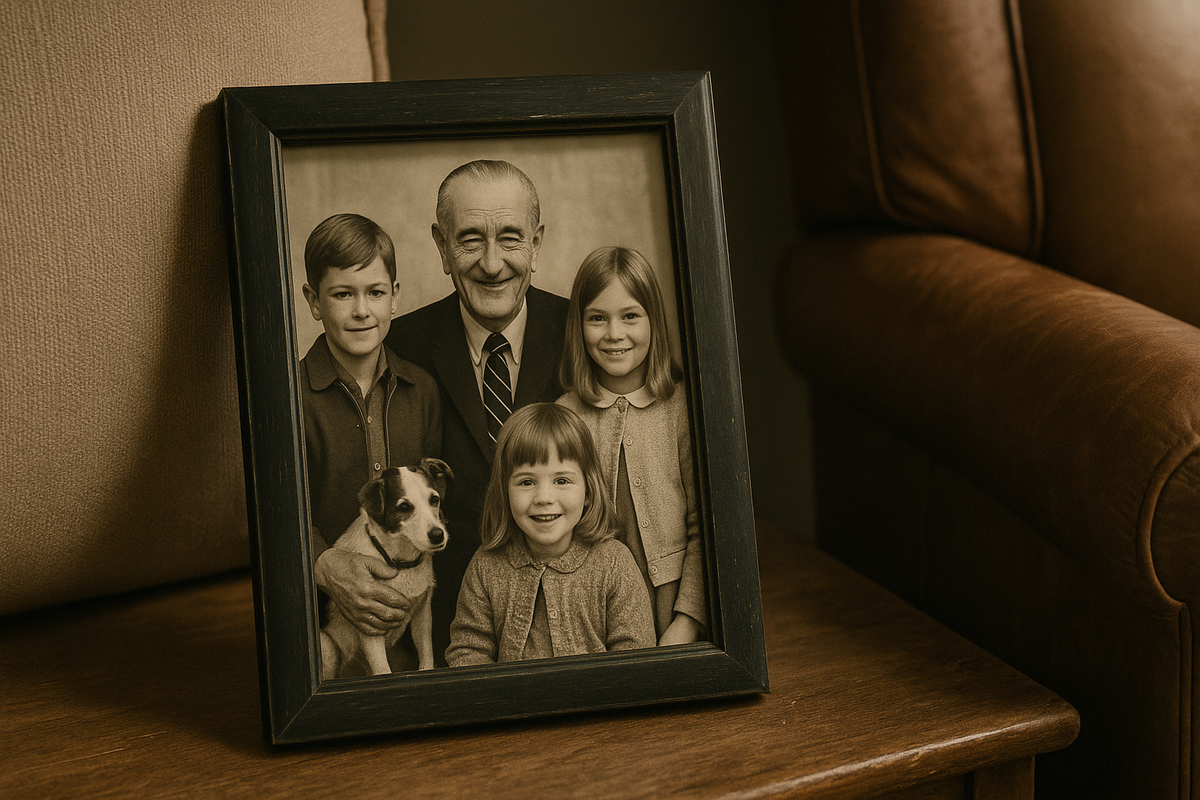
Photographs of Johnson with family, with Yuki, in private moments—images that humanize power in ways official White House portraits never could.
Collector Scarcity
Vintage Ladies' Home Journal magazines are already sought after. Issues tied to presidential history command premium value among serious collectors.
A Family's Monument
Holding this issue means holding the moment when two daughters refused to let their father be remembered only for Vietnam or the Great Society. They insisted on "Daddy." They insisted on "Boppa."
When you hold this issue, you hold the moment when two daughters looked at their father's fractured legacy and said: Let us tell you who he really was.
Add This Issue to Your Collection
If you collect artifacts of American memory, women's storytelling, or presidential history, the June 1973 Ladies' Home Journal belongs in your archive.
Browse Ladies' Home Journal Magazine CollectionThis isn't just a magazine. It's a family's act of preservation. It's proof that history happens in living rooms as much as in legislatures.