
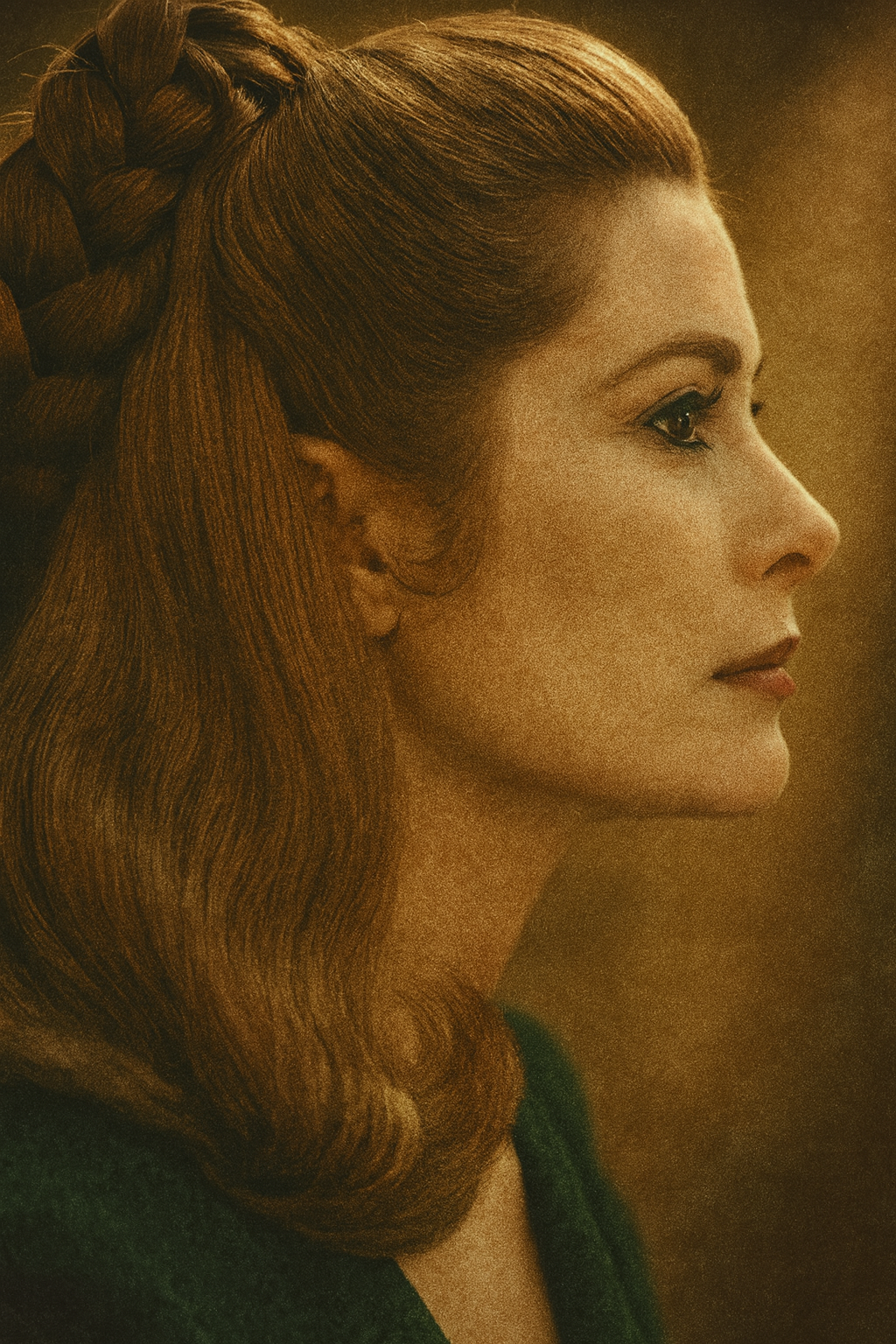
The December 1971 Vogue Cover That Stopped Time
Princess Grace and the Last Gasp of Old Hollywood Royalty
When Princess Grace of Monaco appeared on the cover of Vogue's December 1, 1971 issue, she wasn't simply gracing another magazine—she was marking the end of an era. This was the Christmas issue, and Grace Kelly, the woman who had abandoned Hollywood at its peak to marry a prince, now sat for one of the most intimate royal portraits ever published in a mainstream fashion magazine.
The timing was no accident. By 1971, the feminist movement was rewriting the rules of marriage and motherhood. The counterculture had shattered deference to authority. Yet here was Grace, impeccably coiffed and high-collared, representing everything the decade was supposedly leaving behind: duty over desire, restraint over rebellion, monarchy over modernity.
What makes this issue extraordinary isn't just that Grace was famous—it's that she agreed to let Vogue photograph her family, her palace, and her philosophy with unusual candor. The seven-page spread, shot by Lord Snowdon and written by Curtis Bill Pepper, became a cultural Rorschach test: Was Grace Kelly a woman who had sacrificed herself, or one who had claimed a life beyond what Hollywood could offer?
The answer, as the issue reveals, was far more complicated than either narrative allowed.
Archive Details
Historical Figure: Princess Grace of Monaco (Grace Kelly)
Issue Date: December 1, 1971
Archive Source: Vogue Magazine
Photographer: Lord Snowdon (Antony Armstrong-Jones)
Writer: Curtis Bill Pepper
Feature Length: Seven-page spread with photographs and interview
Hollywood's Loss, Monaco's Gamble
Grace Kelly didn't just leave Hollywood—she vanished from it. After High Society in 1956, she married Prince Rainier III and became Her Serene Highness Princess Grace of Monaco, a title that came with expectations no Oscar could prepare her for. She was tasked with producing heirs, stabilizing a tiny principality's finances, and embodying a fairy tale for a world that was rapidly losing faith in fairy tales.
By 1971, fifteen years into her marriage, Grace had succeeded on every front. Princess Caroline was 14, Prince Albert 13, Princess Stéphanie 6. Monaco's economy had been transformed. Yet the question that fascinated Vogue's readers—and clearly fascinated Grace herself—was whether she had succeeded as a woman, not just as a princess.
Her answer, delivered in Pepper's interview, was disarmingly honest: "Marriage is like life. You never reach a point where you can say, 'Now I'm grown up,' because you go on growing all the time."
This wasn't the language of royal protocol. It was the admission of someone still figuring it out.
Snowdon's Lens: Intimacy at a Distance
Lord Snowdon, himself married into British royalty (and by 1971, estranged from Princess Margaret), understood how to photograph power without reducing it to pageantry. His portraits of Grace in the Monaco Palace Winter Garden captured her in a flowing pink gown, holding her poodle against a backdrop of lush greenery. Another frame showed Princess Caroline in profile, bathed in natural light, her features soft yet unmistakably regal.
These weren't stiff state portraits. They were images of a family caught between two worlds: the Italian marble floors and antique Chinese screens that spoke of history, and the toys scattered across palace rooms that spoke of ordinary childhood.
One detail anchored the spread in Grace's Hollywood past: among the palace's treasures were gifts from Alfred Hitchcock, the director who had made her a star in Rear Window, To Catch a Thief, and Dial M for Murder. The palace was a museum of her former life, even as she lived a new one.
The Philosophy of Instinct
What separated this Vogue feature from typical royal coverage was Grace's willingness to speak about marriage without romance or platitudes. She described acting on "instinct and feeling," noting that "certain truths come all of a sudden." She spoke of timing, of growth, of marriage as process rather than achievement.
For Vogue's 1971 readership—women navigating divorce, career ambitions, and shifting sexual mores—this was radical stuff coming from a princess. Grace wasn't preaching tradition; she was describing survival within it. She had chosen a path of duty, yes, but she wasn't pretending it had been simple or complete.
The article offered glimpses of domestic reality: Grace helping six-year-old Stéphanie arrange flowers, cautioning her children not to swallow toys, navigating the peculiar challenge of raising future rulers in a world that increasingly questioned monarchy itself.
She was neither martyr nor icon. She was, as the photos and text made clear, still Grace Kelly—just older, more complicated, and no longer performing for a camera that would cut when the scene ended.
Why 1971 Mattered
This issue landed at a crossroads. Second-wave feminism was questioning whether women like Grace—who had left a career for marriage—had made the right choice. The counterculture had challenged the idea that titles and palaces meant anything at all. Meanwhile, Europe's remaining monarchies were fighting for relevance in an age of democratization and skepticism.
Grace's presence in Vogue argued for a third position: that dignity, beauty, and purpose could exist within traditional structures, but only if those structures allowed for growth, honesty, and individual agency. She hadn't become a princess by erasing Grace Kelly. She had merged them.
Vogue understood this. The magazine chose Grace for its Christmas issue not as nostalgia but as provocation—a reminder that elegance and duty weren't inherently oppressive, even as the culture debated what freedom for women actually meant.
Deep Dive: What the Issue Revealed
The Cover That Collectors Covet
Snowdon's photographs granted unprecedented access to Monaco's ruling family, combining intimacy with formality in ways that anticipate modern royal media strategy.
Grace Kelly's career and transformation remain unmatched in 20th-century cultural history. Authentic primary sources like this are increasingly rare.
The issue captures the exact moment when traditional femininity and emerging feminist ideals collided, with Grace Kelly as the unlikely focal point.
Snowdon's work carries historical weight as one of the definitive royal photographers of the era, and these images rank among his most accomplished.
Grace Kelly's elegance transcends fashion cycles, making this issue valuable to collectors of Hollywood history, royal memorabilia, and vintage fashion alike.
To own this issue is to possess a document from the precise moment when Old Hollywood, European monarchy, and 1970s womanhood converged—and to hold the question of whether Grace Kelly made the right choice, frozen in December 1971, still unanswered.
Why This Issue Still Speaks
Fashion magazines have always been more than style guides. At their best, they're cultural mirrors, reflecting the anxieties and aspirations of their moment. The December 1, 1971 Vogue did exactly that.
It asked: Can a woman have both agency and tradition? Can royalty matter in a democratic age? Can Hollywood glamour survive real life?
Grace Kelly's answer, delivered through Snowdon's camera and Pepper's prose, was yes—but only with honesty, instinct, and the willingness to keep growing.
For anyone drawn to the intersection of cinema, monarchy, and the evolving role of women in modern history, this issue isn't just collectible. It's essential.
Explore the Collection
Browse the full collection of original vintage Vogue magazines, from Grace Kelly to the feminist essays and bold photography that defined fashion's most transformative decades. Each issue is a piece of history—not just fashion, but the ideas, tensions, and transformations that shaped the 20th century.
Browse Vogue Magazine Collection