
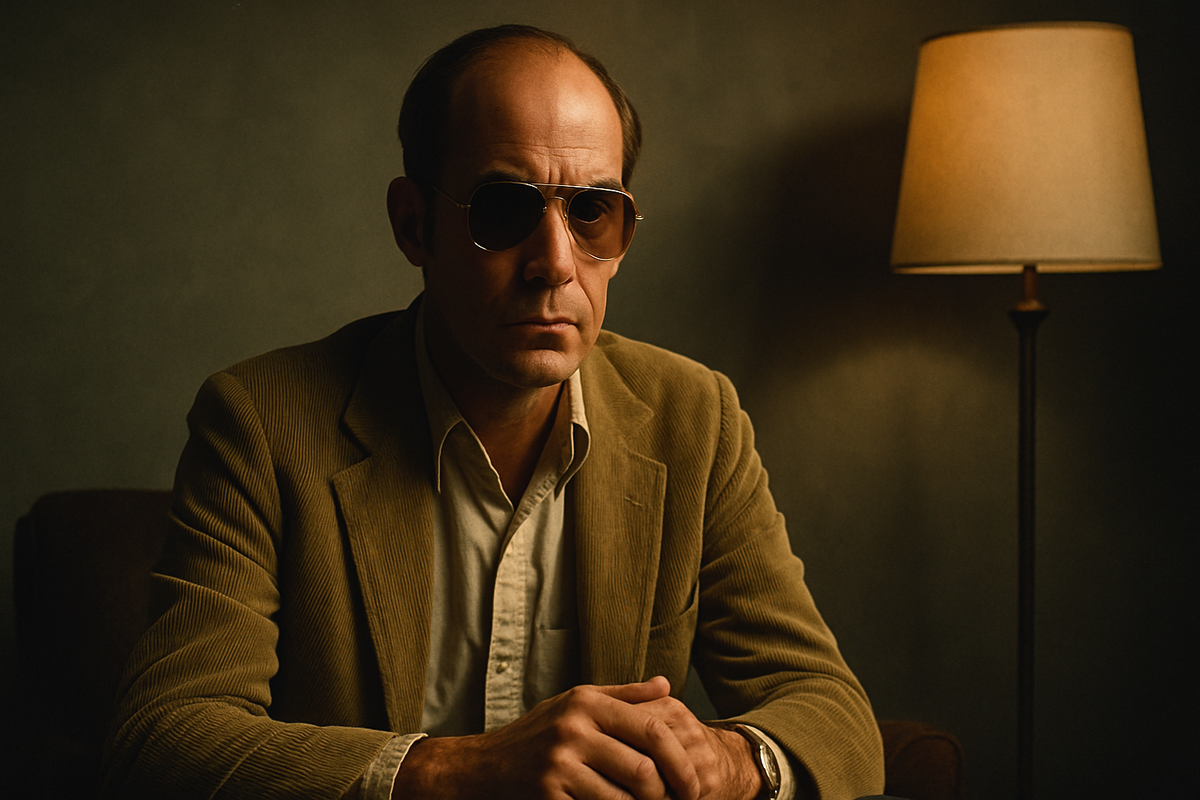
The Magazine That Captured America's Nervous Breakdown
Hunter S. Thompson, Playboy, and the Voice of Post-Watergate Fury
August 1974: Richard Nixon boards Marine One for the last time, flashing his signature V-sign to a nation that no longer believes him. Three months later, readers open their mailboxes to find the November issue of Playboy—and inside, Hunter S. Thompson is waiting to explain what just happened to America.
This wasn't just another celebrity interview. It was a reckoning.
The Playboy Interview with Thompson stands as one of the most volatile pieces of political journalism published in the magazine's fifty-year run. While the cover promised the usual blend of seduction and sophistication—a blonde model in white stockings, posed at her dresser—the interior pages delivered something far more dangerous: an unfiltered autopsy of American democracy performed by the one writer crazy enough to tell the truth.
Archive Details
Historical Figure: Hunter S. Thompson
Issue Date: November 1974
Archive Source: Playboy Magazine
Context: Published three months after Nixon's resignation
The Wreckage of 1974
To grasp why this interview mattered, you need to understand what America looked like in the fall of 1974. The country wasn't just wounded—it was hemorrhaging trust.
Watergate hadn't merely ended a presidency. It had exposed the rot at the center of American power. For the first time, citizens watched their president resign in disgrace, caught in a web of lies so extensive that even his own party abandoned him. The office itself seemed tainted, breakable, mortal.
Vietnam compounded the damage. Though the last troops had withdrawn, the war's psychological aftermath lingered like Agent Orange in the national bloodstream. Veterans returned to indifference or hostility. The certainty that had propelled America through the 1950s—the faith in righteous power, in manifest destiny, in the system itself—had evaporated.
The optimism of the 1960s, with its dreams of social transformation, had curdled into cynicism. America needed someone who could make sense of the chaos, and traditional journalists—with their carefully hedged analysis and manufactured objectivity—weren't cutting it.
Enter Hunter S. Thompson: drug-addled prophet, Nixon's mortal enemy, and the man who had already revolutionized political reporting with Fear and Loathing on the Campaign Trail '72. His gonzo journalism rejected the lie of objectivity, plunging headfirst into the story as both witness and participant. If America was spiraling into madness, Thompson was the only reporter willing to spiral along with it and send back dispatches from the edge.
Why Playboy Mattered
By 1974, Playboy had evolved into something far stranger and more ambitious than its reputation suggested. Yes, Hugh Hefner's empire was built on provocative photography and the sexual revolution. But the magazine had also become one of America's most important platforms for serious journalism.
The Playboy Interview series had already featured Martin Luther King Jr., Malcolm X, Muhammad Ali, and John Lennon. These weren't puff pieces—they were marathon conversations that gave public figures space to think aloud, to contradict themselves, to be human. In an era before podcasts or YouTube, this was where Americans went to hear unfiltered voices.
The Thompson interview exemplified Playboy's unique alchemy: place a naked woman on the cover, then challenge readers to grapple with the disintegration of their country. The magazine understood something fundamental about its audience—they wanted both pleasure and substance, eroticism and intellect. This wasn't hypocrisy; it was a radical vision of the sophisticated American man as someone who could appreciate beauty without abandoning critical thought.
The November 1974 issue delivered precisely that paradox. Page through it and you move seamlessly from erotic photography to Thompson's apocalyptic vision of Nixon, from lifestyle features to discussions of political corruption that would make The Atlantic uncomfortable. No other publication could pull off this combination.
What Thompson Said
The interview itself was incendiary.
Thompson described Nixon not as a failed president but as a monster—one of the most dangerous figures in American history. His hatred wasn't abstract political disagreement; it was visceral, personal, existential. He saw Nixon as the embodiment of everything corrupt in American power: the paranoia, the vindictiveness, the willingness to destroy democracy to preserve control.
He spoke with shocking candor about his drug consumption—cocaine, LSD, mescaline, alcohol—framing these substances not as shameful secrets but as essential tools of perception. In Thompson's cosmology, sobriety meant accepting the official lies. Altered consciousness was a form of truth-seeking.
He revisited his time embedded with the Hell's Angels, recounting violent encounters that read like fever dreams. These weren't sanitized anecdotes; they captured the seductive danger of outlaw America, the places where conventional society's rules dissolved entirely.
Most importantly, Thompson articulated what gonzo journalism actually meant. He demolished the myth of objectivity, arguing that truth emerged only through total immersion in chaos. The journalist couldn't stand apart from the story—he had to become part of it, risk himself in it, let it destroy him if necessary.
And threading through everything was his diagnosis of America's terminal condition. The country was choking on consumerism, poisoned by political lies, paralyzed by fear. The American Dream—whatever that had meant—was dying, and Thompson was documenting its last gasps.
For readers in 1974, this was validation. Someone was finally saying what they felt: that the system was broken, that the emperor had no clothes, that the whole enterprise might be unsalvageable.
The Interview's Major Themes
Nixon as Monster
Thompson described Nixon as one of the most dangerous men in history, someone who symbolized corruption and paranoia—a visceral threat to democracy itself.
The Drug-Fueled Mind
Thompson spoke with shocking honesty about his consumption of cocaine, LSD, mescaline, and alcohol, presenting them as integral to his writing process and worldview.
Hell's Angels Encounters
Thompson revisited his time embedded with the notorious motorcycle gang, recounting violent, surreal experiences that captured the allure and danger of outlaw America.
Gonzo Journalism Defined
The interview demonstrated journalism without distance, reporting that merged with lived experience. Thompson admitted objectivity was a myth—truth emerged only through immersion in chaos.
America in Decline
Thompson painted a portrait of a country spiraling into decay, warning that consumerism, political corruption, and cultural apathy were destroying the American spirit.
A Time Capsule
Together, these themes created more than an interview—they created a document of American disillusionment. For readers in 1974, it was revelation; for collectors today, it remains a landmark.
Why Collectors Prize This Issue
The November 1974 Playboy occupies a special tier in the collector's market, and the reasons go beyond mere scarcity.
Historical Synchronicity
Published just three months after Nixon's resignation, it captures America at its most raw and uncertain. The wound was still fresh. Thompson's fury was immediate, not retrospective.
Cultural Lightning Rod
Thompson remains one of the twentieth century's most influential and controversial journalists. This interview isn't just about him—it channels the rage of an entire generation.
The Playboy Paradox
This issue represents the magazine at its most confident and ambitious—unafraid to pair erotic imagery with journalism that other publications would have buried in the back pages.
Investment Value
Issues tied to watershed moments always appreciate. When collectors search for documents that capture the 1970s zeitgeist, this one is canonical.
Beyond market value, there's something profound about holding this magazine today. It's a reminder that journalism once had space for wild voices, that magazines could be intellectually fearless, that popular culture didn't always mean dumbed-down culture.
The Legacy of 1970s Playboy
What made Playboy's 1970s issues remarkable was their refusal to choose between pleasure and substance. They embraced both, unapologetically.
Each issue from this decade serves as a time capsule—not just of shifting sexual mores, but of a moment when print journalism commanded cultural authority. Readers spent hours with these magazines, absorbing long-form interviews, provocative essays, and fiction by major writers. The format demanded attention and rewarded it.
In our current media landscape—where content evaporates within hours, where attention is fragmented across infinite platforms—these physical artifacts feel almost alien. They represent a world where journalism could take risks, where readers had patience, where a single interview could spark national conversation.
Explore the Archive
The November 1974 issue is one thread in a larger tapestry. Our collection includes thousands of original Playboy magazines spanning decades of cultural upheaval and transformation.
Whether you're a collector tracking down key issues, a historian researching media's role in shaping public consciousness, or simply someone fascinated by the intersection of sex, politics, and journalism, these magazines offer something increasingly rare: unfiltered access to how America saw itself at crucial moments.
Why This Issue Endures
The November 1974 Playboy endures because it captured something essential about its moment—the fear, the anger, the sense that American institutions had betrayed the people they claimed to serve. Thompson's voice, profane and prophetic, spoke for those who felt abandoned by traditional politics and traditional media.
To hold this issue now is to hold evidence that journalism was once willing to be dangerous, that magazines could challenge and provoke, that one writer's rage could crystallize a nation's grief. It's not nostalgia—it's a reminder of what's been lost and what might still be recovered.
The past, printed on glossy pages and preserved in collectors' archives, refuses to stay silent. It speaks with Thompson's voice: urgent, uncompromising, and absolutely necessary.
Browse the Complete Archive
Discover thousands of original magazines from pivotal moments in American history. Each issue is a portal to the past—preserved, authentic, and waiting to tell its story.
Browse Playboy Magazine Collection