
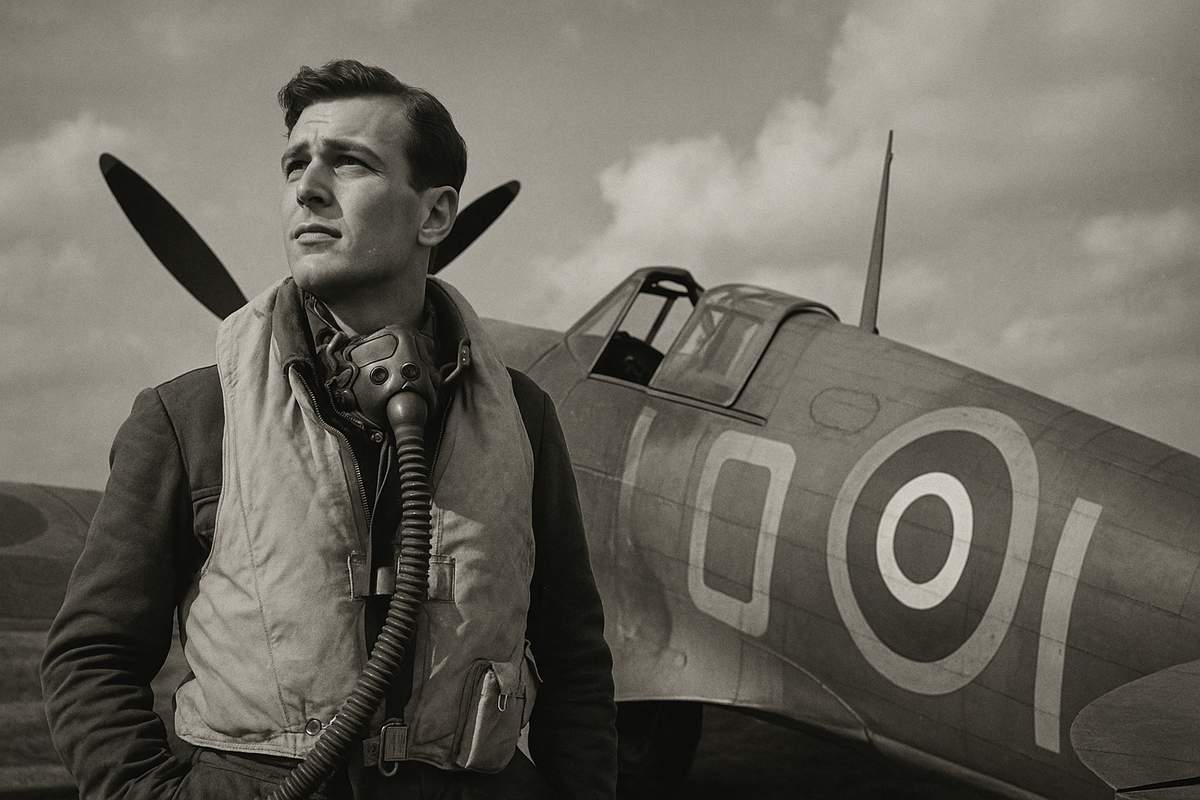
The Last Great Air War
How Esquire Turned 1940 Into a 1969 Prophecy
August 1969. American newsstands displayed the usual lineup—Life, Look, Saturday Evening Post. But one magazine cover stopped browsers cold. Esquire wasn't selling fashion or fiction that month. It was selling memory, rendered as warning.
Inside: "The Last Great Air War (We Hope)."
The parenthetical did the work. Twenty-nine years after the Battle of Britain, with American helicopters burning over Vietnam and Soviet missiles pointed at NATO capitals, Esquire dared to ask whether humanity's last great aerial duel had truly been its last. The feature that followed—tactical diagrams, aircraft recognition charts, side-by-side comparisons of RAF and Luftwaffe pilots—wasn't nostalgia. It was a mirror held up to 1969, reflecting what victory had cost and what another war might demand.
For collectors, this issue represents something rare: a magazine that functions as both historical document and cultural X-ray, capturing two eras in a single artifact.
Summer 1940: When the Sky Became a Frontier
The mechanics of Britain's survival are now legend. France collapsed in June. Hitler's panzers reached the Channel coast. The Luftwaffe, flush with continental victories, launched systematic raids to destroy the Royal Air Force and clear the way for invasion.
What followed was not a battle but a siege fought at 20,000 feet. Young RAF pilots—many still teenagers—scrambled multiple times daily into Spitfires and Hurricanes. They were outnumbered, outgunned, and flying on fumes of courage and Britain's newly operational radar network. The radar stations, strung along the southern coast, gave Fighter Command minutes of warning. Those minutes became the difference between interception and annihilation.
By October, the Luftwaffe had lost. Hitler postponed Operation Sea Lion indefinitely. Churchill delivered his famous tribute: "Never in the field of human conflict was so much owed by so many to so few."
But Esquire in 1969 wasn't interested in repeating Churchill's speech. It was interested in why that speech still mattered.
Archive Details
Publication: Esquire Magazine
Issue Date: August 1969
Feature Title: "The Last Great Air War (We Hope)"
Historical Context: Battle of Britain, July–October 1940
Editor: Harold Hayes
Art Director: George Lois
Design as Historical Argument
Esquire in the late 1960s operated at the peak of American magazine craft. Editor Harold Hayes and art director George Lois had transformed the publication into something between journalism and gallery exhibition. The Battle of Britain feature exemplified this fusion.
Tactical Diagrams
Full-page spreads depicted RAF combat formations—finger-fours, defensive circles, attack vectors—rendered as high-modernist infographics against deep blue backgrounds. These weren't lifted from military manuals; they were reimagined as visual essays.
Aircraft Recognition Charts
"Friendly Machines" (Spitfire, Hurricane) faced "Hostile Machines" (Messerschmitt Bf 109, Heinkel He 111, Junkers Ju 87 Stuka) across double-page layouts. Each aircraft appeared in profile silhouette with performance specifications, armament details, and tactical strengths.
The Pilot Comparison
One spread placed an RAF pilot opposite his Luftwaffe counterpart, gear meticulously itemized—fleece-lined jackets, oxygen masks, compasses, flare pistols. The layout suggested both equivalence and opposition: two young men, different flags, same sky, same mortality.
Photographic Counterpoint
A striking image showed two RAF pilots arm-wrestling in full flight gear, their faces grinning beneath leather helmets. The photograph distilled the entire mythology of the Battle of Britain—competition, camaraderie, defiance—into a single frame.
This wasn't illustration. It was argument through aesthetics. Esquire positioned 1940 as a design problem Britain had solved through technology, courage, and superior systems thinking. The subtext for 1969 readers: Can we?
What the Feature Explained (and Why It Mattered)
Radar as Force Multiplier: The article emphasized Britain's Chain Home radar system, which transformed air defense from reactive scrambling to strategic interception. This wasn't just historical detail—in 1969, radar-guided missiles were reshaping warfare in Vietnam and the Middle East.
The Machines: Detailed specifications celebrated the Spitfire's elliptical wings and the Hurricane's rugged reliability while clinically dissecting the Messerschmitt's superior speed and the Stuka's vulnerability without fighter escort. For a readership watching F-4 Phantoms on nightly news, these comparisons offered historical precedent for aerial supremacy debates.
The Human Cost: Esquire refused to airbrush sacrifice. Many RAF pilots died before their twenty-third birthdays. The magazine's tone acknowledged heroism without romanticizing death—a pitch-perfect editorial choice for readers watching American pilots shot down over Hanoi.
The Subtitle's Payload: "We Hope" transformed the entire feature from commemoration into warning. The Battle of Britain was the last great air war of its kind—propeller-driven, concentrated over one nation, winnable through defense. But in 1969, with supersonic jets and nuclear weapons, the next great air war might not be winnable at all.
Why This Issue Commands Collector Attention
Vintage magazine collectors distinguish between preservation and significance. Plenty of 1969 magazines survive. Few matter.
The August 1969 Esquire matters because it operates on multiple frequencies:
As WWII Documentation
The tactical diagrams and aircraft charts represent some of the most sophisticated Battle of Britain graphics ever published in a mass-market American magazine. Military historians and aviation researchers cite this issue specifically.
As Vietnam-Era Commentary
Reading the feature in context—published during the heaviest American bombing campaigns of the war—reveals Esquire's editorial courage. The magazine wasn't escaping into nostalgia; it was using 1940 to interrogate 1969.
As Design Artifact
The visual layouts showcase Esquire's golden age under Hayes and Lois, when the magazine redefined how American publications could blend text, image, and argument. Graphic design programs still study these spreads.
As Cultural Barometer
The issue captures the precise moment when WWII transitioned from living memory to historical mythology. For readers in 1969, the Battle of Britain was recent enough to feel visceral, distant enough to require explanation. This tension—between memory and history—gives the feature its particular emotional frequency.
The Artifact Today
More than five decades later, the August 1969 Esquire reads like a transmission from a world trying to understand its own relationship to violence, technology, and survival. The Battle of Britain feature succeeds because it refuses simple lessons. Britain won, yes—but at what cost, and with what relevance to a nuclear age?
For collectors of 20th-century media, this issue represents the form at its apex: ambitious, beautiful, intellectually serious, commercially successful. It's a magazine that trusted its readers to think.
For historians, it's evidence of how one generation processed the previous generation's trauma while staring at its own.
For anyone who values design, it's simply exceptional craft.
Collector Significance
Historical Value
Preserves the Battle of Britain story through some of the most ambitious graphics ever published in a mainstream American magazine, serving as a primary source for military historians and aviation researchers.
Cultural Context
Reflects Vietnam War and Cold War anxieties, capturing how one generation remembered another while confronting its own uncertainties about warfare and survival.
Design Excellence
Showcases Esquire's golden age editorial vision, with spreads that continue to be studied in graphic design programs for their innovative integration of text, image, and argument.
Investment Quality
Represents peak 1960s Esquire collectibility—an era when the magazine redefined American journalism and cultural commentary through exceptional craft and editorial courage.
Build Your Archive
If you're searching for original copies of the August 1969 Esquire, you're not just acquiring a magazine—you're preserving an artifact that bridges World War II memory, Vietnam-era anxiety, and the golden age of American magazine design.
Browse Esquire Magazine CollectionThe past doesn't repeat, but it rhymes. The August 1969 Esquire understood this. Its Battle of Britain feature wasn't about 1940 or 1969 exclusively—it was about the stubborn human hope that the last great air war might actually be the last. We're still hoping.