
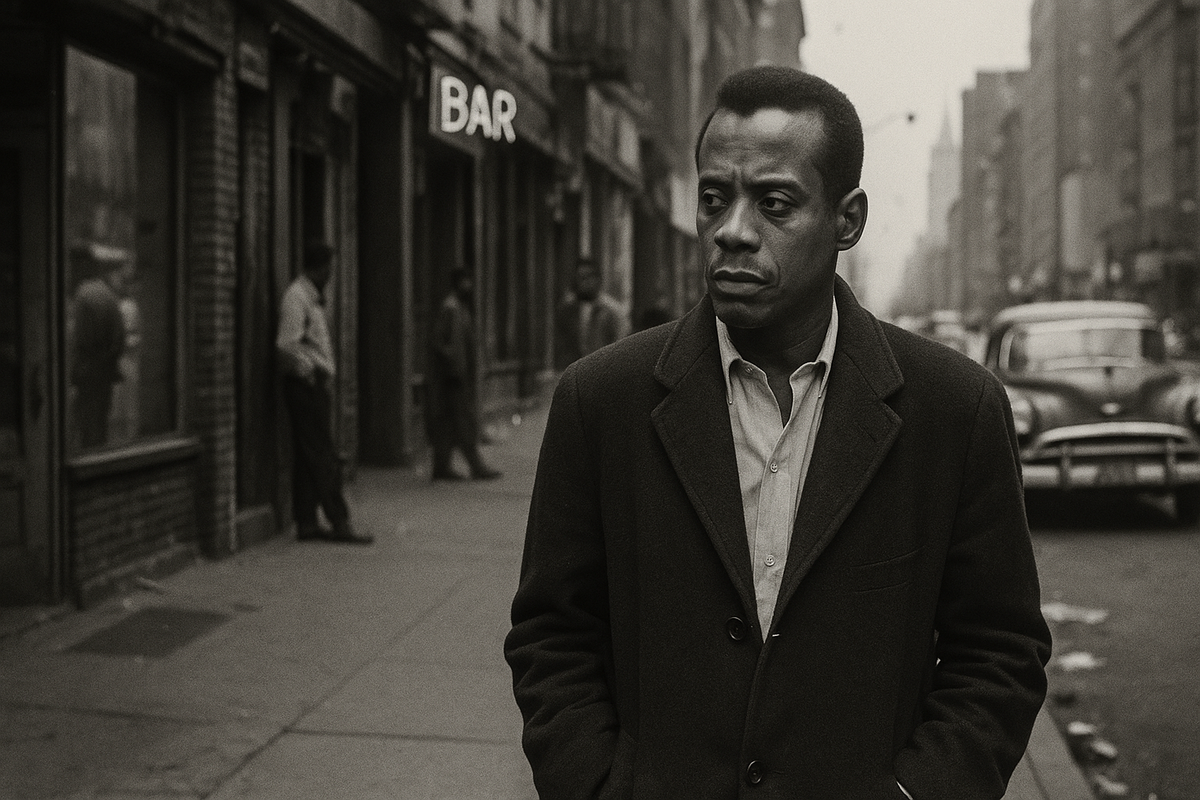
The Essay That Made America Look in the Mirror
James Baldwin's Harlem in Esquire, July 1960
In July 1960, between advertisements for whiskey and Italian loafers, Esquire magazine published an act of moral confrontation.
James Baldwin's "Fifth Avenue, Uptown" wasn't gentle. It didn't coax or persuade. It named what white America preferred not to see: Harlem as the nation's open wound, festering in plain sight. Paired with Saul Leiter's stark street photographs—storefronts, children's faces, a painted warning that read "The unseen eye is watching you"—the essay became one of the most searing documents of American racial reality ever printed in a mainstream magazine.
This wasn't Baldwin the expatriate novelist. This was Baldwin the prophet, writing four years before the Civil Rights Act, five years before Watts burned, at the exact moment when the bill was coming due.
For collectors of vintage magazines, the July 1960 Esquire isn't memorabilia. It's evidence.
Archive Details
Historical Figure: James Baldwin
Essay Title: "Fifth Avenue, Uptown"
Issue Date: Esquire, July 1960
Photographer: Saul Leiter
Archive Source: Original Magazines Collection
The Magazine That Refused to Look Away
Esquire in 1960 occupied a singular position in American publishing. It was sophisticated without being inaccessible, political without being partisan, stylish without being shallow. The magazine's editors understood something their competitors didn't: that the same reader interested in narrow-lapel suits and dry martinis might also want to reckon with the moral architecture of his country.
Publishing Baldwin wasn't a safe choice. In July 1960, lunch-counter sit-ins were spreading across the South. Freedom Riders would soon board buses into violence. Northern liberals preferred to believe racism was a Southern problem, a matter of crude sheriffs and explicit laws. Baldwin's essay demolished that comfort.
"Fifth Avenue, Uptown" positioned Harlem not as a problem to be solved but as an indictment to be answered. Baldwin described housing projects built atop demolished slums, still carrying "the scars of poverty." He catalogued grocery stores with stale goods, parents stretched to breaking, police as symbols of a system designed for control rather than protection. The essay's power lay in its refusal to treat these conditions as accidents. They were choices—America's choices.
The most dangerous line in the piece wasn't a description of material conditions. It was Baldwin's warning about "the silent, accumulating contempt and hatred of a people." He was putting white readers on notice: rage deferred is not rage extinguished.
When Photography Becomes Testimony
Saul Leiter's photographs for the piece functioned as something more than illustration. His images captured the visual grammar of Harlem in 1960—hand-painted signs promising salvation, storefront churches, children who stared directly into the lens without smiling. The photographs didn't exoticize or romanticize. They witnessed.
One image, showing the painted phrase "The unseen eye is watching you" on a Harlem wall, operated as both religious invocation and secular warning. Baldwin's prose and Leiter's lens created a double exposure: Harlem as it existed in physical space, and Harlem as it lived in the American conscience—or failed to.
The layout itself mattered. Esquire's art direction in this era understood that white space, typography, and image placement could amplify meaning. The magazine didn't bury Baldwin's essay in the back pages or soften it with decorative flourishes. It presented the work with the visual gravity it deserved.
What Baldwin Saw Coming
Reading "Fifth Avenue, Uptown" now, with the knowledge of what followed—Harlem's uprising in 1964, Newark and Detroit in 1967, the King assassination riots of 1968—the essay reads like prophecy. But Baldwin wasn't predicting. He was reporting. The rage he described was already present in 1960. White America simply wasn't listening yet.
Consider the essay's treatment of urban renewal. Baldwin described new housing projects as cosmetic improvements that left structural poverty intact—"the same people, in the same situation." This was written before Jane Jacobs published The Death and Life of Great American Cities, before "urban renewal means Negro removal" became a movement slogan. Baldwin had already diagnosed the disease.
His portrait of police in Harlem operated on multiple levels. Individual officers might be decent men. The system they represented was not. This distinction—between personal intent and structural function—would become central to civil rights discourse, but in 1960 it was still radical to state plainly in a magazine read by the professional class.
The essay also recognized something often missed in romantic accounts of the Civil Rights Movement: the North's complicity. Harlem's suffering wasn't caused by Bull Connor or George Wallace. It was caused by New York landlords, New York banks, New York politicians, and the silent consent of Northern liberals who believed their distance from Southern violence absolved them.
Core Themes in Baldwin's Vision
Harlem as Mirror
Baldwin positioned the neighborhood not as an isolated problem but as a reflection of America's racial and moral failures—a judgment on the nation itself.
The Illusion of Progress
Urban renewal projects replaced one form of neglect with another, leaving residents with cosmetic changes but no real improvement in their material conditions.
Accumulated Contempt
The essay's most prescient warning: the "silent, accumulating contempt and hatred of a people" represented one of the most dangerous forces in American society.
Northern Complicity
Baldwin shattered the comforting myth that racism was a Southern problem, exposing how Northern neglect and economic segregation perpetuated injustice.
Structural vs. Individual
The essay distinguished between personal intent and systemic function—police as individuals versus policing as an instrument of control.
Prophetic Witness
Written before the major urban uprisings of the mid-1960s, Baldwin's essay documented rage already present but not yet acknowledged by white America.
Why This Issue Endures
The July 1960 Esquire represents multiple converging streams of cultural significance.
Baldwin at a pivot point. This essay appeared after Giovanni's Room and Notes of a Native Son but before The Fire Next Time—the 1963 masterwork that would make him one of the most important intellectuals in America. "Fifth Avenue, Uptown" captures Baldwin in the act of becoming the voice of moral reckoning he would represent throughout the decade.
Leiter as documentarian. Though Saul Leiter is now celebrated primarily for his pioneering color photography, his black-and-white street work from this period stands as essential documentation of mid-century urban life. Original prints from this Esquire spread have become museum pieces. Owning the magazine means owning the first publication of these images in context.
Esquire's editorial vision. The magazine in 1960 was edited by people who understood that American masculinity needed to be more than consumption and conquest. That sophistication required engagement with difficult truths. That style and substance weren't opposites. Few publications have ever balanced those elements as successfully.
A primary source. This isn't a retrospective or a reprint. It's the original artifact—the magazine that carried Baldwin's words into barbershops and brownstones, into academic offices and advertising agencies. The readers who opened this issue in July 1960 were encountering these ideas in real time, without the softening distance of history.
The Collector's Perspective
Literary Significance
A landmark essay by one of America's greatest writers, published at a crucial historical moment in his career and in the Civil Rights Movement.
Photographic Heritage
Saul Leiter's images have been anthologized and exhibited independently. This magazine contains their first publication in full context.
Design Excellence
Mid-century Esquire at its creative peak—art direction, typography, and layout that understood how visual presentation amplifies meaning.
Historical Artifact
Not a reprint or digital scan, but the original object that carried these ideas into American homes—paper stock, advertisements, and all.
Holding History
In an era when most reading is digital, when algorithms curate our information and articles vanish behind broken links, physical magazines from the mid-20th century offer something increasingly rare: permanence.
These weren't disposable media. Readers kept them. Libraries bound them. Collectors preserved them. The issues that survive carry the thumbprints and coffee rings of their original audiences. They're not reproductions of history—they are history, in the most literal sense.
For collectors focused on African American history, civil rights documentation, or literary journalism, this issue belongs in any serious collection. For those interested in photography or magazine design, it's equally essential. And for anyone who wants to understand how public discourse around race functioned—or failed to function—in 1960, it's a primary source without substitute.
Why It Still Matters
James Baldwin's "Fifth Avenue, Uptown" wasn't written for posterity. It was written for July 1960, for readers who needed to hear what they were avoiding. That it remains urgent sixty-five years later says something uncomfortable about American progress.
The essay's value isn't merely historical. Baldwin's analysis of how structural inequality operates, how contempt accumulates, how systems perpetuate themselves while appearing to reform—these observations apply to every subsequent generation's confrontation with racial injustice. The details change. The mechanisms persist.
For collectors, the July 1960 Esquire is more than a back issue. It's a landmark—a point where American literature, journalism, photography, and political consciousness intersected with unusual power. It represents what magazines could be when edited by people who believed readers were capable of confronting difficult truths.
Owning this issue means preserving one of the moments when American media rose to meet the demands of its historical moment. Not perfectly. Not without the contradictions of publishing Baldwin's radical critique alongside advertisements for the lifestyle his essay indicted. But honestly enough that the work still cuts six decades later.
That's the mark of essential journalism. It doesn't age. It accumulates evidence.
Explore the Original Archive
The July 1960 Esquire is available in our collection alongside other issues that documented America's transformation from the 1930s through the 1970s. Each magazine is an original, not a reprint or facsimile.
Browse Esquire Magazine Collection