
Fighting to Save the Earth from Man
The Time Magazine Issue That Launched a Movement
On February 2, 1970, American newsstands displayed an image that stopped passersby cold: the Statue of Liberty rising behind a barge heaped with garbage, framed against the murk of New York Harbor. This wasn't wartime propaganda or political satire. It was the cover of Time Magazine—and it marked the moment environmentalism stopped being a fringe concern and became a national reckoning.
Inside those pages, readers found something unprecedented: a major American weekly treating ecological collapse not as a future possibility, but as a present emergency. The issue didn't ask if industrial civilization was poisoning the planet. It documented how—and demanded to know what Americans intended to do about it.
More than fifty years later, this single issue remains one of the most historically significant environmental publications ever printed. Here's why it still matters.
The Perfect Storm: America in Winter 1970
The timing was combustible.
Eight months earlier, the Cuyahoga River in Cleveland had ignited—oil slicks and chemical waste catching fire in a spectacle so absurd it made international headlines. Lake Erie was declared biologically dead. Los Angeles choked under smog so thick that children were kept indoors on bad air days. DDT, the miracle pesticide, was turning up in human breast milk and threatening to wipe out America's national bird.
But pollution was only half the crisis. Demographers were sounding alarms about exponential population growth. Time warned readers that global population could double by 2040, straining food supplies and natural resources to the breaking point. The Malthusian nightmare—once dismissed as Victorian hysteria—suddenly looked prophetic.
Into this atmosphere stepped scientists like Barry Commoner and Paul Ehrlich, whose warnings carried the weight of peer-reviewed dread. President Nixon, sensing the political winds, had established the Environmental Quality Council. Proposals for a new federal agency—the Environmental Protection Agency—were circulating through Washington.
The environmental movement was no longer college kids planting trees. It was entering the machinery of government.
Time understood the moment. And it seized it.
Issue Details
Publication Date: February 2, 1970
Cover Story: "Fighting to Save the Earth from Man"
Key Figure Profiled: Barry Commoner, "Paul Revere of Ecology"
Historical Context: Published 10 weeks before the first Earth Day (April 22, 1970)
Archive Source: Original Time Magazine Collection
How Time Made Ecology Unmissable
By 1970, Time Magazine had perfected the art of translating complexity into cultural urgency. The weekly had made millions of Americans care about foreign wars, space exploration, and civil rights through vivid photography and authoritative prose. Now it turned those tools toward ecology.
The magazine's visual arsenal was devastating:
The cover showed that garbage barge and Lady Liberty—a juxtaposition so stark it required no caption. Freedom and filth, progress and poison, sharing the same frame.
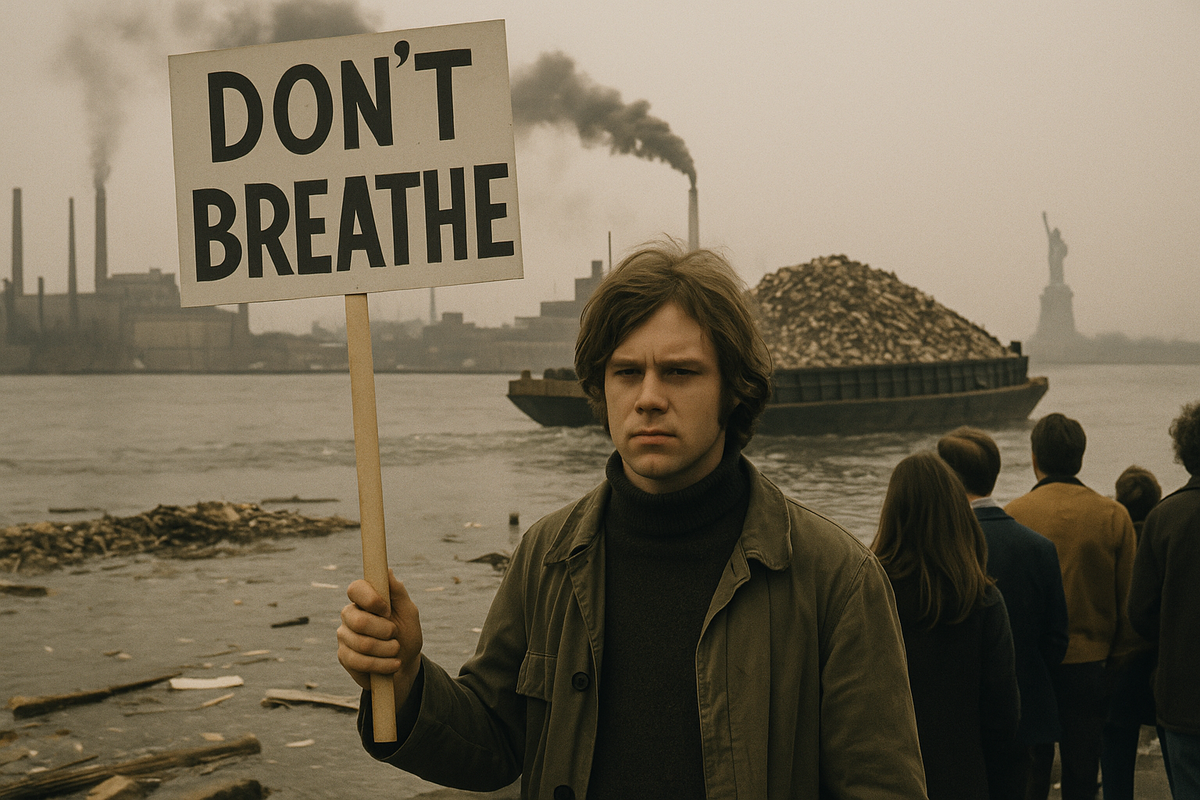
Inside: A protester in Manhattan holding a sign reading "Don't Breathe"—three words that indicted an entire industrial system.
Infographics broke down the biosphere for lay readers, illustrating how human life depended on razor-thin layers of atmosphere, topsoil, and clean water.
Photo essays documented car exhaust, pesticide clouds, and mountains of garbage with forensic clarity.
This wasn't abstract science. Time made environmental destruction personal—the air readers breathed, the water their children drank, the future being foreclosed in real time.
The Voice of Prophetic Journalism
The editorial content matched the visual punch. Time's writers combined hard data with moral urgency, delivering reportage that read like a dispatch from a civilization at a crossroads.
The profile "Paul Revere of Ecology" elevated microbiologist Barry Commoner to the status of national alarm-sounder. Commoner's central thesis was unsparing: unchecked industrial growth was driving humanity toward systemic ecological collapse. His warnings combined scientific rigor with an almost biblical sense of consequence.
Another section, "The Biosphere," gave millions of readers their first clear explanation of Earth as a closed system—a fragile vessel hurtling through space with no backup supply of air, water, or soil. For a generation raised on narratives of endless expansion, this reframing was profound.
Time's editorial stance was unambiguous: environmental destruction had graduated from a niche concern to one of the defining moral and political questions of the modern age. The magazine was no longer merely reporting the news. It was attempting to shape the national conscience.
What Made This Issue Explosive
The February 2, 1970 issue succeeded because it assembled a comprehensive indictment:
Industrial Pollution as Public Health Crisis
The reporting cataloged how American factories dumped millions of tons of waste into rivers, skies, and soil annually, poisoning ecosystems from Lake Erie to the Pacific Coast.
The Population Time Bomb
Red-ink graphs projected population doubling, then doubling again, fueling apocalyptic visions of mass famine and resource wars.
Commoner's Ultimatum
The scientist's message was stark: curb America's appetite for energy, chemicals, and disposable waste, or watch ecological systems fail.
Grassroots Uprising
Photos captured a new generation of activists—on college campuses and city streets—demanding breathable air and drinkable water as basic rights.
The Bill Comes Due
In a section titled "How Great the Cost? Who Will Pay?" Time acknowledged that environmental cleanup would cost billions. But the alternative, it argued, was societal collapse.
Together, these elements created a narrative that was equal parts terrifying and galvanizing. The Earth could be saved—but only through immediate, wrenching change.
Why Physical Magazines Still Matter
Digital archives preserve information. Vintage magazines preserve experience.
These artifacts capture not just events, but the texture of public discourse—the advertisements that funded the journalism, the typefaces that signaled authority, the editorial choices about what deserved a cover and what merited a single column. They document the mood of an era in ways pixels cannot replicate.
The February 2, 1970 issue endures because it proves that today's environmental debates—climate change, overpopulation, pollution—are not new anxieties. They are amplified echoes of warnings sounded more than half a century ago, delivered with the same urgency, the same fear, the same fragile hope.
Why This Issue Commands Collector Attention
Historical Convergence
Published ten weeks before the first Earth Day (April 22, 1970), the issue captures the precise instant when environmental consciousness shifted from margins to mainstream.
Iconic Visual Legacy
That garbage barge cover remains one of Time's most reproduced and referenced images—a visual shorthand for an entire era of awakening.
Cultural Watershed
The issue reframed ecology from academic specialty to civilizational imperative, influencing the legislation, protests, and cultural shifts that followed.
Market Dynamics
As educational institutions and museums build environmental history collections, demand for pristine copies has intensified. High-grade examples command premium prices.
To hold this issue is to hold the first draft of modern environmental politics—the same pages that helped inspire the Clean Air Act, the Clean Water Act, and the EPA itself.
Explore the Archive
Thousands of original Time issues spanning the 1930s through the 1970s are available in our collection, documenting decades of politics, culture, science, and social upheaval as they unfolded in real time.
Whether you're a collector building a cultural archive, a historian sourcing primary materials, or someone preserving family memory, these magazines offer something digital formats cannot: tangible connection to the moments that shaped the modern world.
Browse Time Magazine CollectionFinal Word
The February 2, 1970 Time Magazine stands as one of the most consequential environmental publications of the twentieth century. Its fusion of rigorous reporting, striking photography, and moral urgency delivered both science and wake-up call to millions of readers at a decisive moment.
To hold this issue today is to witness the birth of a movement—to see environmentalism crystallizing from scattered concern into national consciousness. Thanks to Time's unmatched editorial authority, those warnings remain preserved, ready to speak across generations.
For anyone who values history as lived document rather than distant abstraction, magazines like this are not old paper. They are time capsules. They are evidence. They are voices from the past that refuse to stay silent.