
If Russia Grabs Europe
The Saturday Evening Post Article That Made America Face the Cold War
The father sleeps. Two children tiptoe past him, mischief in their eyes, sneaking toward some Christmas secret. It's December 20, 1947, and Jack Welch's cover illustration for The Saturday Evening Post radiates the warm glow of American domestic life.
Turn the page.
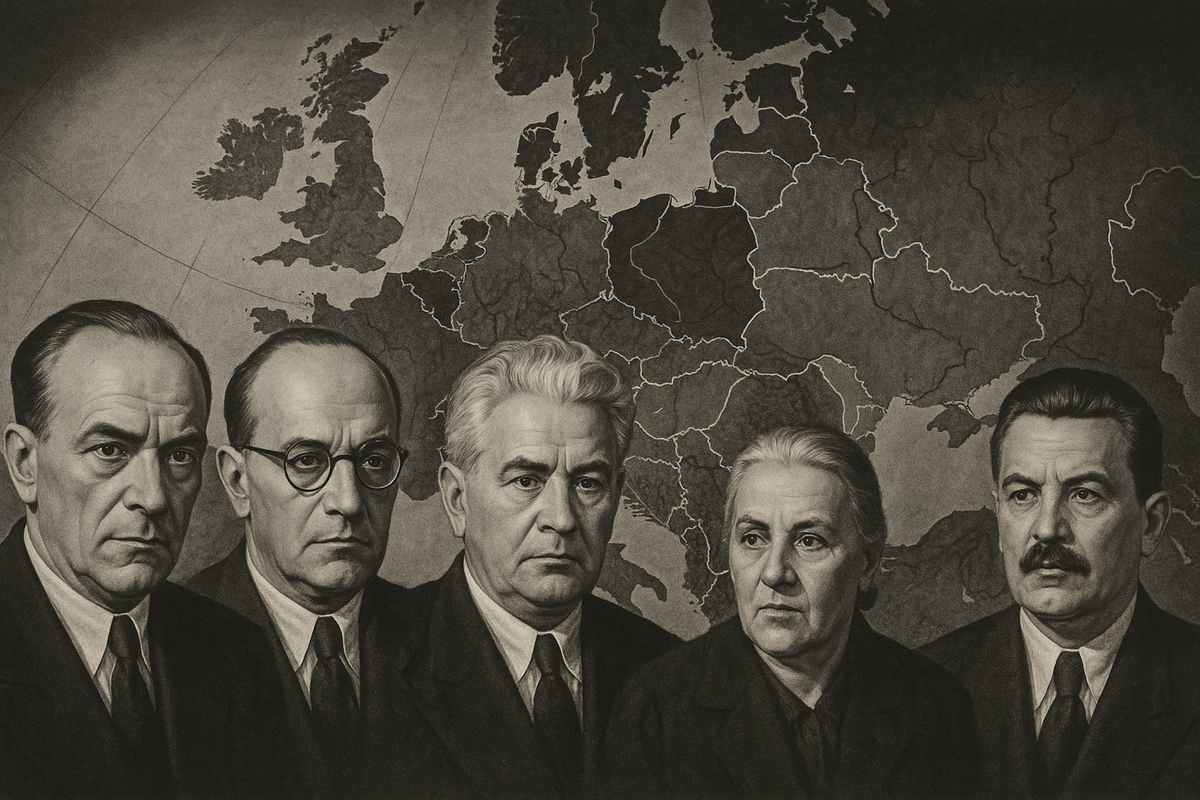
There, staring back at you, are the faces of the men and women who might destroy that world: Palmiro Togliatti. Maurice Thorez. Anna Pauker. Georgi Dimitrov. Wilhelm Pieck. Communist leaders whose names most Americans had never heard, but whose ambitions—if realized—could turn the lights out across an entire continent.
Between that innocent cover and those portraits lay one of the most consequential essays of the early Cold War: Joseph and Stewart Alsop's "If Russia Grabs Europe—," a piece of journalism so urgent, so meticulously argued, that it forced millions of American families to confront a question they desperately wanted to ignore: What happens if we lose Europe?
The World on the Edge
Two years after V-E Day, the dream of postwar peace had already curdled. Poland, Hungary, Romania, Bulgaria—swallowed whole by Moscow. France and Italy teetered, their communist parties swelling with support, their economies shattered, their futures uncertain.
President Truman had announced his doctrine. George Marshall had unveiled his plan. But doctrine and aid packages were abstractions. The Alsops made it concrete.
What if France falls? What if Italy goes red? What if the Iron Curtain doesn't stop at the Elbe, but crashes down across the entire continent?
The brothers laid out the scenario with clinical precision. Not propaganda. Not hysteria. Strategic analysis wrapped in prose sharp enough to cut through the Christmas cheer and lodge itself in the American consciousness.
Historical Context
Authors: Joseph and Stewart Alsop
Publication: The Saturday Evening Post, December 20, 1947
Article: "If Russia Grabs Europe—"
Historical Moment: Same year as Truman Doctrine and Marshall Plan announcement
Faces of the Threat
The Saturday Evening Post didn't just tell readers about the communist menace—it showed them. The portraits of Togliatti, Thorez, Pauker, Dimitrov, and Pieck weren't mere illustration. They were intelligence briefings disguised as magazine photography, transforming distant political figures into faces you'd recognize at the grocery store.
Palmiro Togliatti: the Italian strategist waiting in the wings. Maurice Thorez: France's communist kingpin. Anna Pauker: Romania's iron-willed foreign minister. These weren't cartoon villains. They were real leaders with real power, and the Alsops wanted Americans to know their names before it was too late.
This was journalism borrowing from wartime propaganda techniques—personalizing the enemy, making the abstract threat visceral. Life magazine had done it with battlefield photography. The Post did it with portraits and geopolitical gaming.
The Domino Logic
The Alsops' argument moved like a chess match. If France and Italy fell, Britain would stand isolated. If Britain faltered, the North Atlantic and Mediterranean would become Soviet lakes. Control the Mediterranean, and you threaten North Africa. Control North Africa, and suddenly the Belgian Congo—with its uranium, copper, and strategic minerals—falls within reach.
Every paragraph tightened the noose. The atomic bomb? Useful, but not decisive. Economic isolation? America couldn't sustain prosperity alone. A long war? Unthinkable, but increasingly likely if the U.S. refused to act.
The Alsops didn't predict World War III. They predicted something worse: a slow strangulation of Western power, a creeping surrender of influence, until America woke up to find itself the last democracy in a hostile world.
Strategic Geography
Control of the North Atlantic, Mediterranean basin, and North Africa framed as critical to Western survival.
The Belgian Congo's Resources
The Congo's mineral wealth—uranium, copper—positioned as a strategic prize that could shift global power.
The Role of England
Britain seen as the linchpin of Western Europe's survival, but vulnerable if left isolated.
The American Dilemma
Should the U.S. stand back, or commit fully? The article insisted there was no middle ground.
The Post as Political Arena
By 1947, The Saturday Evening Post reached more American homes than almost any publication in the country. Its formula—serial fiction, humor pieces, Norman Rockwell covers, and hard-hitting journalism—made it the national coffee table. You didn't have to seek out geopolitical analysis. It came to you, sandwiched between Christmas stories and sports features.
This accessibility gave the Alsop piece devastating reach. Millions of readers who might never pick up Foreign Affairs or attend a town hall meeting absorbed this argument in their living rooms, in barbershops, in waiting rooms. The essay shaped public opinion not by reaching elites, but by reaching everyone.
The contrast between Welch's cozy cover and the stark warnings inside created its own kind of argument: your domestic security depends on global vigilance. The children sneaking past their sleeping father could only do so in a world where vigilant men stood guard against Stalin's ambitions.
What It Demanded
The Alsops concluded with a challenge Americans had spent 150 years avoiding: full engagement with the world's fate. No more isolation. No more half measures. Either commit to defending Europe with money, arms, and political will—or accept the consequences of Soviet domination.
It was a call to empire, though they'd never use that word. A call to permanent involvement in European affairs. A call to shoulder burdens previous generations had refused.
And America answered. The Marshall Plan poured billions into reconstruction. NATO formalized the commitment. The Cold War architecture that would define the next four decades began taking shape—motivated in no small part by articles like this one, which made the stakes impossible to ignore.
Why Collectors Covet This Issue
Historical Precision
Published the same year as the Truman Doctrine and Marshall Plan, it captures the exact moment when American isolationism died and Cold War engagement was born. The Alsop essay is primary-source material on how the Cold War was sold to the American public.
Cultural Contrast
That gap between the domestic cover and geopolitical content inside? That's the entire postwar American experience in one magazine. The juxtaposition of cozy domesticity and global threat defines the era.
Rarity With Reach
Unlike classified documents or academic journals, The Post was mass-market—which means these issues shaped millions of minds, yet surviving copies grow scarcer each year.
Complete Context
You get the ads, the other stories, the design aesthetic—the full cultural moment, not just the headline piece. This isn't just memorabilia. It's evidence of how fear was packaged and how arguments were constructed.
The Archive Endures
In an era of infinite scroll and algorithmic feeds, these printed magazines offer something we've nearly lost: the weight of deliberation. Readers in 1947 couldn't swipe past the Alsop article. They had to sit with it, turn its pages, discuss it over dinner. Ideas sank in slowly, permanently.
Every issue of The Saturday Evening Post from this period is a time capsule of that slower, deeper engagement—when journalism shaped opinion through sustained argument rather than viral snippets.
Add This Artifact to Your Collection
Original issues of The Saturday Evening Post from the 1930s through the 1970s remain available to collectors, historians, and anyone who wants to hold the actual pages that American families read as the modern world took shape.
Browse The Saturday Evening Post Magazine CollectionWhether you're building a Cold War archive, researching media history, or honoring family members who lived through these years, these magazines offer something digital scans never can: the texture of history, the smell of aged newsprint, the heft of ideas that changed the world.
The Article That Wouldn't Let Go
"If Russia Grabs Europe—" remains one of the clearest expressions of early Cold War anxiety ever published in a mainstream American magazine. The Alsops understood what many wanted to deny: that victory in 1945 had merely set the stage for a longer, stranger conflict.
The issue itself—with its cheerful cover and ominous contents—perfectly captured the split consciousness of postwar America. Life goes on. Children sneak. Fathers sleep. But underneath that normalcy, the world had changed forever.
When you hold the December 20, 1947 issue today, you're holding the moment when Americans stopped believing the war was over and started preparing for the long twilight struggle ahead. Thanks to The Saturday Evening Post's extraordinary reach, that preparation happened not in government offices or university seminars, but in millions of American homes—exactly where the Alsop brothers knew it had to begin.