
The First Breath of the Baby Boom
Inside the March 1950 Ladies' Home Journal That Photographed Parenthood
When Joan Miller's newborn daughter drew her first breath in a Chicago delivery room, a photographer stood ready. Not for a family album—for the front pages of Ladies' Home Journal, where millions of American mothers would watch Dana Miller grow up, one month at a time.
The March 1950 issue didn't just report on parenthood. It documented it with surgical precision and unexpected intimacy, launching "Baby's First Year," a twelve-month visual chronicle that would become one of the most ambitious experiments in participatory journalism the magazine ever attempted. Photographer Wayne Miller turned his own family into a case study. His wife Joan became America's everymother. And their daughter Dana—born weighing just enough to avoid complications, spending her first three days in an incubator—became the nation's baby.
This wasn't advice. It was proof of concept. And in postwar America, desperate for blueprints on how to raise the largest generation in history, proof mattered more than poetry.
Archive Details
Publication: Ladies' Home Journal
Issue Date: March 1950
Feature Series: "Baby's First Year" (12-month installment series)
Photographer: Wayne Miller
Subject: Dana Miller (newborn daughter of Wayne and Joan Miller)
Historical Context: Peak of the postwar baby boom; rise of hospital births (85% of deliveries)
The Science of Sentiment
The timing was deliberate. By March 1950, the baby boom had shifted from phenomenon to national project. Hospital births had climbed to 85% of all deliveries—a staggering increase from the home-birth culture of just one generation prior. The cost, carefully noted for budget-conscious young families, ran $250 to $350. Average gestation: 280 days. Average weight: 8 pounds. Average length: 18 to 21 inches.
Ladies' Home Journal understood something radical: modern mothers wanted both the warmth of traditional maternal wisdom and the authority of medical science. They wanted to feel competent, not just instinctual. So the magazine gave them numbers alongside narratives, statistics wrapped in the soft focus of a nursery window.
Wayne Miller's photographs did the heavy lifting. His images of Dana's first cry weren't sentimental—they were documentary. Masked doctors. Clinical lighting. The startling, almost violent moment when lungs inflate and a human being announces herself to the world. The caption explained the physiology: "The first cry establishes breathing, inflates lungs, and signals life outside the womb." This was childbirth as biological event, rendered with the same seriousness Life magazine had brought to the war effort just five years earlier.
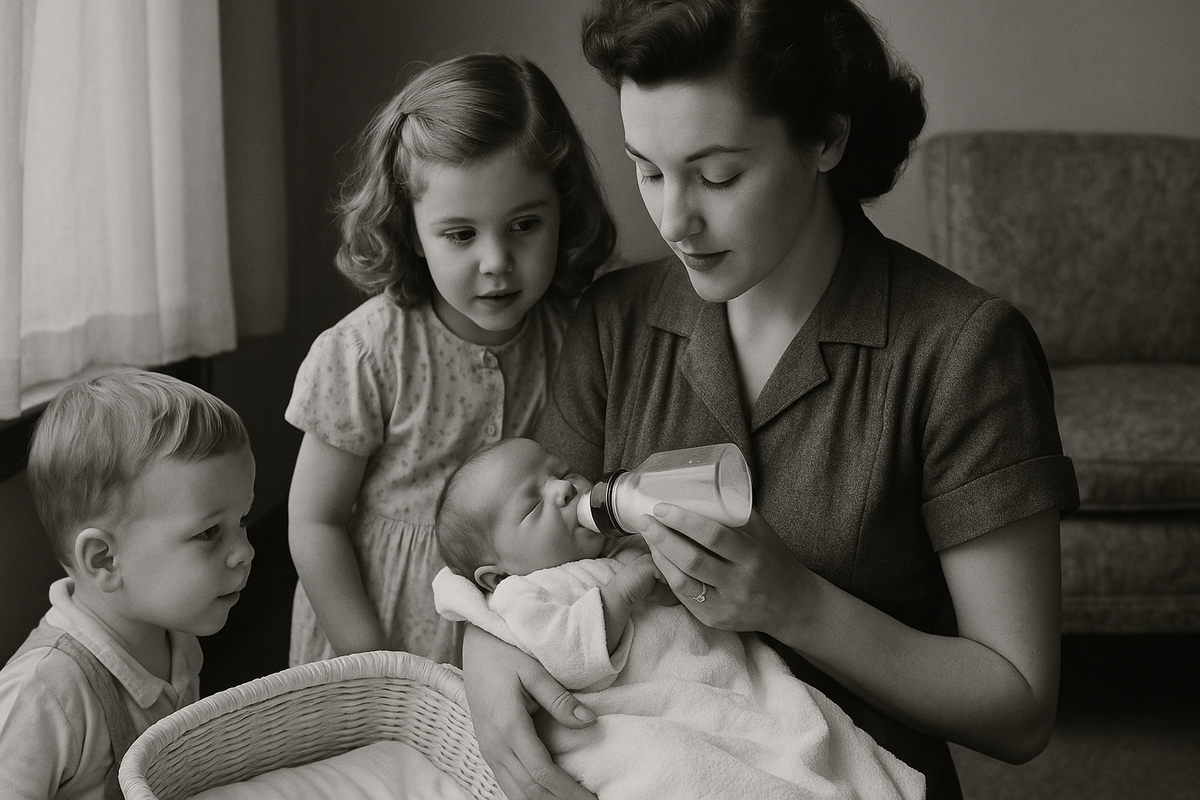
But Miller knew when to soften. A few pages later, Joan cradles Dana by a window, backlit and Madonna-like. Three-year-old Jeanette and eighteen-month-old David peer into the crib with the fascinated gravity of children meeting their future. These weren't posed tableaux. They were scenes from the aspirational everyday—the life young families wanted to believe they could have.
The Mother as Modern Subject
What made "Baby's First Year" revolutionary wasn't the baby. It was the mother.
Joan Miller appeared throughout the series not as a model but as a protagonist. She breastfed on camera—described by the editors as "the ideal food: always sterile, always the right temperature"—at a time when formula companies were beginning their aggressive push into American households. She recovered from childbirth under medical supervision, encouraged to be out of bed by the third day to "regain circulation," a progressive approach to early ambulation that contradicted older practices of extended bed rest.
The magazine walked a tightrope. Joan was presented as both scientifically informed and emotionally attuned, capable of understanding feeding schedules and developmental milestones while maintaining the soft domestic grace Ladies' Home Journal built its brand on. She was the postwar ideal: educated enough to follow doctor's orders, traditional enough to find fulfillment in motherhood, modern enough to trust hospitals over midwives.
The article never mentioned Joan's own ambitions, education, or life before children. She existed, as far as readers knew, entirely in relation to Dana. This wasn't cruelty—it was the cultural contract of 1950. Fathers were providers. Mothers were guardians. And babies were projects to be managed with the same efficiency that had won the war.
Key Insights from the Archive
Documentary Innovation
Miller's photographs merged clinical documentation with intimate family portraiture, creating a new genre of participatory journalism that invited readers into private moments with scientific framing.
Medical Authority
The article legitimized hospital births and modern pediatric practices by presenting them as both scientifically superior and emotionally reassuring—a dual appeal that shaped postwar parenting culture.
Serialized Engagement
By structuring the feature as a twelve-month series, the Journal transformed readers into invested participants who followed Dana's development as they would a beloved character in a novel.
Gender Role Reinforcement
Joan Miller's portrayal as scientifically competent yet domestically centered codified the "modern mother" ideal that would dominate the 1950s—educated but home-bound, capable but deferential.
The Archive Lives On
The Ladies' Home Journal didn't invent the advice column or the photo essay. But in March 1950, it perfected the fusion of both, creating a serialized narrative that treated one baby's life as a story worth following month after month, as addictive as any radio drama.
Today, we scroll through parenting blogs and Instagram feeds documenting every milestone, every struggle, every minor triumph of early childhood. We think this is new. It isn't. The medium has changed. The hunger for reassurance—for proof that we're doing it right, that our experience is normal, that someone else survived this and so will we—remains exactly the same.
The March 1950 issue doesn't just document Dana Miller's first breath. It documents ours: the moment American parenthood became performance, record, and shared ritual all at once.
Why Collectors Covet This Issue
Historical Milestone
Marks the launch of one of the magazine's most successful serialized features, a format that kept readers subscribed and emotionally invested for an entire year.
Photographic Legacy
Wayne Miller's images remain striking examples of documentary work applied to domestic life—a genre that would later influence everything from Life's "Country Doctor" to the intimate family photography of Sally Mann.
Cultural Documentation
A primary source for understanding American culture at a hinge point—the exact moment when parenting became something you could study, measure, and get right.
Women's History Artifact
Documents postwar gender roles, medical practices, and domestic ideals with unusual specificity. For researchers of visual culture and family studies, it's evidence of how motherhood was constructed and sold.
Explore the Full Archive
Discover decades of original Ladies' Home Journal issues—spanning suffrage, domesticity, fashion, and the rise of second-wave feminism. Whether you're preserving family history, researching postwar culture, or collecting the artifacts that shaped American womanhood, these magazines offer something rare: a monthly record of how women lived, what they were told to want, and what they quietly resisted.
Browse Ladies' Home Journal Magazine Collection