
The Magazine That Told Women They Could Be Everything
Inside Vogue's Revolutionary August 1970 Issue
Open the August 15, 1970 issue of Vogue and you won't find answers. You'll find a dare.
"Confused?" the magazine demanded in stark typography across its pages. Then, without apology: "Don't Be."
What followed was not a fashion spread. It was a manifesto in monochrome—a visual argument that women no longer needed permission to choose their own identities. Peasant dirndls faced off against power suits. Folkloric romance collided with boardroom authority. And somewhere in that collision, the 1970s began.
This wasn't confusion. It was liberation dressed in suede.
Archive Details
Publication: Vogue Magazine
Issue Date: August 15, 1970
Featured Editorial: "Confused? This Is the Look"
Key Designers: Oscar de la Renta, Phillip Sills, Herbert Levine
Photography: Black-and-white editorial format
When Fashion Stopped Dictating and Started Negotiating
By August 1970, the rulebook had been thrown out. The late 1960s had dismantled cultural certainties, and fashion was scrambling to keep pace. The counterculture had romanticized peasant blouses and embroidered dirndls. The women's liberation movement had put women in pantsuits and sent them into offices where they demanded equality, not ornament. Vietnam, civil rights struggles, and economic anxiety cast long shadows over what people wore and why.
Vogue's response was radical in its pragmatism: all of it could be right.
The "Confused? This Is the Look" editorial didn't resolve the tension between these identities. It weaponized it. Across multiple spreads, bold declarations hit like commands:
"This is the suit: it's big news this year."
"This is the coat: it swings over everything."
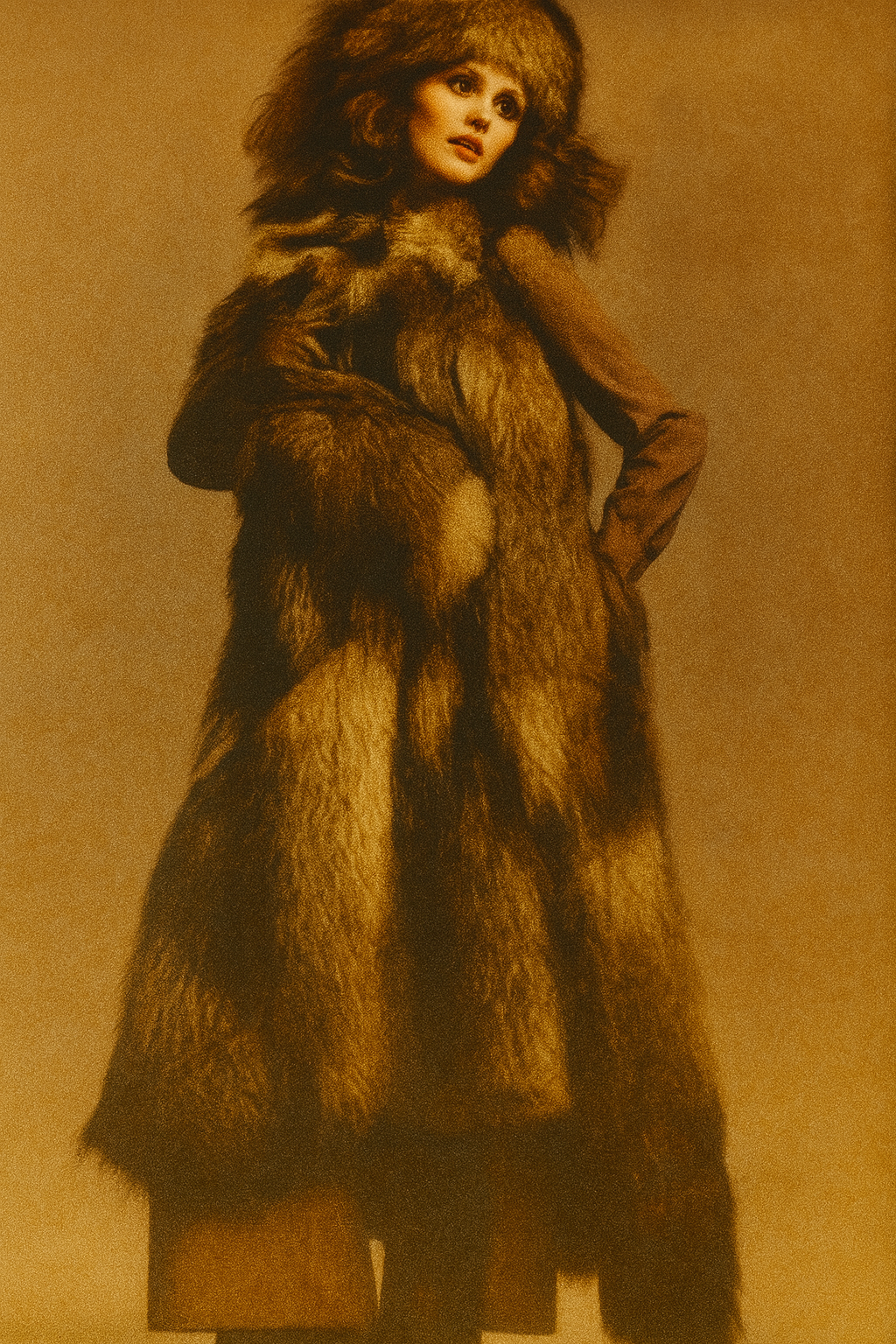
Each proclamation arrived with photographic evidence—models in wide-brim hats, suede suits from Phillip Sills, Oscar de la Renta's exotic monkey coats, knee-high boots by Herbert Levine. The editorial structure itself became an argument: peasant dress versus skirt-and-top. Evening pants versus daytime pants. Suit versus coat. The reader wasn't being told what to wear. She was being handed a menu of selves.
The Architecture of Choice
Shot in unforgiving black-and-white, the photography stripped away distraction. No psychedelic color, no late-sixties whimsy—just silhouettes, textures, movement. The swing of a coat. The drape of a dirndl. The gleam of leather. Every look anchored by boots, the essential footwear of 1970's new terrain.
The monochrome treatment wasn't aesthetic accident. It was editorial strategy. By removing color, Vogue elevated form. The clothes became ideas. And ideas, in 1970, were what women needed most.
But Vogue never let fantasy float too far from reality. The captions grounded every look in American retail: Lord & Taylor, Saks Fifth Avenue, Bonwit Teller, Bendel's, Neiman-Marcus, Jacobson's, I. Magnin. This wasn't Paris couture observed from a distance. This was fashion you could walk into a department store and buy. Aspiration made accessible.
What the Issue Actually Offered
The August 1970 editorial presented fashion as a Choose Your Own Adventure:
Channeled counterculture romance—folkloric, patterned, paired with boots and headscarves.
Practical skirt-and-top combinations positioned as the modern woman's uniform.
Shattered tradition by declaring trousers glamorous enough for nighttime.
Wide-legged, worn with coats and capes—promised freedom and ease.
Earned its "big news" designation as power dressing entered the vocabulary.
Became movement itself: "the coat that swings over everything."
Grounded it all—the foundation of every outfit, the footwear of forward motion.
"Oh, to be in autumn now that furs are here." Russian-inspired luxury pieces and Oscar de la Renta's statement-making monkey coats.
Together, these elements created something unprecedented: a portrait of fashion not as singular trend but as multiplicity. Women didn't have to choose between romance and authority, between comfort and drama. They could be all of it, depending on the day, the mood, the meeting.
Why This Issue Still Matters
The August 15, 1970 Vogue captured a hinge moment in American culture. Fashion was moving beyond 1960s mod into the eclectic layering that would define the decade ahead. But more than documenting transition, this issue enacted it. The "Confused? Don't Be" feature remains one of the era's most sophisticated examples of fashion journalism—typography, photography, and cultural commentary fused into a single argument about identity.
Collector Significance
Marks the exact start of the decade, when fashion was still finding its 1970s vocabulary.
The feature's bold typography and structural oppositions set a new standard for fashion storytelling.
Oscar de la Renta, Phillip Sills, Herbert Levine—the names that shaped the era, preserved in context.
The editorial's central tension mirrored the contradictions women were navigating in real time.
These magazines were never meant to last. Surviving copies in good condition are genuine artifacts.
The Endurance of Print
Vintage Vogue magazines function as time capsules in ways digital archives cannot replicate. The August 1970 issue resonates today because its themes never expired: fashion as choice rather than diktat, the balance between function and desire, the way clothing reflects cultural upheaval.
The magazine preserved everything—the ads, the typography, the grain of the photography, the cultural assumptions embedded in every caption. Unlike digital media that updates, migrates, or vanishes, original magazines endure as fixed historical objects. They don't just document the past. They are the past, held in your hands.
Explore More Fashion History
If the cultural and design history documented in the August 1970 Vogue speaks to you, our collection holds decades of similar treasures. Each issue captures not just style but the desires, anxieties, and identities of its moment.
Browse Vogue Magazine CollectionFrom the 1920s through the 1990s, each decade offers direct access to how people saw themselves and what they believed was possible.
The August 15, 1970 issue of Vogue told women they didn't need to resolve their contradictions. They could wear them. Peasant dresses and power suits. Romance and authority. Folklore and the future. In a culture demanding that women choose sides, Vogue handed them options instead.
For collectors today, this issue remains what it was in 1970: proof that fashion has always been about more than clothes. It's about the freedom to define yourself, one choice at a time.