
The Last Magazine Before the Crash
When Electronic Games profiled a military helicopter simulator and nobody saw the apocalypse coming
February 1983. Arcades are printing money. The Atari 2600 sits under every television in America. And on newsstands, Electronic Games Magazine publishes an issue that will become one of the most peculiar artifacts of the pre-crash era—a magazine whose cover shows Pac-Man in a tuxedo marrying Ms. Pac-Man, while inside, defense journalist David Lustig chronicles the U.S. Navy's SH-2F LAMPS helicopter simulator with the gravity of a Jane's Defence Weekly feature.
No other issue captures the schizophrenia of early 1980s gaming culture quite like this one. It's a document from the exact moment when video games stopped being a novelty and started becoming infrastructure—when the military, the entertainment industry, and consumer technology began speaking the same language.
For collectors, it's more than nostalgia. It's evidence of a threshold.
Archive Details
Publication: Electronic Games Magazine
Issue Date: February 1983
Featured Article: "Flying High with the Navy" by David Lustig
Cover: Pac-Man Wedding (Mr. and Ms. Pac-Man)
Historical Context: Published months before the 1983 video game market crash
The Magazine That Took Games Seriously Before Anyone Else
Founded in 1981, Electronic Games was the first major American publication to treat video games as a legitimate cultural force rather than a passing fad. While newspapers buried arcade coverage in lifestyle sections and Time ran bemused think-pieces about "the Pac-Man phenomenon," Electronic Games published strategy guides, hardware teardowns, industry analysis, and—crucially—technology reporting that positioned games within a larger continuum of simulation and computing.
By February 1983, the magazine had become essential reading for anyone who wanted to understand where gaming was headed. Editor Arnie Katz and his team had built something unprecedented: a publication that could celebrate Pac-Man merchandise in one article and dissect flight dynamics in another without losing credibility in either direction.
That editorial range would define the February 1983 issue completely.
The Cover That Sold a Million Fantasies
The cover is unforgettable even now: Pac-Man and Ms. Pac-Man rendered as newlyweds, he in formal wear, she in a veil, surrounded by jealous ghosts in what looks like a scene from a romantic comedy poster. It's pure 1983—a moment when Pac-Man wasn't just a character but a merchandising empire that rivaled Mickey Mouse in cultural penetration.
For readers walking past newsstands, this cover promised fun, humor, and insider access to the biggest gaming phenomenon on Earth. It promised exactly what arcade culture delivered: bright colors, simple joy, quarters well spent.
The cover lied by omission. Inside was something far stranger.
"Flying High with the Navy": When Military Tech Became Gaming's Future
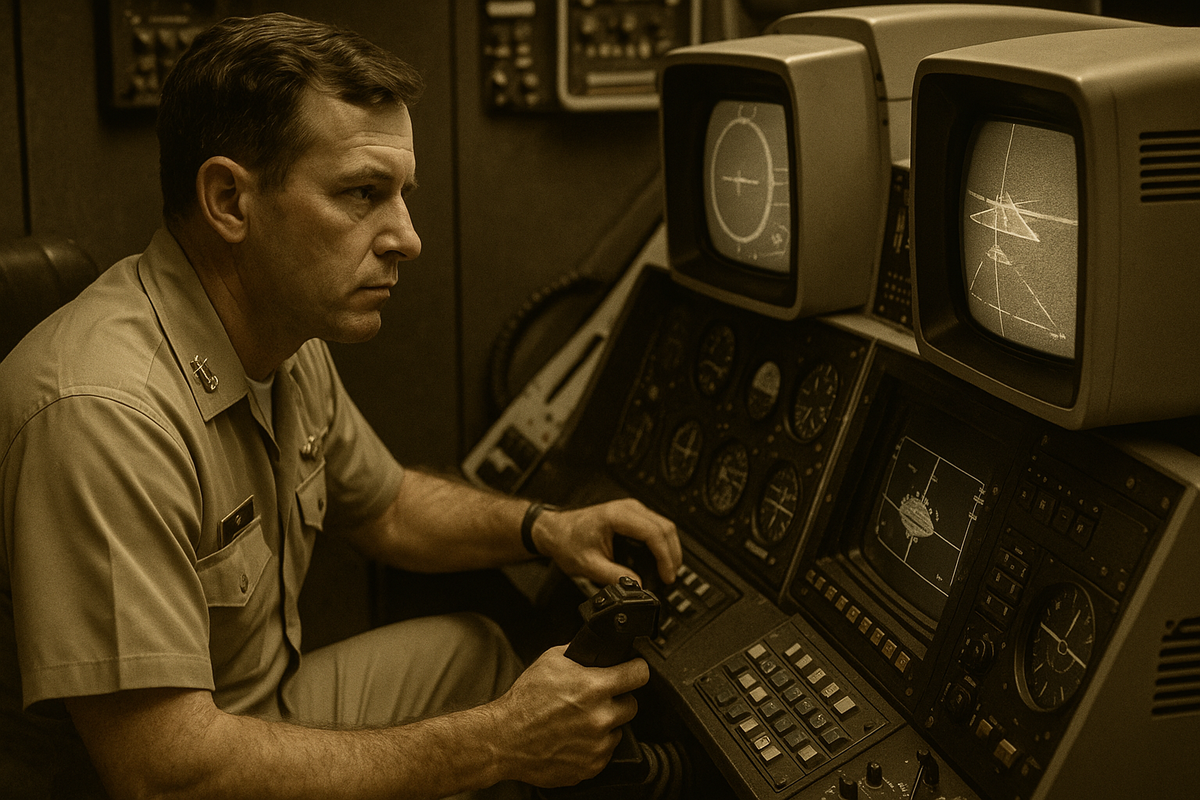
David Lustig's feature on the U.S. Navy's SH-2F LAMPS helicopter simulator reads like speculative fiction, except every word is technical fact. The SH-2F simulator wasn't a game, but Lustig presented it with the enthusiasm of someone reviewing the ultimate arcade cabinet—one that cost millions, weighed tons, and prepared pilots for life-or-death carrier operations.
The simulator was total immersion before anyone used that phrase. Every instrument in the cockpit functioned exactly as it would in the actual aircraft. Rotor noise filled the training module. Radar screens displayed real-world targeting data. Instructors could inject emergencies mid-flight: engine failures, incoming missiles, emergency landings on pitching carrier decks. The pilot experienced everything except the actual consequence of failure.
What made Lustig's article remarkable wasn't the technology itself—military flight simulators had existed since the 1960s. What made it remarkable was the venue. By publishing this feature in a gaming magazine, Electronic Games suggested something radical: that the distance between dropping quarters into Zaxxon and training for naval combat missions was shrinking fast. That simulation technology developed for defense applications would soon define consumer entertainment.
In February 1983, Microsoft Flight Simulator had been on the market for barely a year. Home computers were just beginning to handle graphics that suggested three-dimensional space. VR was science fiction. But readers of Electronic Games were being told: this is where we're going. The games of tomorrow won't just challenge you—they'll recreate reality so convincingly you'll forget you're playing.
Total Cockpit Simulation
Every instrument, dial, and control replicated the real SH-2F helicopter, giving pilots complete operational responsibility in a consequence-free environment.
Emergency Scenarios
Instructors could introduce engine failures, enemy attacks, and missile launches, simulating the chaos of combat with frightening realism.
Sensory Immersion
Rotor noise, radio chatter, and visual feedback captured the overwhelming environment of helicopter missions—total immersion decades before VR.
Multi-Purpose Training
Beyond combat, missions included rescue operations, reconnaissance, and cargo handling—reflecting the full scope of naval helicopter duties.
The Crash That Nobody Saw Coming
Here's what makes this issue historically eerie: it was published months before the North American video game market collapsed.
By December 1983, Atari would bury thousands of unsold E.T. cartridges in a New Mexico landfill. Retailers would pull gaming hardware from shelves. Major publishers would shutter. The industry wouldn't recover until Nintendo arrived in 1985 with the NES and a renewed sense of quality control.
But in February 1983, the crash was still invisible. Arcades were packed. Home console sales were strong. The February issue of Electronic Games radiates optimism—not just about Pac-Man weddings, but about simulation, about technology, about the future of interactive entertainment as a serious medium.
That optimism, preserved in print, is what makes this issue valuable. It's a time capsule from the last moment of innocence, before the industry learned that growth isn't infinite and enthusiasm isn't enough.
The Genealogy of Modern Gaming
Today, the line between military simulation and consumer gaming has vanished entirely. The same Unreal Engine that powers Fortnite trains soldiers. VR headsets developed for gaming now prepare surgeons for procedures. Microsoft Flight Simulator 2020 uses satellite data to recreate the entire planet.
The seeds of that convergence are visible in David Lustig's 1983 article about a helicopter simulator. He saw it. Electronic Games saw it. They published it in the same issue as a cartoon wedding.
That's the throughline: gaming was never just about fun. It was always about building systems complex enough to model reality, then making those systems accessible enough for anyone to explore. The Navy knew it in 1983. Now everyone knows it.
Why This Issue Matters to Collectors
Historical Timing
Published at the apex of arcade culture, months before the crash, it captures the industry's last moment of unbridled confidence.
Iconic Cover Art
The Pac-Man wedding cover is among the most recognizable in the magazine's entire run—a perfect snapshot of character merchandising mania.
The Simulator Article
No other gaming magazine of the era bridged consumer entertainment and military-grade simulation technology this explicitly. It's a one-of-a-kind editorial gamble.
Cultural Breadth
From joystick reviews to defense journalism, this issue demonstrates the full range of what Electronic Games represented—a publication that understood gaming as technology, not just entertainment.
This isn't paper. It's a primary source. It's proof that people in 1983 understood something about simulation and gaming that wouldn't become obvious to mainstream culture for another two decades.
Explore the Archive
Original copies of the February 1983 Electronic Games Magazine surface regularly in the vintage gaming market. If you're building a collection that documents gaming's formative years—or if you're simply fascinated by the moment when arcades, home consoles, and military technology all spoke the same language—this issue belongs in your archive.
Browse Electronic Games Magazine CollectionExplore every issue from the arcade boom through the console wars—each one a window into how the games we play today were imagined decades ago.
The Artifact in Your Hands
Hold the February 1983 issue and you're holding a contradiction: a magazine that celebrated cartoon mascots and profiled defense contractors with equal seriousness. A publication that understood gaming as both pop culture spectacle and technological frontier.
Forty-two years later, that contradiction has resolved. Gaming is serious technology. Simulation is entertainment. The military and the arcade speak the same language.
Electronic Games saw it first. The proof is in your hands.