
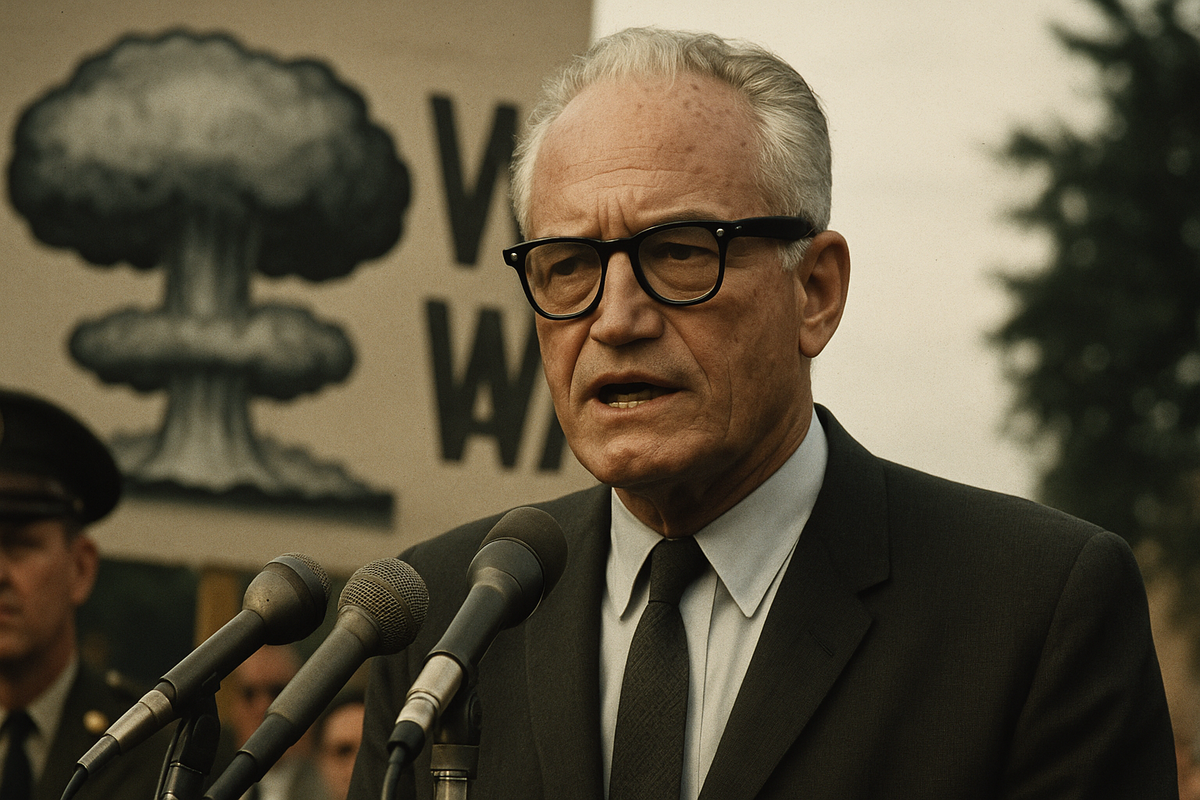
Barry Goldwater, Nuclear Anxiety, and the Politics of Fear in 1964
How Time Magazine captured America's existential dread on the eve of a landmark election
When Americans picked up the September 25, 1964 issue of Time Magazine, they weren't just reading another campaign roundup. They were holding a referendum on survival itself.
Just weeks before Election Day, Time crystallized the question that dominated American dinner tables and bomb shelter debates: Could the nation trust Senator Barry Goldwater with the nuclear codes? For a public still rattled by the Cuban Missile Crisis two years earlier—when the world had teetered 13 days on the edge of annihilation—Goldwater's reputation as a man with an "itchy finger" on the atomic trigger wasn't political theater. It was existential dread.
This issue captured that moment with surgical precision, blending Cold War strategy analysis with the raw cultural anxiety of living under the mushroom cloud. Six decades later, it remains one of the most revealing artifacts of American democracy under nuclear shadow.
Archive Details
Historical Figure: Senator Barry Goldwater
Issue Date: September 25, 1964
Archive Source: Time Magazine
Historical Context: Published weeks before the 1964 presidential election, during the height of Cold War nuclear tensions
The Specter of Armageddon
The early 1960s didn't just have tensions—they had the tension. Fallout shelters in suburban basements. Civil defense drills that taught children to duck under desks against 20-megaton blasts. Black-and-white PSAs explaining how to identify radiation sickness. The Cuban Missile Crisis of October 1962 had proven that nuclear war wasn't an abstraction but a phone call away.
Into this climate stepped Barry Goldwater, the Arizona senator whose libertarian bravado and anti-communist fervor made him a hero to conservatives—and a nightmare to moderates. His proposals to delegate nuclear authority to NATO field commanders, to loosen presidential controls, to make atomic weapons "conventional" tools of warfare—these weren't just policy positions. They were kindling thrown on public fear.
Time documented the fallout (no pun intended) with characteristic clarity. Goldwater's rhetoric about making nukes "usable" confirmed the worst suspicions: that he viewed atomic weapons as oversized artillery rather than civilization-ending horrors.
Johnson's Calculated Restraint
President Lyndon B. Johnson, thrust into office by Kennedy's assassination in November 1963, understood the assignment. His campaign didn't just attack Goldwater's policies—it attacked his temperament. Johnson positioned himself as the adult in the room: experienced, steady, capable of staring down Khrushchev without flinching or overreacting.
The strategy reached its apex with the "Daisy" ad, which aired exactly once in early September 1964 and became the most infamous political spot in American history. A little girl counts daisy petals. A nuclear countdown begins. The screen erupts in a mushroom cloud. Johnson's voiceover: "These are the stakes." The ad never mentioned Goldwater by name. It didn't need to.
Time understood what Johnson's team had achieved: the weaponization of anxiety itself. The magazine's coverage reflected how the election had become a referendum not on tax policy or civil rights alone, but on whether Americans could sleep at night.
NATO and the Burden of the Bomb
Beyond domestic politics, Time explored the deeper strategic puzzle: How could the United States maintain sole custody of nuclear weapons while expecting European allies to serve as a frontline against Soviet expansion? NATO commanders like General Lauris Norstad and General Lyman Lemnitzer were caught in the contradiction—tasked with defending Western Europe but denied the ultimate deterrent.
The debate wasn't academic. Could battlefield commanders be trusted with tactical nukes if Soviet tanks rolled through the Fulda Gap? Should the U.S. share warheads with allies, or maintain monopoly control even if it meant slower response times? Goldwater's willingness to decentralize nuclear authority spoke to this strategic dilemma, but his rhetoric made it sound reckless rather than pragmatic.
Time dissected these questions with the seriousness they deserved, showing readers that nuclear policy wasn't just Washington talking points—it was the architecture of global survival.
Visual Journalism as Cultural Record
What elevated this issue beyond policy wonkery was Time's command of visual storytelling. The magazine deployed political cartoons and infographics that translated abstract terror into visceral imagery:
A cartoon depicted Goldwater struggling to balance "Nuclear War" like an unwieldy weapon, the visual metaphor brutally effective.
Another illustration showed children on a playground, comparing America's nuclear arsenal to "other kids' toys"—a darkly satirical take on the arms race's absurdity.
A graphic titled "Army's Tactical Weapons" mapped out missile ranges and explosive yields in stark, clinical detail, forcing readers to confront the scale of destruction lurking in silos and submarines.
This wasn't mere decoration. The cartoons and charts did what prose alone couldn't: they made the unimaginable visible. They transformed megadeaths and throw-weights into something the eye could process, even if the mind couldn't fully accept.
Time's mid-century design aesthetic—bold typography, modernist layouts, the confident swagger of postwar American publishing—gave the content both urgency and authority. This was journalism as public service, delivered with the polish of a publication at the height of its influence.
What This Issue Reveals
The "Itchy-Finger" Trap
Goldwater's hawkish language became a self-inflicted wound. Time documented how voters saw him not as strong but as unstable, a distinction that proved fatal.
NATO's Nuclear Paradox
The magazine's deep dive into transatlantic weapons-sharing debates remains relevant today, as alliance politics continue to grapple with burden-sharing and extended deterrence.
The Visual Turn in Politics
The cartoons and graphics demonstrated how imagery—whether editorial satire or campaign ads—could bypass rational argument and strike directly at the gut.
Johnson's Mastery of Fear
By projecting calm competence against Goldwater's volatility, LBJ turned anxiety into an electoral landslide. Time captured the strategy in real time.
Why Collectors Prize This Issue
Election-Year Drama
Few campaigns have presented such a stark choice, making this issue a snapshot of American democracy at a crossroads.
Cold War Documentation
The coverage provides primary-source insight into NATO strategy and nuclear doctrine at the height of superpower rivalry.
Cultural Artifact
The "itchy-finger" narrative, the Daisy ad's shadow, the satirical cartoons—this issue is a time capsule of collective anxiety.
Scarcity and Demand
Issues tied to transformative elections, especially those involving nuclear policy and iconic figures like Goldwater and Johnson, command premium interest among serious collectors.
This isn't just a magazine. It's a document of how a nation debated its survival while trying to maintain democratic norms. It's proof that journalism once assumed readers could handle complexity, nuance, and fear simultaneously.
The Enduring Power of Print
Vintage magazines survive because they offer what digital archives cannot: the tactile experience of history. The paper stock, the ad layouts, the unaltered editorial voice—these details place you in 1964, not looking back at it through layers of hindsight.
Flipping through this issue, you feel the weight of the nuclear question. You see the confidence of Time's editors, who believed their readers deserved both facts and interpretation. You encounter a moment when the stakes of politics weren't hypothetical but measured in megatons.
For historians reconstructing Cold War consciousness, for collectors preserving cultural memory, for families honoring their heritage, original magazines are irreplaceable. They don't just tell you what happened. They show you what it meant.
Add This to Your Collection
If you're drawn to Cold War history, presidential campaigns, or the intersection of media and public anxiety, the September 25, 1964 issue of Time Magazine belongs in your archive.
Browse Time Magazine CollectionFrom World War II through the turbulent 1960s and beyond, each issue is a first-hand record of the events, personalities, and fears that shaped the 20th century.
Conclusion
The September 25, 1964 Time Magazine stands as a defining artifact of Cold War America. Its dissection of Barry Goldwater's candidacy, the nuclear policy debates roiling NATO, and the anxieties of a population living with annihilation—it's all there, preserved in ink and image.
For readers in 1964, this issue was a sobering guide to the stakes of November's vote. For collectors today, it's a direct line to an era when politics, survival, and media power converged in ways we're still trying to understand.
Hold this magazine, and you're holding the pulse of a nation deciding its future while staring at the bomb.