
Four Jills in a Jeep: When Hollywood Went to War and Changed Everything
How Carole Landis and three actresses turned a USO tour into one of World War II's most honest cultural documents
On New Year's Day 1944, American breakfast tables held more than coffee and rationed butter. They held a confession.
Carole Landis—blonde bombshell, pin-up queen, the woman whose legs launched a thousand fantasies—was writing from a muddy military camp somewhere in North Africa. Not through a studio publicist. Not in carefully managed prose designed to sell her next picture. She was writing in her own voice, raw and unvarnished, about what it meant to sleep in a freezing barracks, bomb through convoy routes, and stand before an audience of combat-shattered men who wouldn't applaud.
"Four Jills in a Jeep," published across five issues of The Saturday Evening Post beginning January 1, 1944, wasn't celebrity fluff. It was combat journalism in heels.
Archive Details
Featured Personalities: Carole Landis, Kay Francis, Martha Raye, Mitzi Mayfair
Issue Date: January 1, 1944 (five-part series)
Publication: The Saturday Evening Post
Historical Context: World War II USO Tour, England and North Africa
The War Nobody Talks About
Hollywood's contribution to World War II gets reduced to propaganda films and bond rallies—safe, photogenic patriotism performed at a comfortable distance from the front. But Landis, Kay Francis, Martha Raye, and Mitzi Mayfair did something different. They embedded themselves in the war's machinery. They followed USO routes through England and North Africa during some of the conflict's bloodiest months, performing in makeshift theaters built from ammunition crates, eating K-rations, and learning what it meant when an audience of exhausted soldiers simply stared back in silence.
The Post didn't bury this story in its back pages. It led with it. The magazine that Norman Rockwell had turned into America's illustrated conscience gave Landis the platform to document something unprecedented: four women from the dream factory confronting the nightmare of modern war.
Why January 1944 Mattered
Context is everything. As Americans opened this issue, the Allied invasion of Europe was four months away—though no civilian knew that. North Africa had been secured at enormous cost. Italy was a grinding stalemate. The home front was three years deep into rationing, factory shifts, and gold star telegrams.
The Saturday Evening Post had always been a barometer of American mood, but during the war it became something more: a psychological lifeline. It published Rockwell's "Four Freedoms" series. It ran firsthand accounts from battlefields and factories. It balanced grim reality with sustaining fiction, giving readers both truth and escape in carefully measured doses.
Landis's narrative fit perfectly into this formula. It wasn't denial, and it wasn't despair. It was proof that Americans—even those paid to look glamorous—could endure hardship without losing their humanity.
What Landis Actually Wrote
Strip away the celebrity veneer and you find something startling: honest reporting.
Landis described performing for audiences that wouldn't respond, where laughter died in throats too tired to care. She wrote about food poisoning, about freezing nights in unheated barracks, about the logistical chaos of moving four women through a war zone. She captured the small gestures that mattered more than any USO poster suggested—soldiers lining up just to touch a woman's hand, to remember that softness still existed somewhere in the world.
One moment crystallizes the entire narrative: Queen Elizabeth, meeting the four actresses in England, promises that "The Star-Spangled Banner" would henceforth be performed properly at royal functions. It's a minor diplomatic courtesy, barely a footnote to history. But Landis recognized it for what it was—a symbolic acknowledgment of the Anglo-American alliance, delivered woman to woman, celebrity to monarch, in the midst of civilization's existential crisis.
This wasn't the Hollywood version of war. This was war itself, filtered through the eyes of someone trained to perform but forced to witness.
The Photographs Tell the Rest
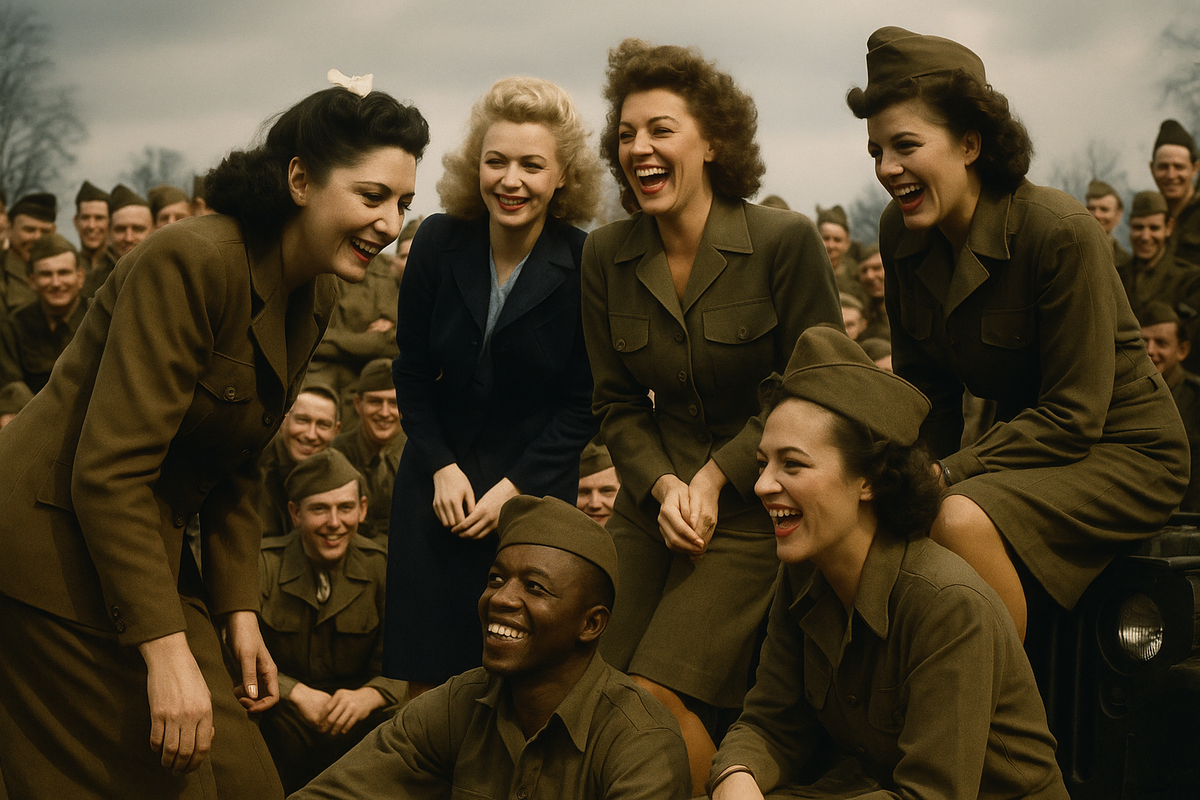
The images accompanying Landis's text completed the story. Kay Francis signing autographs with the focused intensity she brought to her film roles. Martha Raye—comedian, vocalist, woman who could make a room explode with laughter—climbing onto a tank like it was a studio prop. Mitzi Mayfair, the dancer nobody remembers now, sharing cigarettes with men who might not see another sunrise.
These weren't publicity stills. They were documentary evidence. The lighting was wrong, the compositions uncontrolled, the glamour stripped away by military necessity. That authenticity made them revolutionary. Americans were accustomed to seeing stars in controlled environments, every angle perfected by studio photographers. Here they saw women who looked tired, windblown, and entirely committed to something larger than their careers.
The Saturday Evening Post understood the assignment. While other magazines fetishized military hardware or sanitized battle narratives, the Post gave readers human connection. It showed them that morale was a weapon, that laughter could be as strategically valuable as artillery, that four women could shift the emotional calculus of war simply by showing up.
Key Moments That Defined the Journey
Performing Under Pressure
The actresses faced audiences that sometimes responded with silence, revealing the challenge of entertaining men exhausted by war.
Resilience Through Humor
Landis's descriptions of food mishaps, awkward performances, and improvised shows demonstrated the determination needed to carry on.
The Queen's Gesture
Queen Elizabeth's promise regarding proper performance of the U.S. anthem symbolized Allied unity at the highest level.
Women in Wartime Roles
By traveling to England and North Africa, the actresses proved women could contribute beyond factories and nursing.
The Human Connection
Simple acts—dunking doughnuts, signing autographs, joking with troops—became vital morale-building moments.
Documentary Photography
Candid images of the tour provided Americans with unprecedented glimpses of celebrity sacrifice in wartime.
Why It Still Resonates
Most war stories calcify into myth. We remember D-Day, Pearl Harbor, Hiroshima—the big, dramatic moments that fit neatly into historical narrative. We forget the thousands of smaller moments that sustained soldiers between battles: a letter from home, a decent meal, a woman's voice singing something from the world they'd left behind.
Landis's account preserves those forgotten moments. It reminds us that wars are fought by human beings who need more than bullets and rations. They need proof that the civilization they're defending still exists, that beauty and humor and grace haven't been entirely consumed by violence.
In our current era of digital media saturation, where every celebrity gesture is instantly broadcast and immediately forgotten, there's something powerful about holding a physical magazine from 1944. The paper has yellowed. The photographs have faded slightly. But the words remain sharp, and the story they tell—of courage, exhaustion, and the stubborn human refusal to let war destroy everything good—has not diminished.
What This Means for Collectors
The January 1, 1944 issue of The Saturday Evening Post occupies a unique position in the collectible market. It's not just a magazine—it's a primary historical document authored by someone who lived the events it describes.
Norman Rockwell's covers from this era already command serious prices, and while this particular issue's cover artist remains a matter of archival verification, the association with Rockwell's Post legacy enhances its cultural value. More significantly, this is one of the rare instances where a Hollywood star produced genuine war reportage rather than approved publicity material.
Collectors pursuing World War II home front artifacts need this issue. Vintage Hollywood historians need it. Anyone studying women's expanded roles during the war—not just as factory workers or military auxiliaries, but as cultural diplomats—needs it. The magazine bridges multiple collecting categories: celebrity culture, wartime propaganda, women's history, and literary journalism.
Beyond market value, this issue preserves 1940s America in amber. The advertisements alone are worth study—what was being sold, how it was being sold, what anxieties and aspirations the copywriters exploited. The short stories, the editorial cartoons, the advice columns—all of it reflects a nation under extraordinary pressure maintaining the rituals of ordinary life.
This is not decoration. This is documentation.
Access History Directly
Original issues of The Saturday Evening Post are more than collectibles. They're time machines that let you trace the evolution of American culture through its most defining century.
For collectors, historians, and anyone who believes that primary sources matter more than secondhand summaries, these magazines offer something irreplaceable: direct access to the voices, images, and values of another era.
Browse The Saturday Evening Post Magazine CollectionThe Final Frame
When Carole Landis sat down to write "Four Jills in a Jeep," she couldn't have known she was creating one of World War II's most honest cultural documents. She thought she was simply telling her story—the discomforts, the small triumphs, the overwhelming strangeness of being a Hollywood actress in a combat zone.
But that honesty is precisely what makes the January 1, 1944 Saturday Evening Post essential. It captures a moment when celebrity and sacrifice intersected, when women's contributions to the war effort expanded beyond any previous boundary, when a magazine served as the nation's shared living room, bringing distant battles and far-flung heroism into American homes.
The war was fought with steel and strategy. But it was sustained by stories like this one—reminders that even in civilization's darkest hour, laughter, courage, and human connection remained humanity's most powerful weapons.