
The Magazine That Declared War
When Ric Flair Invaded WWF and Changed Wrestling Forever
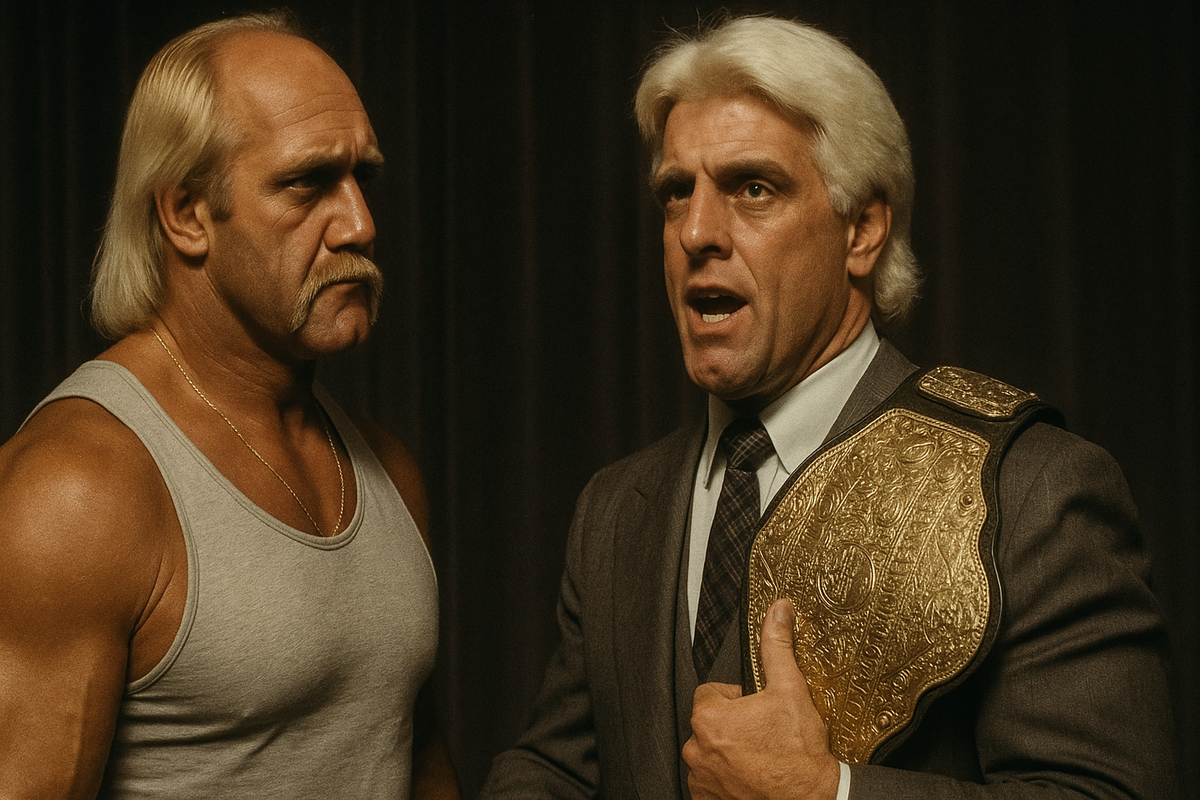
On newsstands in October 1991, a single issue of WWF Magazine detonated what the industry had considered impossible for decades: the collision of wrestling's two parallel universes. Inside the November 1991 edition, beneath a cover crackling with early-'90s neon electricity, Ric Flair—draped in Armani and dripping with the arrogance of a sixteen-time world champion—stared down the camera and issued a declaration that rewrote the rules: "I Am The Real World's Champion, Hogan!"
This wasn't a work. Well, it was a work—but it was a work built on something devastatingly real. Flair had arrived in Titan Tower's territory carrying the physical championship belt of WWF's rival promotion, turning a backstage contract dispute into the most explosive invasion angle wrestling had ever seen. For fans who'd spent years arguing in schoolyards about whether Hogan or Flair was the true king, WWF Magazine delivered the fight to their doorsteps in glossy, full-color proof.
Thirty-three years later, this issue remains one of the most significant pieces of wrestling journalism ever printed—not because it reported the news, but because it was the news.
Archive Metadata
Historical Figures: Ric Flair, Hulk Hogan, The Undertaker
Issue Date: November 1991
Archive Source: WWF Magazine (World Wrestling Federation)
Historical Context: First WWF appearance of "Nature Boy" Ric Flair following his departure from WCW, carrying the NWA World Heavyweight Championship belt
Connected Event: Survivor Series 1991 (Gravest Challenge)
The Powder Keg: Why Flair's Arrival Shattered Wrestling's Berlin Wall
By autumn 1991, the World Wrestling Federation stood at a crossroads. The golden age of Hulkamania—built on cartoon morality plays and Saturday morning excess—was showing hairline cracks. Pay-per-view had transformed the business model; WrestleMania, SummerSlam, and Survivor Series now dictated the industry's rhythm. But World Championship Wrestling, backed by Ted Turner's cable empire, was hemorrhaging money to raid WWF talent and build a legitimate alternative.
Then Jim Herd, WCW's executive vice president, made a catastrophic miscalculation. After months of creative clashes with Ric Flair—the man who was the NWA/WCW brand—Herd fired the champion weeks before a scheduled title defense. Flair, still in possession of the "Big Gold Belt" (WCW had failed to retrieve it due to a $25,000 deposit dispute), walked into Vince McMahon's office with leverage no wrestler had ever possessed: a rival promotion's world championship.
McMahon, a carnivore who'd spent the 1980s cannibalizing regional territories, recognized the opportunity instantly. Flair wouldn't just debut—he'd debut as champion, belt and all, creating a kayfabe logic bomb that blurred promotional lines and made every previous "champion vs. champion" angle look like pretend.
The November 1991 WWF Magazine became the official document of this invasion.
Inside the Magazine: Where Print Became Steel Chair Warfare
WWF Magazine in 1991 operated as something between Sports Illustrated and propaganda ministry—equal parts journalism and storyline accelerant. The Flair feature understood this balance perfectly.
The Interview as Manifesto
Flair's quotes didn't read like typical wrestling hype. They carried the weight of a man who'd headlined arenas on five continents, who'd wrestled Harley Race and Dusty Rhodes and Terry Funk in matches that defined decades. When he called Hogan "a creation of the WWF marketing machine," it landed differently than a scripted promo because Flair had earned the right to that arrogance. The article framed him not as a villain but as wrestling royalty slumming in new territory—a champion who'd conquered every other kingdom and arrived to claim the last one standing.
The Big Gold Belt Mystery
Though WCW had legally forced WWF to blur the championship in photographs (a delicious irony: the belt's image was censored while Flair held it on television), the magazine's layout worked around the restriction brilliantly. Full-page spreads showed Flair in $3,000 suits, the blurred gold visible enough to convey its presence, its wrongness in WWF's universe. Readers understood what they were seeing: contraband. A stolen throne.
The Hogan Provocation
The article's genius lay in its timing. Published weeks before Survivor Series 1991, where Flair would cost Hogan the WWF Championship in a match against The Undertaker, the magazine didn't preview the storyline—it planted it. Fans reading Flair's taunts in October carried that tension into November, transforming a scripted interference into the payoff of a blood feud that had been building in their imaginations for years.
This was kayfabe as high art: the magazine and the matches forming a single, seamless narrative.
What Made This Issue Historically Irreplaceable
The Only True Promotional Invasion
Every "Monday Night War" angle, every ECW crossover, every NWO storyline traces its DNA to this moment. Flair didn't arrive as a free agent—he arrived as a conqueror with proof of conquest.
Peak Kayfabe Preservation
This issue lives in the liminal space where readers knew fights were choreographed, but the stakes—Flair's real-world championship pedigree, the legitimate promotional war—were genuine.
The WrestleMania VIII "What If"
Though Flair vs. Hogan at WrestleMania VIII fell through, the magazine built that dream match into wrestling lore before it could happen—a historical "what if" document.
Flair at Maximum Wattage
This magazine preserved "The Nature Boy" at his commercial peak: physically imposing, verbally lethal, culturally relevant. The equivalent of a 1927 Yankees program.
The Collector's Calculus: Why This Issue Commands Attention
Vintage wrestling magazines exist in a strange market. They're not comic books (which have established grading systems) or sports cards (which have player-specific premiums). Their value derives from narrative significance—how crucial the issue was to wrestling's unfolding story.
The November 1991 WWF Magazine checks every box:
- Historical inflection point: Flair's WWF debut
- Dual superstar appeal: Flair and Hogan in their primes
- Pay-per-view connectivity: Direct tie to Survivor Series 1991
- Physical rarity: 33 years of attrition, water damage, and childhood bedrooms have eliminated most copies
- Cross-promotional intrigue: The only magazine legally forced to censor a championship belt in photos
For serious collectors, this isn't nostalgia—it's primary source material. Historians studying the Monday Night Wars need this issue to understand how the first shot was fired. Flair completists need it to document his career's most audacious chapter. Hogan archivists need it to see the moment his invincibility was first genuinely challenged.
And for anyone who was twelve years old in 1991, reading this magazine in a comic shop while "Smells Like Teen Spirit" leaked from a nearby record store? It's a time capsule of what it felt like when wrestling mattered.
Why WWF Magazine Mattered More Than We Realized
In the pre-internet wilderness of early-'90s fandom, magazines were the connective tissue between monthly pay-per-views. They extended storylines, built characters, and created the illusion of access. WWF Magazine excelled at this alchemy.
But the November 1991 issue transcended promotional work. By giving Flair a platform to methodically dismantle Hogan's legitimacy—in print, where arguments carried more permanence than a three-minute promo—the magazine elevated the feud beyond "good guy vs. bad guy" into something resembling sports debate. Was Hogan truly the best, or had WWF's marketing machine simply convinced a generation he was? Flair's presence forced the question.
That intellectual weight, combined with the visceral thrill of seeing Flair in WWF colors, made this issue required reading. It rewarded close attention. It made fans feel smarter for understanding the nuances.
It treated them like adults.
Collector Significance
Historical Timing
Captures Ric Flair's very first WWF run, one of the most legendary career moves in wrestling history.
Iconic Rivalries
With Hulk Hogan at the peak of his popularity, the magazine immortalized the dream feud of Hogan vs. Flair.
Pay-Per-View Connection
Released just before Survivor Series 1991, directly tied to one of the most infamous WWF events of the era.
Physical Rarity
Magazines featuring Ric Flair, Hulk Hogan, The Undertaker, and other top stars of the early '90s are among the most sought-after by wrestling historians.
Owning a Piece of Wrestling's Berlin Wall Moment
The November 1991 issue of WWF Magazine isn't just a collectible—it's evidence that wrestling's greatest feud happened partially on paper, in the hands of fans who studied every word, every photograph, every implication.
Finding a clean copy today requires patience and luck. Most have yellowed spines, dog-eared corners, or missing pages from readers who taped their favorite photos to bedroom walls. The few survivors in near-mint condition represent something increasingly rare: physical media from the last era when magazines drove popular culture.
Whether you lived this moment in real time or you're discovering it through wrestling's vast oral history, holding this magazine connects you to the night Ric Flair walked into enemy territory and changed the business forever.
The Final Bell
Three decades after publication, the November 1991 WWF Magazine endures because it captured lightning in a bottle: the moment wrestling's two biggest stars, from two warring promotions, collided in print before they could collide in the ring.
It's a document of war. A piece of propaganda. A historical record.
And it's still, all these years later, one hell of a read.
For collectors, historians, and anyone who believes wrestling's greatest stories were told in the space between the matches—this is the magazine that proved it.
Explore Our Archive
Browse our full collection of original WWF World Wrestling Federation magazines and discover more artifacts from wrestling's golden era.
Browse WWF Magazine Collection