
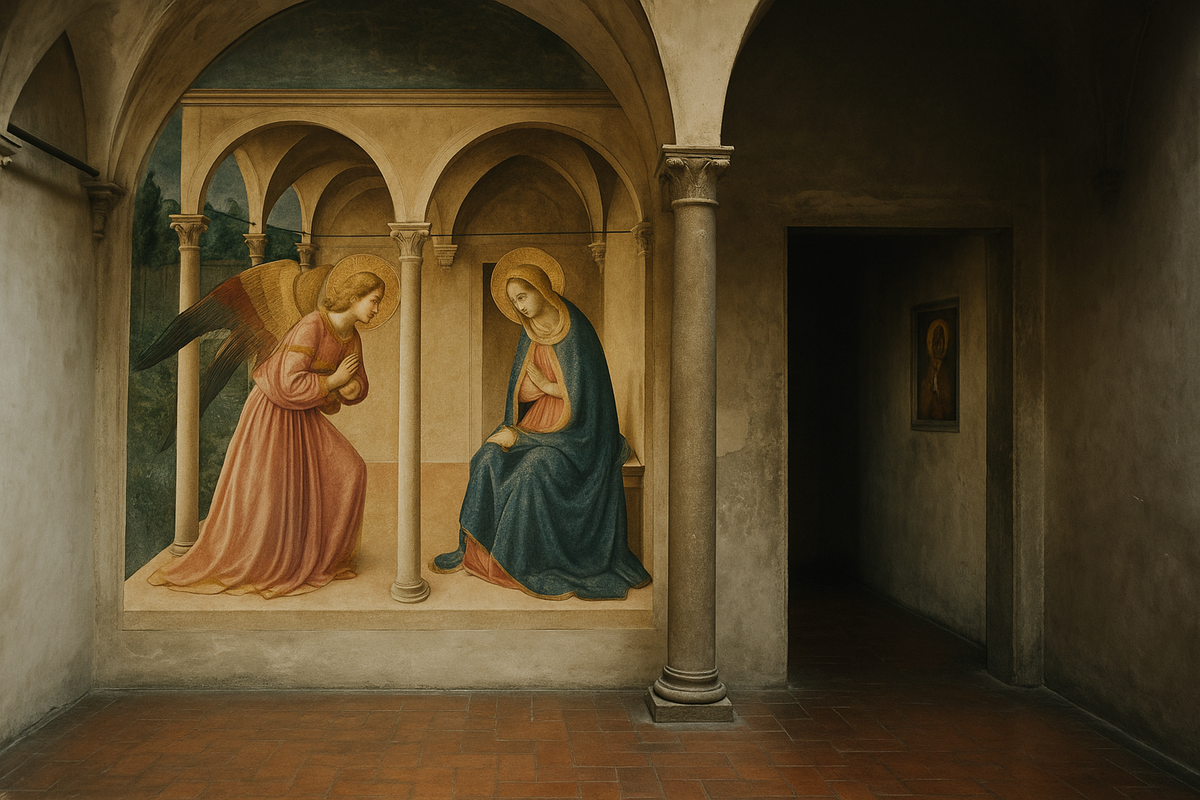
Fra Angelico, Sacred Beauty, and the Renaissance Gift to the Modern World
How Time Magazine's December 26, 1955 Issue Brought Renaissance Humanism to Cold War America
On December 26, 1955, American families opened their mailboxes to find something unexpected from Time Magazine: not year-end political analysis or Cold War commentary, but a full-color meditation on a 15th-century Dominican friar whose paintings had been gathering dust in Florentine convents for five centuries.
The cover story wasn't accidental. It was calculated.
While the Soviet Union launched satellites and nuclear arsenals expanded, Time's editors made a different wager: that their readers—suburban families navigating atomic anxiety and unprecedented prosperity—needed Fra Angelico more than they needed another arms race briefing. The magazine bet that sacred beauty could speak louder than ideology, that Renaissance humanism carried answers the modern world had misplaced.
They were right.
Why Fra Angelico? Why 1955?
The postwar decade demanded cultural ammunition. As Washington framed the Cold War as a battle between civilization and barbarism, American institutions scrambled to prove the West's intellectual superiority. Museums expanded their Renaissance collections. Universities erected entire programs around "Western Civ" as ideological armor. The Metropolitan Museum of Art saw record attendance. Europe wasn't just history—it was proof of concept.
Time Magazine understood this hunger. By profiling Fra Angelico during Christmas week, the editors weren't simply covering art. They were offering spiritual inoculation against materialism, a visual gospel for a generation that had survived one war and feared another. The friar-painter became a proxy: proof that faith, beauty, and intellect could coexist without compromise.
Fra Angelico's humility made him perfect for the moment. Unlike Michelangelo's swagger or Leonardo's ambition, Angelico painted from his knees. His frescoes at San Marco served monks in their cells, not princes in their courts. He died in Rome in 1455, was later beatified by the Catholic Church, and left behind a body of work that refused to separate devotion from craft.
For Americans anxious about losing their moral center, Angelico was a map back.
Archive Details
Historical Figure: Fra Angelico (c. 1395–1455), Dominican friar and Renaissance painter
Issue Date: December 26, 1955
Archive Source: Time Magazine
Feature Type: Cultural cover story with full-color art reproductions
Editorial Frame: "The Bearers of Gifts" — Renaissance sacred art as antidote to Cold War materialism
Time as Cultural Architect
By 1955, Time had transcended newsweekly status to become something closer to a national curriculum. It didn't just report—it curated reality, telling readers which books mattered, which artists endured, which ideas shaped history. Millions of families relied on Time not for information alone, but for interpretation.
The December 26 issue delivered accordingly. Richly illustrated reproductions of The Coronation of the Virgin, The Annunciation, and the Story of Mary panels from Cortona filled the pages in full color—a rarity for the era. Readers in Milwaukee and Los Angeles could study the luminous blues, radiant golds, and serene faces that defined Angelico's vision without boarding a transatlantic flight.
Time's editorial voice framed Angelico as "the angelic painter," a title already centuries old but newly relevant. The prose positioned him at a crossroads: heir to Byzantine mosaics and medieval illumination, yet pioneer of Renaissance perspective and realism. His work wasn't trapped in the past. It carried forward.
Three Gifts to the Modern Age
The feature structured its argument around a triptych of themes, each reinforcing the others:
Art as Gift, Not Ego
Fra Angelico painted for God, not patrons. His frescoes weren't signatures—they were offerings. Time emphasized this selflessness as countercultural even in the 1400s, and radical in the 1950s, when Abstract Expressionism was teaching Americans that art demanded personality, rebellion, defiance.
Faith and Beauty, Fused
The San Marco frescoes and The Annunciation demonstrated how devotion could sharpen rather than soften artistic innovation. Angelico didn't choose between spiritual intensity and technical mastery. He married them. Time ranked his Annunciation "at the summit of Tuscan painting"—a bold claim that placed a monk's humility above Florentine ambition.
Antidote to Materialism: The implicit argument ran underneath every paragraph: if the 20th century had lost its soul to science, industry, and ideology, Renaissance Florence offered recovery. Angelico's paintings weren't museum relics—they were medicine.
The Masterworks: What Readers Saw
Time gave its audience a curated gallery:
The Coronation of the Virgin placed Mary within a celestial court of saints and angels, bathed in blues and golds that symbolized the union of heaven and earth—not as abstraction, but as visible truth.
The Annunciation captured Gabriel's greeting to Mary with quiet humility and luminous serenity, every gesture deliberate, every shadow intentional. Time's description—"at the summit of Tuscan painting"—positioned it alongside Masaccio and Botticelli without apology.
The Story of Mary panels illustrated key events—Visitation, Adoration of the Magi—with clarity and delicate emotion. No drama, no theatrics. Just presence.
The San Marco frescoes revealed Angelico's dual identity: monk and artist, prayer and profession indistinguishable. Each fresco served the Dominican mission of uniting contemplation with beauty.
These reproductions weren't ornamental. They were pedagogical, teaching middle-class Americans how to see Renaissance art not as alien or elite, but as inheritance.
The Legacy of Sacred Journalism
What distinguishes issues like this from mere archival ephemera is editorial ambition. Time didn't profile Fra Angelico because the art world demanded it. No major retrospective forced their hand. They profiled him because their editors believed sacred art still had work to do in 1955—and they were right.
The feature endures because it treated Renaissance painting as active force, not historical footnote. It brought Fra Angelico into conversation with atomic anxiety, suburban conformity, and Cold War ideology without flattening any of them.
For readers then and collectors now, the issue functions as bridge: between 15th-century Florence and 20th-century America, between museum and living room, between scholarship and faith.
Why Collectors Covet This Issue
Historical Timing
Published during Christmas, it reframed the Nativity story through Renaissance visual theology—a seasonal artifact with enduring spiritual resonance.
Print Quality
The full-color reproductions remain among the finest Fra Angelico plates produced in mid-century American media. Before coffee table books became ubiquitous, this was the coffee table book.
Cultural Snapshot
It captures the exact moment when American intellectual life turned toward European humanism as Cold War strategy. The issue doesn't just describe art—it participates in ideological construction.
Scarcity
Holiday-themed cultural cover stories from Time's golden era survive in smaller numbers than political issues. Collectors prize them accordingly.
Owning this issue means holding the artifact itself—the physical object that entered American homes and shaped how a generation understood beauty, faith, and the Renaissance.
Collect the Moment
If you're a collector, cultural historian, or simply someone who recognizes that art history and national identity were once inseparable, the December 26, 1955 issue of Time Magazine deserves space in your archive.
Browse Time Magazine CollectionWhether you're building a library of vintage Time issues, researching Cold War cultural strategy, or teaching Renaissance art, this issue offers something irreplaceable: the original document, preserved.
Beauty as Strategy
The December 26, 1955 issue of Time Magazine stands as proof that journalism once believed in beauty as argument. By presenting Fra Angelico as a bearer of gifts—a painter whose frescoes united sacred devotion with visual innovation—Time gave postwar Americans permission to believe that faith and intellect, art and ideology, could coexist without contradiction.
Holding this issue today means more than admiring Fra Angelico's blues and golds. It means reconnecting with a moment when a newsweekly trusted its readers to care about a Dominican friar, when Christmas week meant reflection rather than consumption, when the past was treated not as escape but as instruction.
For collectors and historians alike, it remains what it was in 1955: a gift, carefully chosen, still worth opening.