
The Magazine That Captured America Coming Apart
How Donald Barthelme's "The Indian Uprising" turned The New Yorker into a literary grenade—and why the March 6, 1965 issue remains one of the most collectible publications in American history
March 6, 1965. A Saturday. Readers across America opened their mailboxes to find the latest issue of The New Yorker—elegant cover, urbane cartoons, the usual crisp prose. But buried in those pages was a literary grenade.
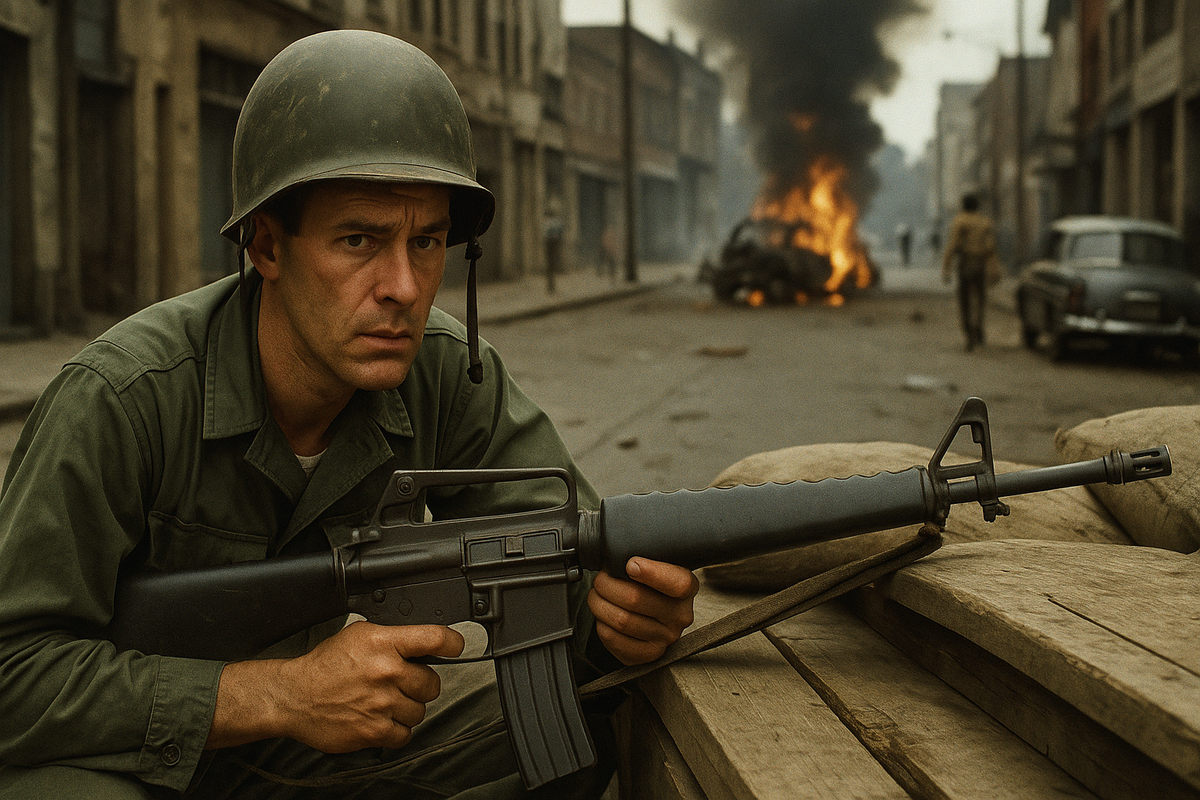
Donald Barthelme's "The Indian Uprising" detonated every convention of storytelling. No clear plot. No reliable narrator. Just fragments: Comanche warriors charging through a modern city. Paratroopers. Cocktail parties. A teacher lecturing while barricades collapse. Lists of furniture. Absurd military communiqués. Violence and domesticity colliding in the same sentence.
It wasn't just experimental fiction. It was a mirror held up to a country that had stopped making sense.
A Nation Under Siege
By March 1965, America was fracturing in real time. More than 180,000 U.S. troops would be deployed to Vietnam by year's end, and for the first time, war footage—burning villages, body counts, jungle combat—flickered across television screens each evening. The war wasn't distant anymore. It was in the living room.
One day after this issue hit newsstands, Martin Luther King Jr. would lead marchers across the Edmund Pettus Bridge in Selma, Alabama, straight into a wall of state troopers with billy clubs and tear gas. Bloody Sunday. The Civil Rights Movement had reached its most violent confrontation yet, and the images—like Vietnam—would be broadcast into American homes.
The old narratives were collapsing. Progress wasn't linear. Order wasn't guaranteed. And for writers like Barthelme, realism could no longer capture the absurdity of modern life.
Historical Context
Featured Work: "The Indian Uprising" by Donald Barthelme
Publication Date: March 6, 1965
Archive Source: The New Yorker, Vol. 41, No. 2
Cover Artist: Charles E. Martin
Historical Moment: Published one day before Bloody Sunday in Selma and during the rapid escalation of the Vietnam War
Postmodernism as Survival
The 1960s gave birth to postmodernism—not as an aesthetic choice, but as a necessity. When reality stops making sense, traditional storytelling becomes a lie. Writers like Thomas Pynchon, John Barth, and Barthelme turned to fragmentation, irony, and collage. They mirrored the chaos rather than imposing false coherence on it.
"The Indian Uprising" embodied this shift. Its structure was deliberately disorienting: soldiers fighting Indians while analyzing furniture, citizens discussing Baudelaire while their city burned, a war that blended historical mythology with Cold War paranoia. Readers in 1965 found it unsettling, even alien. But it also felt strangely familiar—like the nightly news, where nothing connected and everything was urgent.
Barthelme wasn't describing confusion. He was creating it, forcing readers to experience the fragmentary logic of modern warfare and modern life.
The New Yorker at Its Most Daring
By 1965, The New Yorker had become the most prestigious literary magazine in America. It had published Salinger, Updike, Arendt's "Eichmann in Jerusalem." It was sophisticated, urban, unafraid of complexity. The March 6 cover—Charles E. Martin's illustration of Manhattan gallery-goers admiring bold abstract paintings—captured the magazine's cultural confidence. New York was the center of the art world, and The New Yorker was its house organ.
But the magazine was more than elegant cartoons and urbane wit. It was a collage itself: fiction alongside reportage, poems next to advertisements, high art brushing against consumer culture. Barthelme's story didn't just appear in The New Yorker—it was The New Yorker, distilled into prose. The fragmented narrative, the surreal juxtapositions, the refusal to explain itself—it all mirrored the magazine's own editorial DNA.
Inside that issue, readers found war rendered as a series of non-sequiturs:
Paratroopers descending. Barricades made of hollow-core doors and bottles of sherry. A captured Comanche being interrogated. Miss R., still teaching, still lecturing, while the city burns.
The effect was disorienting—but so was 1965. The story refused to offer resolution because there was no resolution. It reflected the media's own coverage of Vietnam: confusing, violent, impossible to synthesize into a single narrative.
What Made "The Indian Uprising" Revolutionary
War in Fragments
Instead of a clear battle, Barthelme gives readers scattered images: paratroopers, barricades, a captured Comanche, and a teacher lecturing amid chaos. It mirrored the disorienting coverage of Vietnam in American media.
Everyday Objects Amid Violence
Lists of furniture, rugs, bottles of sherry, and hollow-core doors appear in the middle of the war. These mundane details echoed consumer culture, suggesting that material comfort coexisted uneasily with violence and upheaval.
Absurdity as Truth
By blending surreal humor with grim imagery, Barthelme suggested that modern warfare—and modern life—had become absurd, a series of fragments that no longer formed a coherent whole.
The Voice of Postmodernism
For many readers, the story felt unsettling, even alien. Yet it also expressed the confusion of the 1960s, when old narratives of order and progress no longer seemed to hold.
The Artifact
Holding the March 6, 1965 New Yorker is holding the moment when American literature, politics, and culture collided. It's a reminder that fiction can be as urgent as journalism—and that magazines are not just reading material, but witnesses to history.
Barthelme's "The Indian Uprising" broke every rule of storytelling because the rules no longer applied. The story gave readers a surreal, unsettling reflection of their own fractured reality. And sixty years later, it still reads like a dispatch from a country trying to understand itself while falling apart.
Why Collectors Hunt This Issue
Literary Landmark
"The Indian Uprising" was later anthologized, dissected in graduate seminars, and taught as a defining text of postmodern fiction. This issue is its first appearance—the original artifact, not the reprint.
Cultural Time Capsule
The advertisements alone are worth the price of admission: mid-century modern furniture, luxury travel, cocktail culture. Combined with Barthelme's fiction, the cartoons, and the essays, this issue captures the texture of mid-1960s America—its contradictions, its anxieties, its style.
Standalone Artistic Value
Charles E. Martin's cover illustration represents the intersection of fine art and popular culture that defined the decade. It's a collectible work of graphic art in its own right.
Historical Crossroads
Published during the escalation of Vietnam and just before Bloody Sunday in Selma, this issue embodies the turbulence that would define the decade. It's not just literature—it's history.
Where to Find It
If you're searching for the March 6, 1965 issue, you're not just hunting for a vintage collectible—you're seeking entry into a pivotal moment in American culture. When you acquire original New Yorker magazines, you're preserving the cultural texture of an era: the ads, the covers, the fiction, the essays. All of it combines to create a living archive of the 20th century.
Browse The New Yorker Magazine CollectionFrom the 1920s through the modern era, these issues allow you to trace entire decades of culture, art, and politics as they first appeared—unfiltered, unrevised, in their original form.