
When America Ruled the Waves
Inside Time's 1967 America's Cup Masterpiece
In August 1967, while protestors burned draft cards and Haight-Ashbury rewrote the rules of American youth, another drama unfolded on different terms entirely. Off the coast of Newport, Rhode Island, million-dollar yachts sliced through Atlantic swells in a contest that had never seen an American defeat. For 116 years, the America's Cup had remained in U.S. hands—and Time Magazine's August 18 issue captured the moment when that streak faced its latest challenge.
The feature, "The Intrepid Gentleman," did something remarkable: it transformed a sport played by millionaires into a story of national identity. This wasn't just yacht racing. It was American exceptionalism written in white sails and polished teak.
Archive Details
Publication: Time Magazine
Issue Date: August 18, 1967
Featured Article: "The Intrepid Gentleman"
Historical Figure: Bus Mosbacher (Skipper), Olin Stephens (Designer)
Archive Source: Original Time Collection
The Last Stand of Old Money
By 1967, the America's Cup had transcended sport. Born from an 1851 race where the schooner America humiliated Britain's Royal Yacht Squadron, the Cup had become the longest winning streak in international competition. The New York Yacht Club guarded it like a national treasure, staging defenses from Newport's gilded harbor since the 1930s.
But 1967 was a paradox year. While Martin Luther King Jr. denounced the Vietnam War and the Summer of Love peaked in San Francisco, Newport's lawn parties and yacht club rituals continued as if the calendar had stopped in 1920. Time understood this tension. The magazine framed the Cup not as an escape from contemporary America, but as a parallel universe where different values—continuity, craftsmanship, understated power—still held sway.
The boats themselves told this story. Intrepid, designed by the legendary naval architect Olin Stephens, represented a technological leap: lighter construction, radical hull geometry, aggressive maneuverability. This wasn't your grandfather's yacht. It was a weapons-grade racing machine wrapped in tradition's clothing. Against challengers like Australia's Dame Pattie, Intrepid would prove whether American innovation could sustain American dominance.
Time's Editorial Alchemy
Time Magazine had perfected a particular magic by 1967: making the inaccessible feel intimate. Few readers owned yachts or summered in Newport, yet the August 18 issue pulled them onto the deck.
The reporting operated on multiple levels simultaneously. Readers got tactical breakdowns—how a spinnaker deployment could win or lose a leg, why windward positioning mattered in twelve-meter racing. They got personality: Bus Mosbacher, the skipper, portrayed as the platonic ideal of the gentleman-athlete, commanding Intrepid with tactical brilliance and unshakeable calm. They got anthropology: descriptions of cocktail hours at the New York Yacht Club, where old money mingled and fortunes older than the Republic underwrote the boats.
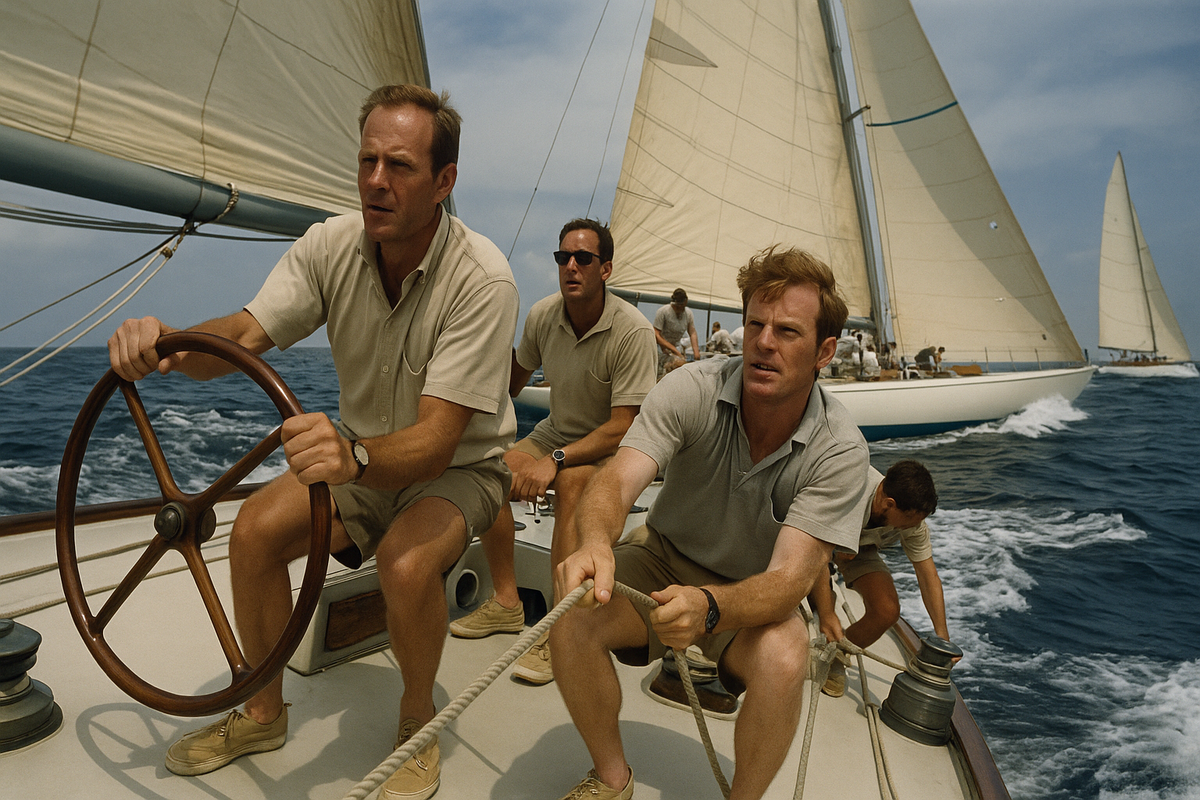
The magazine's visual presentation matched its editorial ambition. Black-and-white photography captured Intrepid heeled over in full racing trim, crew positioned like chess pieces across the deck. Technical diagrams broke down crew positions and sail configurations. The cover itself announced this as more than sports coverage—this was cultural documentation.
Time's writers understood something crucial: the America's Cup was theater. The actual racing might last hours across multiple days, but the real story was what the Cup meant. American technological prowess. The persistence of aristocratic ritual in a democratizing age. The question of whether tradition could coexist with revolution.
Inside the August 18, 1967 Issue
The Dominance Narrative
Time emphasized America's unbroken 116-year hold on the Cup, framing it as a story of continuity and national confidence in an era of upheaval.
Engineering Innovation
Olin Stephens' Intrepid design represented a bold leap in yacht technology, showcasing radical hull shapes and lighter construction methods.
The Gentleman-Athlete
Bus Mosbacher embodied the ideal: steady temperament, tactical intelligence, and the grace of old-world sportsmanship meeting modern competition.
Newport's Theater
More than a race, the Cup was portrayed as a social event where wealth, elegance, and tradition met the sea in America's most exclusive harbor.
Why This Issue Commands Attention
Walk into any serious vintage magazine collection, and the August 18, 1967 Time stands apart.
The timing freezes a singular moment. Within five years, Australia would mount increasingly serious challenges. By 1983, the Cup would finally leave American hands, shattering the longest winning streak in sports history. This issue captures the confidence of the last years before that fall—when American supremacy at sea felt as permanent as the tides themselves.
The craftsmanship holds up. Time's photo editing and page design from this era represents magazine journalism at its peak, before budget cuts and digital disruption. Each spread was composed like a museum exhibition. The integration of technical illustration with action photography created something that transcended ordinary sports reporting.
The cultural snapshot endures. Newport's world—the one Time documented so precisely—would soon face its own reckonings. Property taxes, changing social mores, and the democratization of sailing would transform yacht racing from a purely elite pursuit into something more accessible. This issue preserves that transition point, when the old order still reigned but couldn't quite ignore the gathering winds of change.
For collectors, these elements converge into something rare: a magazine that works as both historical document and aesthetic object. You can read it for the racing coverage, study it for the social history, or simply admire it as an example of mid-century magazine craft at its finest.
The Preservation of Prestige
Vintage Time issues from the 1960s carry particular weight because they captured America at the height of its contradictions. The same magazine that would soon document moon landings and political assassinations here turned its lens on yacht racing—and found a story just as revealing about who Americans thought they were.
"The Intrepid Gentleman" article understood that covering the America's Cup meant covering American identity itself. The boats were fast, the sailors skilled, the technology cutting-edge. But underneath ran deeper currents: pride, continuity, the belief that some traditions deserved defending even as the nation transformed around them.
That's why this issue resonates beyond sailing enthusiasts. It's a window into how America presented itself—to itself and to the world—in a year when that presentation was under unprecedented scrutiny.
Collector Significance
Historical Timing
Captures the America's Cup during the final decades of unbroken American dominance—a 116-year winning streak that would end in 1983.
Visual Excellence
Striking black-and-white photography and technical diagrams represent Time's peak era of photo-journalism and editorial design.
Cultural Documentation
Preserves Newport's elite yacht culture at a moment of social transition, documenting rituals and traditions that would soon transform.
Enduring Appeal
Speaks to sailing enthusiasts, cultural historians, and collectors of mid-century American media as both artifact and aesthetic achievement.
Time Magazine's August 18, 1967 issue stands as one of the definitive documents of yacht racing's American century. "The Intrepid Gentleman" captured Bus Mosbacher's tactical genius, Olin Stephens' design innovation, and the rituals of Newport's summer season with equal precision.
More than five decades later, the issue retains its authority. The photography still stuns. The writing still illuminates. And the story it tells—of American confidence, technological ambition, and the stubborn persistence of tradition—speaks to questions we're still asking about who we were and who we wanted to be.
For collectors and historians alike, vintage magazines like this aren't just paper and ink. They're time machines. And this particular issue offers passage to a moment when white sails against blue water carried the weight of national pride, and victory seemed as inevitable as the sunrise.
Where History Lives
Original copies of Time's August 18, 1967 issue remain available through specialized vintage magazine collections. From the 1930s through the 1970s, these publications documented American culture in real time, preserving moments that secondary sources can only approximate.
Browse Time Magazine Collection