
The Magazine That Closed One Era and Opened Another
How Ebony's November 1962 issue traced Black leadership from Booker T. Washington to Martin Luther King Jr.—and became one of the most significant artifacts in American publishing history
November 1962. A reader in Harlem opens her mailbox and pulls out the latest Ebony. On the cover: Martin Luther King Jr., photographed not in the chaos of a march but in contemplative profile—a man carrying the weight of history on his shoulders. She doesn't know it yet, but she's holding the last chapter of a story that began with Booker T. Washington's compromise and would end with King's assassination six years later.
Inside, historian Lerone Bennett Jr. has just published the final installment of his Negro History series: "From Booker T. to Martin L." It's not just an article. It's a thesis. A genealogy of Black leadership that traces the philosophical line from Washington's vocational pragmatism through Du Bois' militant intellectualism to King's synthesis of both—mass protest grounded in moral authority.
For that reader in 1962, this wasn't nostalgia. It was a roadmap. The civil rights battles exploding across the South weren't spontaneous—they were the culmination of strategic evolution spanning half a century. Bennett made that argument explicit: every generation's struggle creates the language for the next.
Sixty years later, this issue remains one of the most significant artifacts in African American publishing history.
Why November 1962 Mattered—Then and Now
The timing was surgical. That year marked the centennial of the Emancipation Proclamation, a milestone dripping with irony. One hundred years after Lincoln's promise, African Americans were still fighting for the right to vote, eat at lunch counters, and attend integrated schools. The symbolism was unavoidable, and Ebony leaned into it.
But 1962 wasn't just symbolic—it was volcanic. The Freedom Rides had just bloodied the South. James Meredith's enrollment at the University of Mississippi required federal troops. The Student Nonviolent Coordinating Committee (SNCC) was radicalizing. The Southern Christian Leadership Conference (SCLC) was planning Birmingham. The movement was accelerating, and Bennett's article functioned as both historical context and strategic analysis.
By publishing "From Booker T. to Martin L." at this moment, Ebony did something radical: it positioned King not as an isolated prophet but as the inheritor of a tradition. Washington laid groundwork. Du Bois sharpened the critique. Charles Hamilton Houston and Thurgood Marshall won in court. A. Philip Randolph proved mass mobilization worked. King synthesized it all.
The article told Ebony's readers: This didn't start yesterday. And it won't end tomorrow.
Issue Details
Historical Figure: Martin Luther King Jr. (cover), Lerone Bennett Jr. (author)
Issue Date: November 1962
Archive Source: Ebony Magazine – Negro History Series (Final Installment)
Article Title: "From Booker T. to Martin L."
Historical Context: Centennial of Emancipation Proclamation, height of Civil Rights Movement
Ebony as Institution, Not Just Publication
Since John H. Johnson founded it in 1945, Ebony operated as more than a magazine—it was infrastructure. At a time when mainstream media either ignored Black life or caricatured it, Ebony presented African Americans as doctors, entrepreneurs, artists, parents, and intellectuals. It was Life magazine, but for a readership that Life pretended didn't exist.
Lerone Bennett Jr., the magazine's senior editor and in-house historian, understood this mission deeply. His Negro History series, which concluded with the November 1962 issue, wasn't filler content. It was canon-building. He gave Ebony's readers a usable past—one that connected Reconstruction-era organizing to 1960s sit-ins, that linked 19th-century abolitionists to 20th-century activists.
In "From Booker T. to Martin L.," Bennett profiled the architects of Black political strategy:
Booker T. Washington, who preached accommodation and vocational training at Tuskegee—a strategy that bought time but ceded moral ground.
W.E.B. Du Bois, who rejected Washington's compromise and co-founded the NAACP, demanding immediate equality and intellectual leadership through what he called the "Talented Tenth."
Charles Hamilton Houston and Thurgood Marshall, who built the legal infrastructure that dismantled Plessy v. Ferguson and won Brown v. Board of Education in 1954.
A. Philip Randolph, whose threatened 1941 March on Washington forced Franklin Roosevelt to issue Executive Order 8802, banning discrimination in defense industries—proof that mass mobilization could bend federal policy.
Mary McLeod Bethune, whose influence with Eleanor Roosevelt brought women's leadership into national civil rights organizing.
Martin Luther King Jr., who fused Christian theology, Gandhian nonviolence, and mass protest into a movement that couldn't be ignored or dismissed.
These weren't just names. For Ebony's readership, they were the continuity—the proof that progress wasn't accidental but engineered across generations.
The Visual Language of Resistance
Ebony understood something other magazines didn't: politics isn't separate from culture. The November 1962 issue reflected this in its visual architecture.
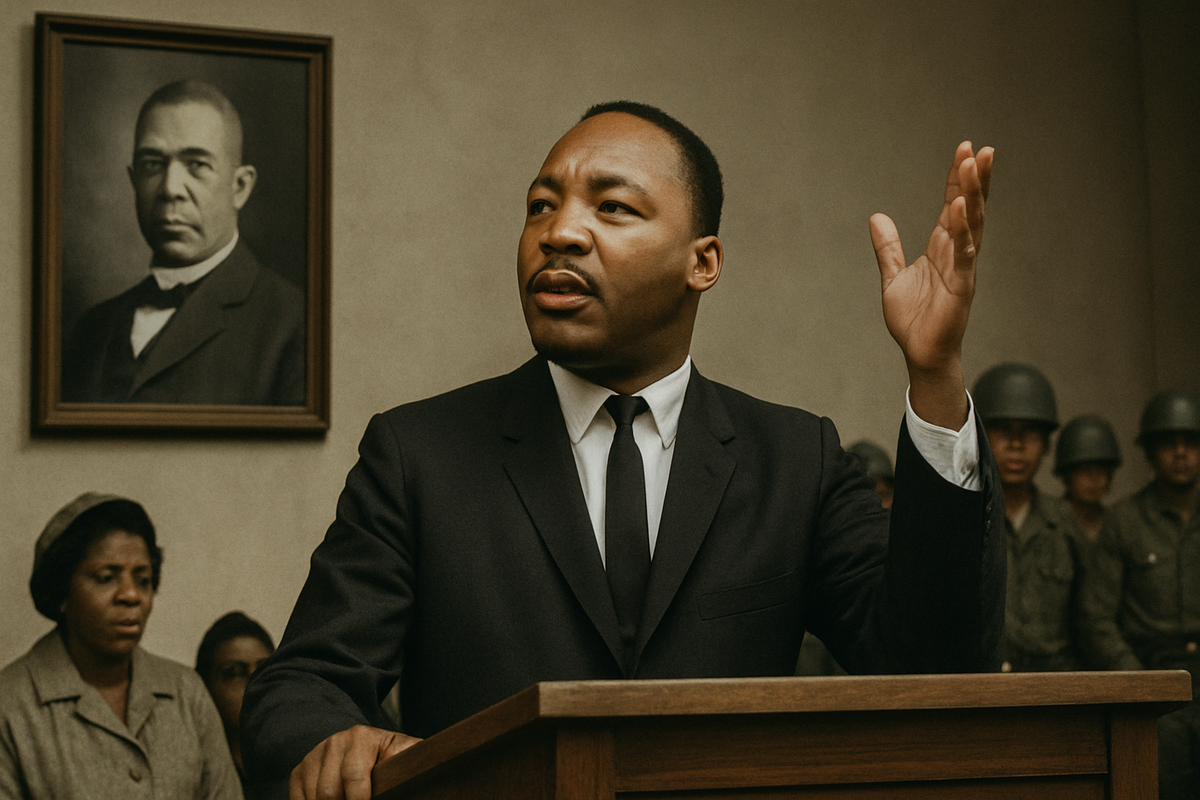
The cover image of King was deliberate—dignified, contemplative, almost regal. Not the firebrand of Birmingham but the philosopher-king. Inside, the layout juxtaposed past and present:
Booker T. Washington's formal portrait anchored the article in the 1900s.
Photographs of federal troops enforcing desegregation at Little Rock reminded readers that legal victories required force to implement.
Images of Chicago beach wade-ins showed that racial violence wasn't confined to the South.
King at the pulpit, mid-speech, arm raised—captured the immediacy of leadership in real time.
And then: Addie Phillips, walking alone in the rain during the Montgomery Bus Boycott. Not a celebrity. Not a strategist. Just a woman who decided to walk rather than submit.
That photograph encapsulated Ebony's editorial philosophy: the movement wasn't just King and Randolph and Marshall. It was Phillips. It was every domestic worker who walked miles to work during the boycott. It was every student who sat at a lunch counter and absorbed blows without retaliating. Leadership mattered, but so did the people willing to follow.
This visual strategy—mixing intellectual portraiture with grassroots documentation—made Ebony essential. It was history as it happened, documented by people who understood its significance.
Bennett's Argument: Strategy as Inheritance
The genius of "From Booker T. to Martin L." wasn't just its biographical sweep—it was its thesis about strategic evolution.
Leadership Adapts to Context
Washington's caution made sense in the post-Reconstruction South, where white terrorism was rampant. Du Bois' militancy made sense as the Great Migration reshaped Black political power. King's nonviolence made sense when television could broadcast Southern brutality into Northern living rooms.
Legal Victories Require Enforcement
Brown v. Board didn't integrate schools—Little Rock proved that. Litigation opened doors; mass protest and federal intervention forced them to stay open.
Women Were Never Auxiliary
Bennett emphasized that figures like Bethune, along with grassroots organizers in boycotts and sit-ins, weren't supporting players—they were co-architects of strategy.
The Struggle Was National, Not Regional
By 1962, race riots in northern cities proved that segregation wasn't a Southern problem—it was an American one.
The Emancipation Proclamation's Legacy Was Incomplete
One hundred years later, Ebony reminded readers that the freedom promised in 1863 remained aspirational. The article made that gap explicit.
Strategy Is Cumulative
For readers in 1962, this wasn't academic. It was a warning: legal wins and moral clarity weren't enough. The fight required sustained, strategic pressure across multiple fronts—courts, streets, ballot boxes, and public opinion.
The Long View: What Bennett Couldn't Have Known
Reading "From Booker T. to Martin L." today is eerie. Bennett traced fifty years of progress—but he couldn't see the next six. King would be dead by 1968. The Black Power movement would fracture nonviolence as doctrine. The legal gains of the 1960s would face decades of erosion and backlash.
But Bennett's core argument holds: strategy evolves, but struggle persists. The leaders change. The tactics shift. The continuity remains.
That's why this issue matters beyond its collectible value. It's a reminder that movements aren't spontaneous—they're cumulative. Every march builds on the last. Every legal brief cites the previous one. Every generation inherits both victories and unfinished work.
The November 1962 Ebony captured that inheritance at a specific moment—right before everything accelerated and then exploded. It's a snapshot of optimism grounded in hard-won historical knowledge.
For anyone trying to understand how the Civil Rights Movement thought about itself, this issue is essential.
Why Collectors Prize This Issue
Landmark Series Conclusion
Bennett's Negro History installments were among the most ambitious attempts to synthesize African American history for a popular audience. This was the capstone.
Iconic Cover
A portrait of King during the Civil Rights Movement's peak makes this one of the most sought-after Ebony issues. It's not just a magazine—it's a document.
Historical Pivot Point
1962 sits between the early victories (Montgomery, Little Rock) and the coming trauma (Birmingham, Selma, Memphis). The optimism in this issue is haunting in retrospect.
Archival Photography
These images aren't staged—they're primary sources. For historians, collectors, and families, they're irreplaceable.
Scarcity
Magazines were disposable. Most copies didn't survive. The ones that did are often fragile, yellowed, incomplete. A well-preserved November 1962 issue is rare.
Cultural Infrastructure
Vintage Ebony issues documented African American life when mainstream media wouldn't. For descendants of that era, owning these issues is an act of preservation.
For Collectors and Historians
Original issues of Ebony from the 1940s through the 1980s documented African American life with unmatched depth and dignity. The November 1962 issue—with Lerone Bennett Jr.'s "From Booker T. to Martin L."—stands among the most historically significant.
Owning one of these issues isn't just collecting. It's safeguarding history that mainstream archives overlooked for decades. It's preserving the record of a people who insisted on documenting their own story—on their own terms.
Browse Ebony Magazine Collection