
The Assassin's Shadow: How Time Magazine Captured America's Gun Reckoning in 1968
When two bullets in two months decapitated American liberalism, Time held up a mirror to a nation that could no longer look away
Two bullets in two months had decapitated American liberalism.
When subscribers unfolded the June 21, 1968 issue of Time Magazine, the ink was barely dry on Robert F. Kennedy's obituary. Martin Luther King Jr. had fallen in April. Now Kennedy—shot in a Los Angeles hotel kitchen just days before this issue went to press—lay dead at 42. The nation wasn't mourning anymore. It was hemorrhaging.
Time responded with "The Gun Under Fire," a feature that functioned less as reportage and more as a mirror held up to a country that could no longer look away. This wasn't simply journalism. It was an autopsy of American violence, published while the patient was still convulsing.
Archive Details
Publication: Time Magazine
Issue Date: June 21, 1968
Feature Article: "The Gun Under Fire"
Historical Context: Published days after Senator Robert F. Kennedy's assassination and two months after Dr. Martin Luther King Jr.'s murder
Archive Significance: Primary source document capturing the national gun control debate at its breaking point
A Republic on the Brink
The year 1968 remains a scar on the American century. Vietnam consumed young men by the thousands with no exit strategy in sight. Cities from Memphis to Chicago burned with civil rights fury. The Democratic Party, hemorrhaging credibility, lurched toward its catastrophic Chicago convention.
Then came the assassinations.
King and Kennedy didn't just die—they were executed in public view, their deaths broadcast into living rooms across the nation. Gun violence was no longer an abstract crime statistic relegated to police blotters. It was altering the trajectory of American leadership in real time. The ballot box had been supplanted by the gun barrel.
Public outrage ignited calls for sweeping reform. But resistance mobilized just as quickly. The National Rifle Association, gun manufacturers, and conservative lawmakers dug in. Time captured this exact inflection point: the moment when America asked itself whether it could survive without confronting its gun culture—and whether reform was even possible when the firearm lobby already possessed the power to strangle legislation in its crib.
The Anatomy of the Article
Time didn't flinch. "The Gun Under Fire" deployed hard statistics, visceral photography, and biting editorial commentary in equal measure. One passage cut to the bone: "Forget the democratic processes, the judicial system and the talents of organization… the affluence of a people may be great enough, but the fundamental respect for law has come unmoored."
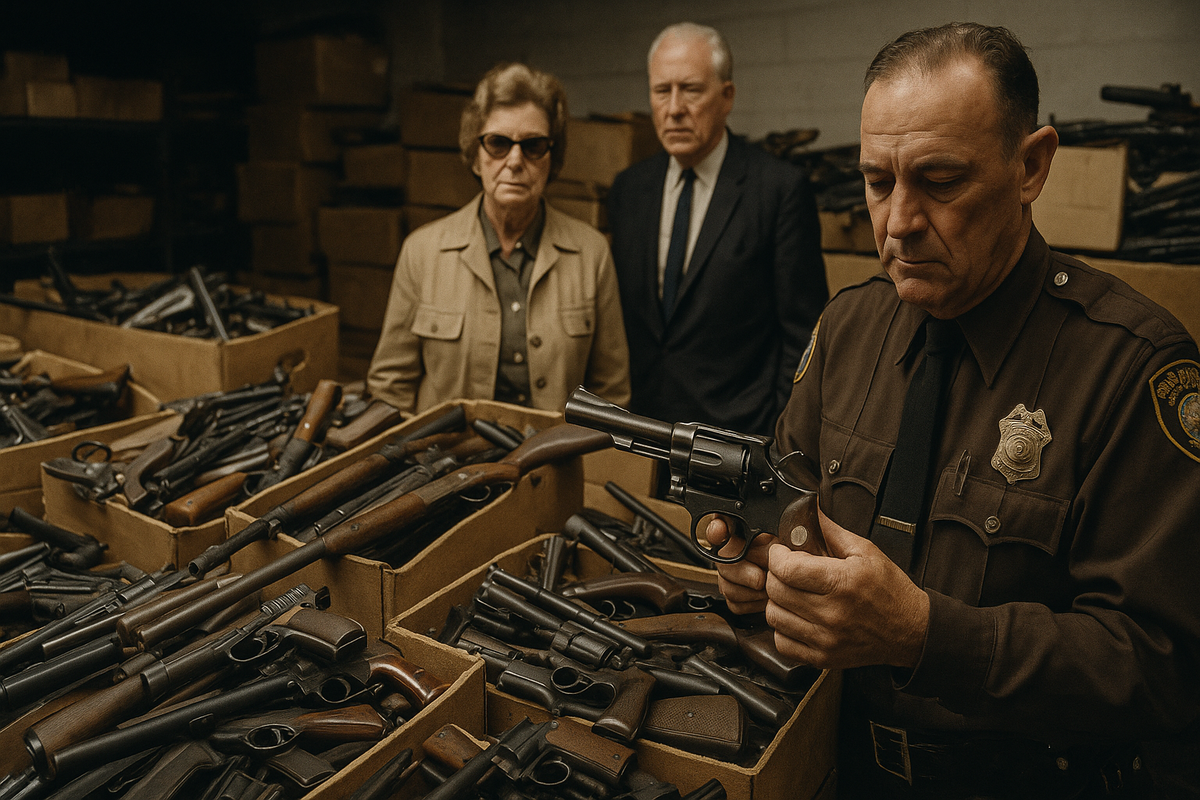
The visual language was equally brutal. Readers confronted photographs of confiscated weapons—pistols, rifles, shotguns—stockpiled in Los Angeles police evidence rooms like surplus inventory. The sheer volume was the message: a nation drowning in its own arsenal. Other images showed elderly Michigan women at pistol ranges and young Texans training with BB guns, illustrating how deeply firearms had woven themselves into the fabric of ordinary American life.
But Time deployed something sharper than photographs: satire. Political cartoons laced throughout the feature drove home the absurdity with surgical precision. One drawing reimagined the Great Seal of the Presidency as a bullseye. Another depicted a man clutching his rifle, snarling: "If anybody disagrees, I'll shoot them." The irony needed no annotation.
This fusion of serious documentation and dark humor gave the article a layered resonance—tragic, sobering, and grimly prescient all at once.
The Magazine as National Interpreter
While the cover of the June 21 issue addressed broader national unrest, "The Gun Under Fire" distinguished itself through its editorial architecture: photography, illustration, and statistical evidence fused into a single narrative argument.
This was Time's evolutionary advantage. Newspapers reported events. Time curated them into digestible narrative arcs that Americans could absorb at the breakfast table. The stacked weapons weren't merely evidence—they were symbolic of a country losing control of its founding mythology. The juxtaposition of documentary photography and satirical cartoons created texture, allowing the issue to function simultaneously as news report, cultural critique, and historical artifact.
In 1968, before the 24-hour news cycle, before cable television fractured the national conversation, magazines like Time served as the primary lens through which Americans understood crisis. Reading this issue wasn't passive consumption. It was guided interpretation of a national emergency.
What the Article Revealed
The Frontier Myth Under Interrogation
Time traced America's gun fixation back to the frontier hero—the armed settler as liberty's guardian. But the magazine posed an uncomfortable question: Could a mythology forged in the 19th century wilderness survive in 20th century urban America?
The Scale of the Problem
Statistics in the article quantified the crisis: millions of licensed gun owners nationwide, with over 3,000 gun dealers operating in Massachusetts alone. The numbers illustrated not just widespread ownership, but a vast commercial infrastructure built on firearms circulation.
The NRA's Metamorphosis
Time documented the National Rifle Association's transformation from a sportsmen's club into a political juggernaut, already capable of blocking meaningful federal legislation.
Resistance in the Senate
While clergy and reformers demanded action, conservative senators like Everett Dirksen of Illinois and Strom Thurmond of South Carolina erected legislative roadblocks, prioritizing gun rights over gun control.
The Verdict
The article concluded with grim realism: reforms might reduce immediate danger, but gun culture had embedded itself too deeply in American identity for easy extraction. The assassinations made change urgent. But urgency didn't equal consensus.
A Living Archive
What elevates this issue beyond collectibility is its function as historical evidence. Each page reflects the compressed urgency of the late 1960s: war abroad, upheaval at home, a culture interrogating its foundational values.
Vintage magazines are time machines. They preserve not just information, but the experience of receiving that information—the layout decisions, the editorial choices, the visual grammar that guided interpretation. This is the media ecosystem that shaped a generation's worldview, frozen in ink and paper.
Why Collectors Should Own This Issue
The June 21, 1968 Time Magazine isn't memorabilia—it's a primary historical document from one of democracy's darkest chapters.
Timing
Published within days of Robert Kennedy's assassination, the issue captured the national debate at its most raw and unfiltered moment.
Documentary Value
The integration of reporting, photography, and political cartoons makes it both a journalistic artifact and a piece of visual history—evidence of how media shaped public consciousness in real time.
Perpetual Relevance
The gun rights versus gun control debate remains America's most enduring and divisive political fault line. This issue provides the origin story of that modern conflict.
Owning this magazine means possessing the actual pages that American families read while processing grief, fear, and rage in the summer of 1968. Not a reprint. Not a summary. The original artifact that sat on newsstands and coffee tables, shaping opinion as history unfolded.
Build Your Archive
For collectors assembling a library of 20th century America, the June 21, 1968 issue is essential. It represents both a moment of national tragedy and a case study in how media framed the country's most urgent debates.
Browse Time Magazine CollectionFrom the 1920s through the 1970s, the collection documents how Time chronicled world wars, civil rights struggles, political assassinations, and cultural revolutions. Each issue is an original artifact from the era it covers.
The Verdict
The June 21, 1968 issue of Time Magazine—featuring "The Gun Under Fire"—stands as one of the most important cultural documents of its decade. It captured a nation in grief after political assassinations, exposed the scope of America's gun crisis, and illustrated the collision between historical mythology and contemporary reality.
To hold this issue today is to hold the exact pages that forced Americans to confront an uncomfortable question: Could the United States curb its relationship with firearms, or was the cycle of violence permanent?
For anyone who values history as more than abstraction, this magazine transcends paper. It's a living artifact, preserving a debate that continues to shape America more than half a century later.