
The Dictator in Your Living Room
When Life Magazine Introduced Americans to Adolf Hitler
December 7, 1936. Most Americans that Sunday were thinking about Christmas shopping, not Germany. But anyone who cracked open the third issue of a bold new magazine called Life found something unsettling waiting on pages 24 and 25: a visual dissection of Adolf Hitler, presented not as a monster, but as a biography.
No moral judgment. No condemnation. Just photographs and captions tracing a failed Austrian art student's climb to absolute power—published before the world knew what was coming.
This wasn't sensationalism. It was something more dangerous: clarity. And for collectors and historians today, this issue remains one of the most chilling documents of how the 20th century sleepwalked into catastrophe.
Archive Data
Historical Figure: Adolf Hitler
Issue Date: December 7, 1936
Archive Source: Life Magazine (Issue No. 3)
Feature Title: "Hitler on High" — Biography of a Dictator
A New Magazine Captures a New Kind of Threat
Henry Luce's Life Magazine was only weeks old when it published "Hitler on High," but its revolutionary approach to photojournalism was already apparent. Photography wasn't decoration—it was the story. Words guided the eye, but images carried the weight.
The timing was deliberate. By late 1936, Hitler had ruled Germany for nearly four years. That March, German troops reoccupied the Rhineland, violating the Treaty of Versailles with barely a murmur of resistance from Britain or France. In August, Berlin hosted the Olympics—a meticulously staged propaganda showcase that the world watched with uneasy fascination.
In America, isolationism reigned. Europe's problems felt distant, containable. Yet awareness was growing that Germany's trajectory under Hitler represented something unprecedented. Life gave its readers what newspapers couldn't: a face-to-face encounter with the man reshaping Europe.
The magazine didn't put Hitler on its cover. It didn't need to. Inside, the visual biography commanded attention through sheer force of organization and detail.
Twenty Stages from Obscurity to Omnipotence
The essay laid out Hitler's life in twenty numbered stages, each paired with archival photographs. The progression was stark:
Born in Braunau, Austria, 1889. An unremarkable child in a provincial town.
Troubled school years. He excelled only in history and drawing—foreshadowing both his obsessions and his failures.
Corporal in World War I. The war that broke Europe gave Hitler purpose and grievance in equal measure.
The Beer Hall Putsch, 1923. A failed coup that landed him in prison, where he wrote Mein Kampf—transforming defeat into doctrine.
Rise as orator and demagogue. Promises of jobs to workers, land to farmers. The rhetoric of restoration.
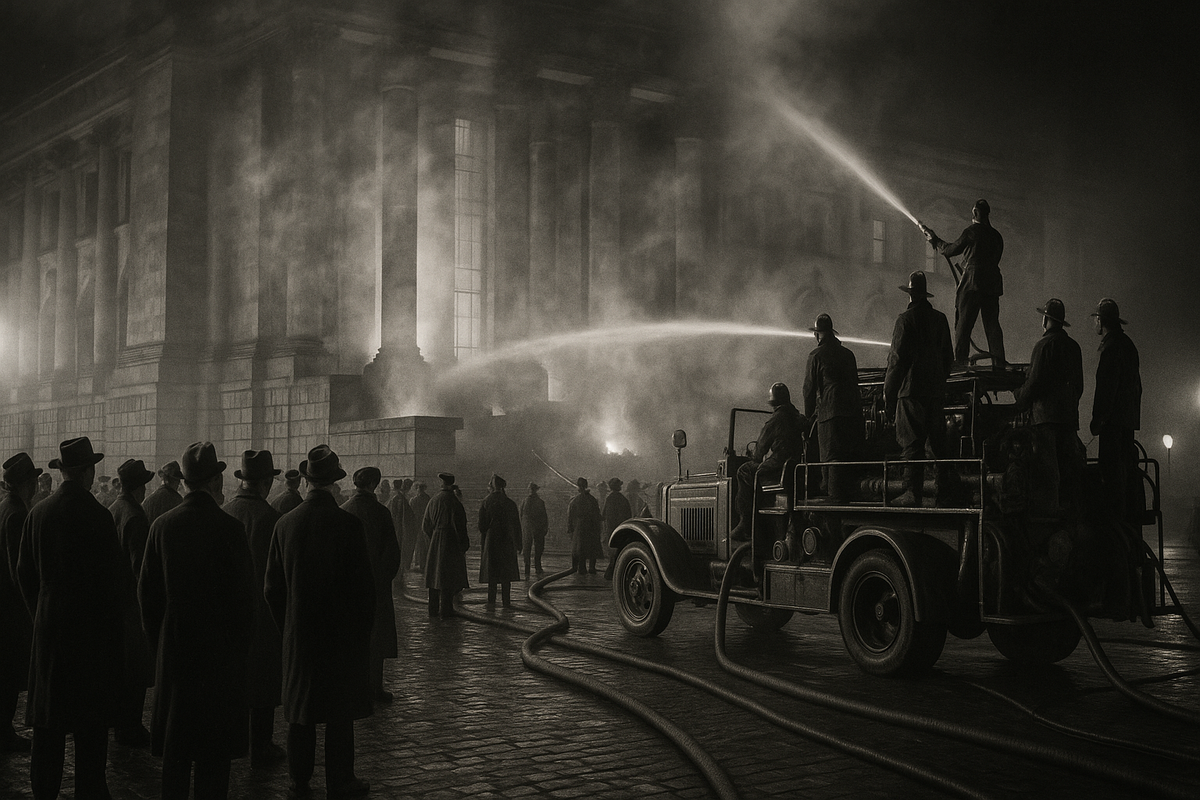
The Reichstag fire, 1933. Still mysterious in origin, framed here as the pivot point for Nazi consolidation of total control.
Mass deification. By 1936, Hitler commanded rallies that resembled religious ceremonies, his followers numbering in the hundreds of thousands.
What makes this chilling is the simplicity. Life presented Hitler's ascent as a sequence of logical steps, each building on the last. Readers could see how personal failure, historical trauma, and political genius converged into dictatorship. The magazine wasn't justifying—it was explaining. And that explanation, delivered without the hindsight of war or Holocaust, feels almost clinical in its neutrality.
The Many Faces of der Führer
The lead image showed Hitler in uniform, arm raised in salute, photographed from below to emphasize dominance. But beneath it ran a strip labeled "Faces of der Fuehrer": rabble-rouser, music-lover, charmer, high hat, thinker, dog-lover.
This was the essay's most unsettling innovation. Instead of portraying Hitler as a one-dimensional tyrant, Life revealed his strategic versatility—the multiple personas he deployed depending on audience. Fiery. Reflective. Domestic. Charming.
For 1936 readers, this underscored his political genius: Hitler could be all things to all people. For readers today, it demonstrates how authoritarianism markets itself through adaptability and performance.
The photographs reinforced this. Storm troopers marching through Munich streets. The Reichstag in flames. Hitler addressing seas of upturned faces, their devotion captured in sharp focus. Life wasn't editorializing—it was documenting. And the documentation was damning precisely because it seemed so objective.
Why This Moment Still Matters
What endures about this issue is what it reveals about both journalism and history. Life Magazine gave Americans clarity—a visual narrative that made Hitler comprehensible. But comprehension without condemnation, explanation without alarm, can be its own form of complicity.
That's the uncomfortable truth embedded in these pages. The magazine wasn't wrong to profile Hitler. But its neutrality—appropriate for a new publication establishing credibility—now reads as naïveté. The world underestimated him. Life documented that underestimation.
This is why vintage magazines matter. They don't just show us events—they show us how events were perceived before outcomes were known. They capture the moment when history could still have gone differently, when warnings were visible but not yet heeded.
The December 7, 1936 issue is a time capsule of that dangerous middle ground: when Americans knew enough to be concerned, but not enough to act.
What This Issue Means to Collectors
Publishing History
The third issue of Life Magazine ever published. For collectors building a complete run, this is foundational—one of the earliest examples of Luce's photojournalism revolution.
Historical Significance
One of the first comprehensive American media portrayals of Hitler. Published before Austria's annexation, before Munich, before war—it captures how Americans were introduced to the dictator who would define their generation.
Archival Value
Documents perception in real time. Unlike wartime propaganda or postwar condemnation, this article shows how Hitler was explained and understood before the world knew the full scope of his ambitions. That contemporaneous perspective—clinical, descriptive, unsettlingly neutral—makes it invaluable to historians studying how democracies failed to recognize authoritarian threats.
The issue isn't just collectible. It's a warning preserved in black and white.
Explore the Archive
If this issue intrigues you, thousands more await—original Life magazines spanning four decades of American history. Each issue is a window into how the 20th century saw itself: the photography, the reporting, the cultural moments that defined generations.
Browse Life Magazine CollectionThese aren't reproductions. They're original witnesses to history—the same pages Americans held in 1936, 1945, 1969. For collectors, students of media, or anyone who believes the past has lessons for the present, they're irreplaceable.
A Warning That Still Speaks
Holding the December 7, 1936 issue of Life Magazine today means holding more than vintage paper. It's holding a document of how power seduces, how propaganda functions, and how democracies fail to see threats until it's too late.
Thanks to Henry Luce's pioneering vision, that warning remains legible nearly ninety years later—frozen in photographs and captions that captured a dictator's rise before the world understood what it was witnessing.
History doesn't repeat. But it does echo. And this issue, more than most, still echoes loud.