
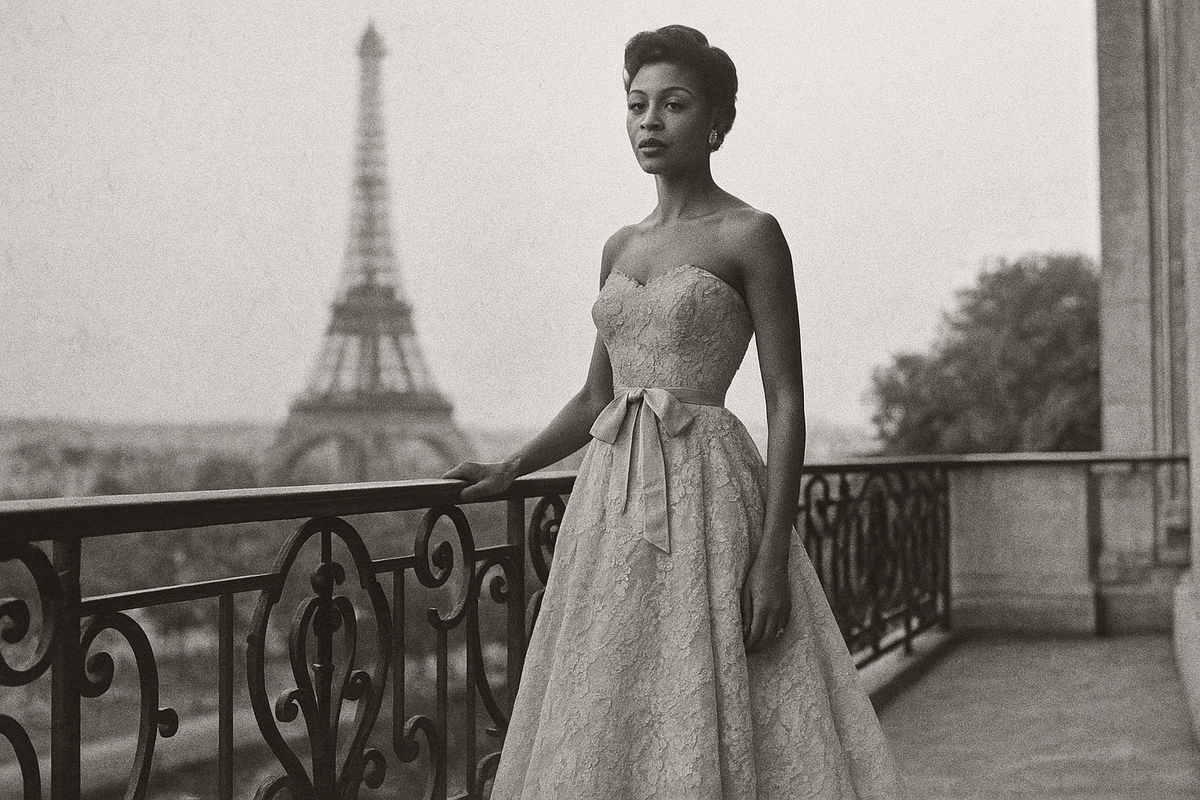
When Paris Couture Walked Into Black America
The November 1959 Ebony That Changed Everything
In November 1959, a magazine arrived in mailboxes across Black America carrying something more subversive than protest signs: photographs of Black women wearing Dior.
Not illustrations. Not aspirational sketches. Actual couture—Chanel dance dresses with turquoise moiré ribbons, Balenciaga coats, Lanvin-Castillo gowns with Spanish lace mantillas—modeled by Black women who would soon carry these same garments into segregated cities where those women couldn't try on a dress in a department store.
The November 1959 issue of Ebony Magazine, featuring "The Magic of a Paris Original," was an act of cultural defiance disguised as fashion journalism.
While the Supreme Court's Brown v. Board of Education ruling was five years old and federal troops had escorted the Little Rock Nine into Central High School just two years prior, the battle for dignity was being fought on multiple fronts. Ebony understood something radical: representation in haute couture was as political as a lunch counter sit-in. To be seen as worthy of Paris—of Dior, of Chanel, of Pierre Cardin—was to claim space in a world determined to deny it.
The Woman Who Brought Paris to Harlem
Freda DeKnight didn't just report on fashion. As Ebony's pioneering fashion editor, she traveled to Paris—alone, Black, female, in 1959—to handpick couture for an African American audience that mainstream fashion magazines pretended didn't exist.
Her mission was precise: find the best of haute couture, the pieces that would translate from Parisian ateliers to the stages of the Ebony Fashion Fair, the touring spectacle that had launched in 1958 and would become a cultural institution. DeKnight spent weeks navigating the salons of Europe's most exclusive designers, selecting pieces that balanced aspiration with accessibility. A $1,500 original might be unattainable, but the American copies—priced under $50—would bring Paris to Detroit, Memphis, Birmingham, Los Angeles.
DeKnight's reporting carried authority because she understood her readers weren't window shopping. They were claiming their place in the global narrative of elegance.
Archive Details
Publication: Ebony Magazine
Issue Date: November 1959
Feature Article: "The Magic of a Paris Original"
Fashion Editor: Freda DeKnight
Historical Context: Published during the civil rights movement, five years after Brown v. Board of Education
What Paris Meant in 1959
The article's central thesis was unapologetic: Paris remained the apex of fashion, even as American and Italian designers gained ground. This wasn't jingoism. It was fact, documented through fabric and silhouette.
Jacques Esterel's wedding gown—the same designer who created Brigitte Bardot's real wedding dress—featured lace sourced from Lyon, the French city synonymous with textile mastery. Chantilly lace, Calais lace, Lyon lace: these weren't just materials, they were geographical markers of heritage and craft. The black lace mantilla gown by Lanvin-Castillo nodded to Spanish influence while maintaining Parisian construction. Jean Patou's polka-dot satin coat elevated outerwear into art.
But the genius of DeKnight's curation was context. She didn't just describe a Chanel dance dress with turquoise moiré ribbons as beautiful—she explained why it mattered. The playful youthfulness of the piece challenged assumptions about who couture was for. The structured tweed suits by Pierre Cardin and Nina Ricci weren't simply garments; they were armor for women navigating professional spaces that didn't want them there.
Every caption read like a miniature essay. Hem lengths, silhouettes, fabric origins—DeKnight treated fashion as seriously as Ebony treated civil rights reporting, because for her readers, they were connected.
Ebony affirmed that Paris couture remained the pinnacle of fashion in 1959, even as American design gained traction.
Jacques Esterel's lace gown, with fabric from Lyon, stood out as one of the most glamorous wedding dresses of the year.
Lanvin-Castillo's black lace gown, paired with a mantilla, reflected international flair within Parisian construction.
Jean Patou's polka-dot satin coat and Cardin's structured wool coats elevated everyday clothing into couture.
Chantilly lace, Calais lace, Lyon lace, and moiré ribbons were more than materials—they were symbols of heritage and luxury.
While couture gowns could cost $1,500, affordable American copies ensured ordinary readers could enjoy the styles.
The Ebony Fashion Fair: Couture as Protest
The touring Ebony Fashion Fair transformed fashion from spectacle into movement. Over 200 garments and 400 accessories traveled to more than 20 cities in 1959, bringing Paris to Black communities locked out of white retail spaces.
Imagine the audacity: In towns where Black women were forbidden from trying on clothing in stores, they watched Black models glide across stages wearing the identical gowns photographed in Paris salons. The Fashion Fair wasn't escapism—it was proof of belonging. It said: You are part of this story. You deserve this beauty.
The show would continue for decades, becoming one of the longest-running fashion events in American history. But in 1959, it was still new, still radical, still making the argument that elegance itself could be resistance.
The Magazine as Weapon and Mirror
Ebony's editorial strategy was surgical. While Vogue and Harper's Bazaar ignored African Americans entirely—or relegated them to service roles in the rare instances they appeared—Ebony gave its readers the full spectrum of humanity.
The November 1959 issue didn't segregate content into "serious" and "frivolous." Paris couture appeared alongside political commentary and civil rights reporting. The magazine insisted that Black readers could—and should—care about both justice and joy, politics and glamour, protest and beauty.
This editorial philosophy was visible in the magazine's photography. Unlike the illustrated covers dominating mainstream fashion magazines, Ebony used bold, clear photography to document reality. The cover of the November 1959 issue featured portraiture that exuded dignity—not aspiration to whiteness, but affirmation of Black beauty on its own terms.
Inside, the Paris fashion feature demonstrated photojournalistic mastery. Gowns weren't simply displayed as clothing—they were presented as art, as cultural artifacts, as proof that Black women belonged in the global conversation about style and sophistication. Black-and-white images highlighted the textures that made couture distinct: the crush of suede, the structure of brushed wool, the delicacy of Chantilly lace against skin.
The Enduring Power of Ebony
Ebony magazines from the 1950s endure because they refused to accept the narrative that Black Americans were secondary characters in their own country's story. Each issue was a counter-argument, a correction, a celebration.
The November 1959 issue, with its Paris couture and Ebony Fashion Fair coverage, made a claim that resonates today: beauty is political, representation matters, and elegance is a form of resistance.
At a time when mainstream media erased or stereotyped Black lives, Ebony showed the full picture—the activist and the artist, the church leader and the fashion model, the lawyer and the entertainer. That editorial vision is why these magazines are treasured as both journalism and cultural artifacts.
Why This Issue Matters to Collectors Today
Published at the cusp of the 1960s—before the sit-ins, before Freedom Rides, before the March on Washington—this issue captured Black elegance at a pivotal moment.
As one of the first Black women to hold significant editorial power at a major publication, DeKnight's work broke ground that remains under-recognized.
Early issues documenting the Ebony Fashion Fair are increasingly scarce. As the Fair became an institution over subsequent decades, these founding-era magazines gained historical weight.
Vintage Ebony magazines from the 1950s are harder to find than later decades. Issues tied to major cultural themes command collector attention.
For families, these magazines are more than collectibles. They're the same pages grandparents read, physical links between generations navigating different eras of the same struggle.
Owning this issue means holding an artifact that documented dignity and style in the face of systemic exclusion. It's not nostalgia—it's evidence.
Own a Piece of This History
If this story resonates, you don't have to just read about it—you can hold it.
From the 1940s through the 1970s, Ebony documented African American life with unmatched depth and dignity.
For collectors, historians, and families, they're more than reading material.
They're living artifacts of heritage—pieces of history that belong on your bookshelf as much as in museums.
Conclusion
The November 1959 Ebony Magazine, with its feature "The Magic of a Paris Original," was more than fashion journalism. It was a declaration: Black women belonged in the story of global elegance, not as footnotes but as protagonists.
Through Freda DeKnight's curation, the photography of couture in Parisian settings, and the revolutionary reach of the Ebony Fashion Fair, this issue placed African Americans at the center of the world's most exclusive stage—at a time when they were still fighting for the right to vote, to attend school, to sit where they chose on a bus.
For anyone who values history, fashion, or the long battle for representation, this issue is a reminder that Ebony magazines are not simply magazines. They are artifacts of African American cultural history, proof that beauty and dignity were claimed even when equality was denied.
And thanks to collectors who preserve them, their stories—of courage, elegance, and refusal to be erased—continue to inspire.