
From Hero to Controversy: When Truman Fired MacArthur and America Held Its Breath
The April 23, 1951 Time Magazine captured the most explosive civil-military confrontation in American history—a constitutional crisis that split the nation and defined Cold War democracy
On April 11, 1951, President Harry Truman did something no American leader had dared in living memory: he fired the nation's most celebrated general in the middle of a war.
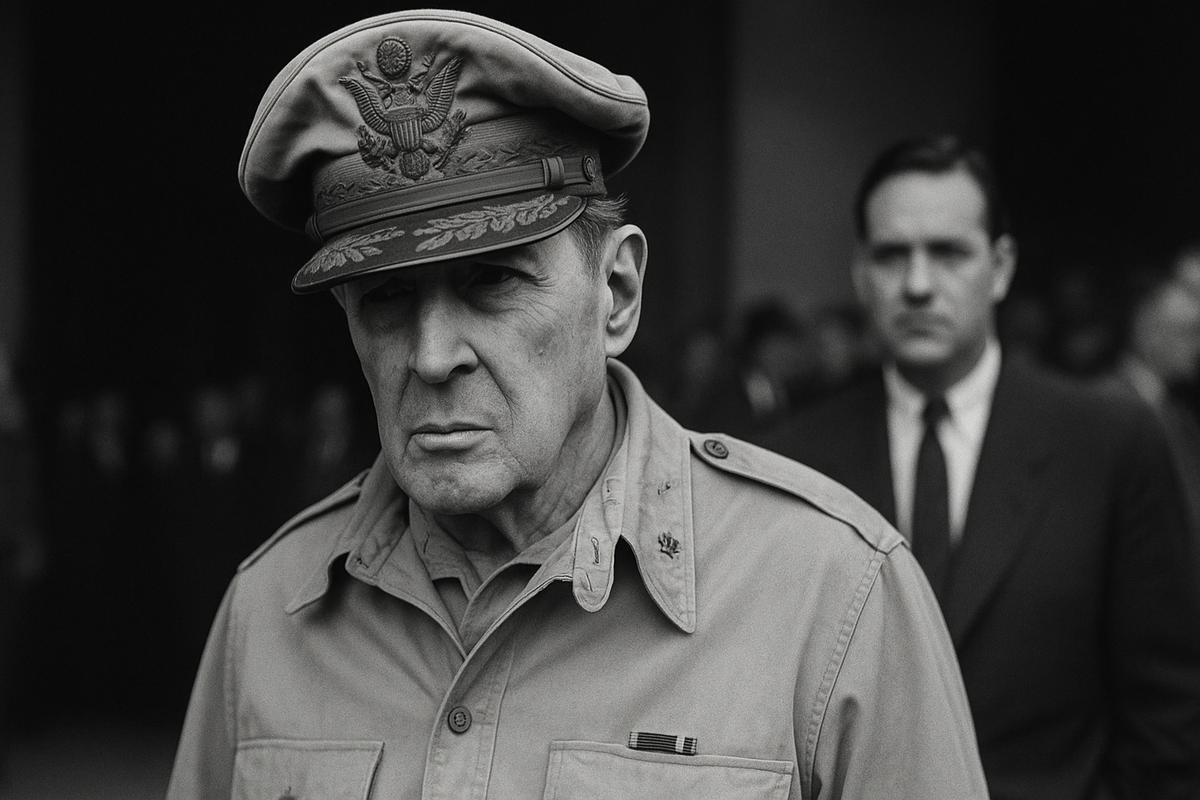
Twelve days later, Americans opened the April 23, 1951 issue of Time Magazine and found themselves staring into the face of General Douglas MacArthur—stern, unyielding, draped in the authority of a man who had liberated the Pacific and now stood accused of threatening the Republic itself. This wasn't just news. It was a constitutional crisis wrapped in Cold War paranoia, delivered to kitchen tables across a country still trying to understand what kind of superpower it had become.
The Truman-MacArthur showdown remains one of the most electrifying confrontations in American history, and Time's coverage captured it at the exact moment the nation fractured over a single question: Who really commands in a democracy—the general or the president?
Issue Details
Historical Figure: General Douglas MacArthur / President Harry Truman
Issue Date: April 23, 1951
Archive Source: Time Magazine National Affairs
Historical Context: Korean War / Cold War Civil-Military Relations
Spring 1951: The War That Wouldn't End
The Korean War was supposed to be quick. Instead, it had metastasized into something far more dangerous.
U.S. and U.N. forces, under MacArthur's command, had initially driven North Korean troops back across the 38th parallel in a campaign that seemed to validate the general's Pacific War legend. Then China entered the conflict in late 1950 with hundreds of thousands of troops, and the war exploded into something unrecognizable—a grinding, frozen hell that threatened to ignite World War III.
MacArthur wanted escalation. He pushed for bombing runs into Manchuria, a naval blockade of China, and the deployment of Nationalist Chinese forces from Taiwan. To the general, this was the logical extension of containment: crush communism wherever it showed its face, or surrender the initiative entirely.
Truman saw catastrophe. Expand the war into China, he believed, and the Soviets would have no choice but to intervene. The result wouldn't be victory—it would be Armageddon.
The two men had clashed privately for months. But when MacArthur began publicly undermining Truman's strategy—issuing his own ultimatums to China, lobbying congressional Republicans, openly contradicting administration policy—the president made his move.
On April 11, Truman relieved MacArthur of command. The shockwave was immediate.
Time's National Reckoning
When Time hit newsstands on April 23, its National Affairs section framed the story with surgical precision: "The Nation: Homeward Bound" and "The Presidency: The Little Man Who Dared." The headlines alone telegraphed the scale of the drama—this was David and Goliath recast as constitutional theater.
At the visual center: MacArthur himself, photographed in stark black-and-white, his face set beneath his military cap like a Roman general carved in marble. Time had a genius for photographic symbolism, and this image worked on multiple levels. It honored MacArthur's stature while subtly suggesting the rigidity that had led to his downfall.
The reporting inside blended hard political analysis with cultural commentary. Time dissected the firestorm in Congress, where Republicans seized on the dismissal as evidence of weakness. It chronicled the public rallies—massive, fervent—where Americans waved signs defending MacArthur as a martyr to bureaucratic cowardice. And it laid bare the internal debates within Truman's own administration, where cabinet members had pleaded with the president to reconsider.
But Time didn't just report the chaos. It interpreted it. The magazine understood that the real story wasn't MacArthur's firing—it was the question beneath it: Could America wage a limited war in the nuclear age, or would every conflict inevitably spiral into total annihilation?
Political cartoons scattered throughout the issue drove the point home with acid wit. One showed Truman sawing off MacArthur's branch of a tree. Another mocked the fractures inside the Republican Party, unable to decide whether MacArthur was a savior or a liability. These weren't mere illustrations—they were editorial arguments in visual form.
What the Issue Revealed
The Constitutional Fracture
Time made explicit what many Americans only half-understood: civilian control of the military wasn't a suggestion. It was the foundation of the Republic. MacArthur's defiance didn't just challenge Truman—it challenged the principle that generals answer to elected leaders, not the reverse.
MacArthur's Arc
A sidebar biography traced the general's trajectory from West Point prodigy to Pacific hero to Cold War lightning rod. The piece reminded readers why his dismissal felt so visceral: MacArthur wasn't just any commander. He was the man who had taken Japan's surrender on the deck of the USS Missouri. Firing him was like toppling a monument.
Truman's Wager
The magazine presented Truman as a president willing to sacrifice his political future to prevent a wider war. Polling showed most Americans sided with MacArthur. Truman knew he would pay for this decision, and he made it anyway.
The Congressional Storm
Republicans, sensing blood, turned the hearings into spectacle. Senator Joseph McCarthy called Truman's action "treasonous." Senator Robert Taft demanded impeachment. The debate wasn't just partisan—it was existential.
A Nation Divided
Time captured the public mood in all its contradictions. MacArthur drew crowds in the hundreds of thousands for his "farewell tour." Yet poll numbers began shifting as Americans absorbed the constitutional implications. Hero worship collided with democratic principle, and the collision was messy.
Time's Editorial Signature
Time in 1951 occupied a unique space in American journalism. It wasn't wire-service neutrality, and it wasn't opinion-page bombast. It was interpretive reporting—analysis wrapped in narrative authority.
The prose was tight, almost hardboiled. Articles opened with scene-setting details, then pivoted sharply into political dissection. Irony crept in at the edges—a raised eyebrow rendered in syntax. The magazine trusted readers to follow complex arguments without hand-holding, but it never left them stranded.
Visually, Time preferred photography over illustration, a choice that conveyed immediacy. MacArthur's cover portrait wasn't art—it was evidence. The man himself, unfiltered.
This editorial confidence mattered in 1951 because television was still primitive. Most Americans relied on print to make sense of the world, and Time didn't just inform them—it gave them a framework for understanding what the hell was happening.
Why These Magazines Endure
Mid-century magazines survive as cultural artifacts because they preserve something academic histories cannot: the feeling of the moment.
Reading the April 23, 1951 Time, you're not learning what happened—you're experiencing how it felt when the outcome was still uncertain. The tone, the language, the urgency—all of it immerses you in a world where World War III seemed plausible and where one man's firing could genuinely threaten democratic order.
For historians, these issues are primary sources—unmediated evidence of how events were perceived at the time. For collectors, they're treasures of print culture, physical objects that carry weight beyond their content. And for families, they're tangible links to grandparents and great-grandparents who sat at kitchen tables turning these exact pages, arguing about Truman and MacArthur over morning coffee.
Why Collectors Covet This Issue
Constitutional Drama
Truman's dismissal of MacArthur remains one of the clearest tests of civilian authority over the military in American history. Owning this issue means holding the document that explained it to the public in real time.
Cold War Archaeology
The anxiety radiating from these pages—the fear of World War III, the uncertainty about how to fight communism without triggering nuclear war—captures the early Cold War mindset in a way no retrospective analysis can.
Iconic Imagery
MacArthur's cover portrait has become one of the defining images of the general. It's been reproduced in history textbooks, documentaries, and museum exhibits. The original is here.
Cultural Ephemera
Flip through the issue and you'll find advertisements for mid-century products, advice columns, and letters to the editor—all of it offering a window into everyday American life in 1951. The magazine isn't just about MacArthur. It's about the country processing MacArthur.
Holding History
The April 23, 1951 Time Magazine endures because it captured a moment when America confronted the limits of military power and the meaning of civilian authority. Truman's decision to fire MacArthur wasn't just bold—it was a defense of the constitutional order, made at enormous political cost.
For modern readers, the issue serves as a reminder that democracy is fragile, that principle sometimes demands sacrifice, and that the hardest decisions often look like weakness before they reveal themselves as courage.
For collectors, it's a chance to hold the artifact itself—to own the magazine that Americans clutched in 1951 as they debated loyalty, strategy, and the future of the Republic.
This is more than memorabilia. It's evidence of a nation arguing with itself about who it wanted to be.
Browse Time Magazine CollectionExplore thousands of issues covering politics, culture, and world events from the 1920s through the late 20th century. Each is a preserved artifact—a time capsule of its era.