
The Waitress Who Became a War Photographer
When Ladies' Home Journal Told Women They Could Fail—and Win
In April 1957, between recipes for tuna casserole and advertisements for Frigidaire refrigerators, Ladies' Home Journal published something radical: a confession of failure.
Margaret Bourke-White—the woman who had photographed Stalin, survived a torpedo attack in the Mediterranean, and documented the liberation of concentration camps—opened her essay "My First Job" with an admission that must have startled the magazine's million-plus readers. Her first job was waitressing. She earned 40 cents an hour. And when she lost it, she cried bitterly.
This wasn't the triumphalist narrative American women were used to reading in 1957. It was rawer than that. And in a decade when the cultural machinery was working overtime to shepherd women back into domestic life after their wartime mobilization, Bourke-White's essay landed like a quiet detonation.
She wasn't telling women to stay home. She was telling them that failure could be the first step toward greatness.
Archive Details
Historical Figure: Margaret Bourke-White, pioneering photojournalist
Publication: Ladies' Home Journal, April 1957
Essay Title: "My First Job"
Cultural Context: Post-WWII America, pre-second wave feminism
Archive Source: Original magazine collection
The Magazine That Shaped Postwar Womanhood
By the mid-1950s, Ladies' Home Journal had become something more than a magazine—it was a cultural parliament. With a readership that reached into the millions, it didn't just reflect American domestic life; it legislated it. The Journal told women how to set a table, raise children, manage a budget, and navigate the emotional terrain of marriage. Dr. Benjamin Spock dispensed pediatric wisdom from its pages. Fashion spreads dictated hemlines. Fiction serialized the moral anxieties of suburban life.
But the Journal also understood something its competitors missed: women's lives were more complicated than the singular narrative of homemaking suggested. World War II had cracked open the question of what women could be. Millions had worked in factories, managed offices, driven ambulances. The war ended, but the question didn't. The 1950s became a decade-long negotiation between the push back toward traditional domesticity and the pull of expanded possibility.
Ladies' Home Journal straddled this tension with editorial cunning. It celebrated the homemaker while quietly making space for the striver, the learner, the woman with ambitions that extended beyond her threshold. Publishing Margaret Bourke-White in April 1957 was an act of editorial courage disguised as a personal essay.
From Cornell to the Front Lines: A Photographer's Origin Story
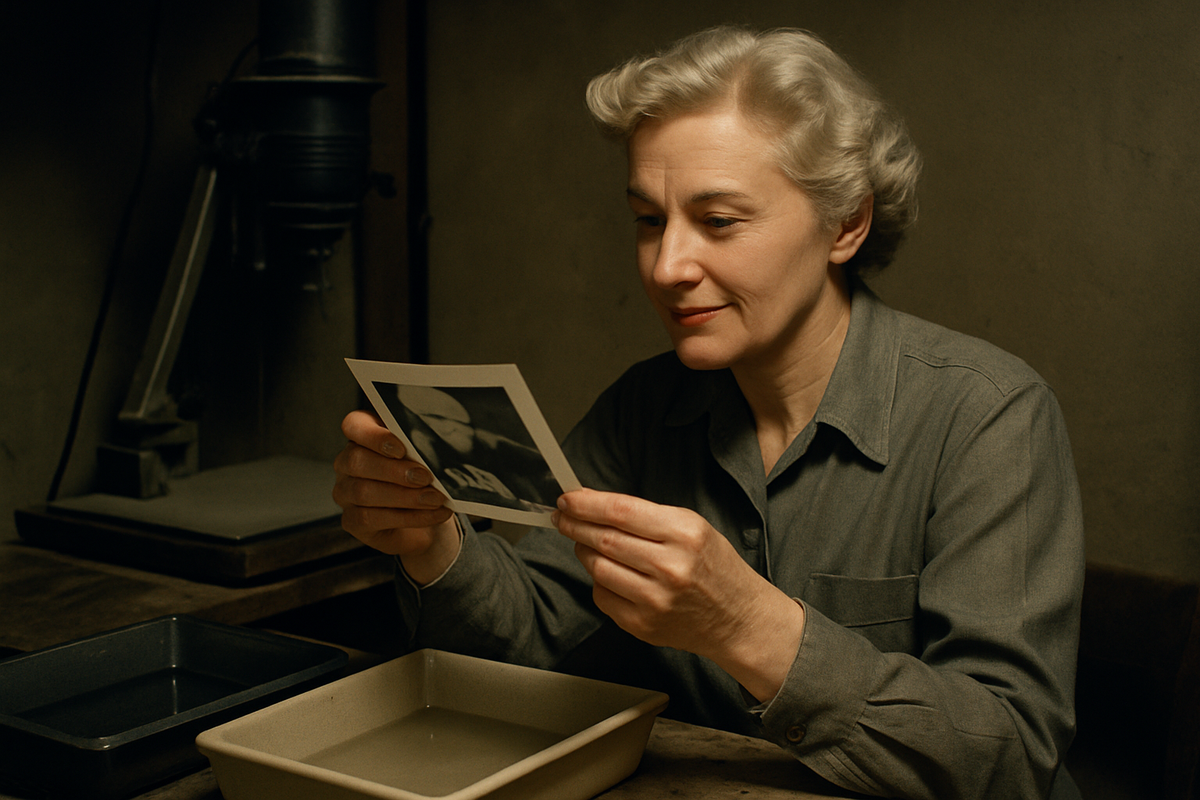
Bourke-White's essay traced a trajectory that began in humiliation and ended in mastery. After losing the waitressing job, she enrolled at Cornell University, where she stumbled into photography almost by accident. She described the frigid thrill of photographing frozen pipes and icy waterfalls in upstate New York, learning by trial and error in darkrooms where every successful print felt like a small miracle.
The mechanics of cameras became her obsession. She taught herself through persistence, through failure, through the unglamorous repetition that transforms amateurs into professionals. There was no shortcut, no sudden revelation—just the slow accumulation of skill earned in dim rooms smelling of chemicals and possibility.
What makes her account so striking is its refusal to sanitize the journey. She didn't gloss over the disappointment of lost opportunities or the tedium of technical practice. She presented ambition as something earned through discipline, not bestowed by talent. For Ladies' Home Journal readers juggling children, budgets, and their own deferred dreams, this framing offered something rare: permission to fail, and proof that failure could be prologue.
By 1957, Bourke-White had become one of the most celebrated photojournalists in the world. She had shot Life magazine's first cover. She had documented the Dust Bowl, the construction of the Fort Peck Dam, Gandhi hours before his assassination, the faces of Soviet factory workers, and the unspeakable aftermath of Buchenwald. She had survived a military transport ship sinking in the Mediterranean. She had flown combat missions. She had done things no American woman photographer had done before.
And she was telling readers it all began with crying over a lost waitressing job.
The Visual Grammar of Aspiration and Struggle
The magazine's art director made a choice that now reads as deeply symbolic. Bourke-White's essay appeared on a spread that also featured a Union Pacific Railroad advertisement. The ad depicted elegantly dressed passengers dining in a luxury railcar—the visual language of postwar prosperity, mobility, and middle-class arrival.
The juxtaposition was almost novelistic. On one side, Bourke-White's story of early struggle, failed jobs, and the grinding work of self-education. On the other, an image of sleek modernity, of Americans who had already arrived at success. The editorial layout created an implicit narrative: the struggle leads to the dining car. The crying waitress becomes the woman who can afford the train.
Whether intentional or not, this pairing captured Ladies' Home Journal's dual mandate—to acknowledge the realities of women's lives while gesturing toward their possibilities. The magazine understood that its readers lived in the space between those two images: between the struggle and the arrival, between the failure and the mastery.
Bourke-White's portrait anchored the essay in the bottom left corner. Her smile was confident, professional, assured. It was the face of a woman who had made it. But the text beneath that photograph told a different story—one that began with tears and developed in darkrooms.
The Lessons That Echo Forward
Bourke-White's essay distills principles that transcend its moment:
Failure as Education
The waitressing job wasn't wasted time—it taught her what she didn't want, which clarified what she did. Loss can be diagnostic.
Mastery Demands Patience
Her darkroom hours were unglamorous, repetitive, technical. Greatness is built in increments too small to photograph.
Women's Ambitions Deserve Documentation
Even when the dominant culture insisted otherwise, her voice claimed space. The fact that Ladies' Home Journal published it suggests the editors understood their readers' lives were more complex than the magazine's advertised content suggested.
Contemporary Resonance
In 2025, when career trajectories are expected to be non-linear and failure is rebranded as "iteration," Bourke-White's 1957 honesty feels almost contemporary. She was describing resilience before it became a leadership buzzword.
Why This Issue Matters to Collectors
Historical Witness
The April 1957 Ladies' Home Journal sits at the hinge point of American femininity—after Rosie the Riveter, before Betty Friedan. It captures a moment when the culture was still insisting that women's proper sphere was domestic, even as it quietly made room for narratives of professional ambition.
Editorial Rarity
While Life and Look regularly featured Bourke-White's photography, her first-person writing appeared less frequently in mass-market women's magazines. This essay is a biographical primary source from one of photojournalism's pioneers.
Cultural Layering
The issue's mix—Bourke-White's essay alongside homemaking features, Dr. Spock's parenting advice, fiction, and aspirational advertising—creates a complete snapshot of midcentury American domesticity in all its contradictions.
Condition Scarcity
Magazines were designed to be disposable. They lived on coffee tables, absorbed spills, got torn apart for recipes and patterns. Well-preserved copies are increasingly rare, making intact issues valuable research materials for scholars of women's history, media studies, and visual culture.
Vintage Ladies' Home Journal magazines function as primary sources in ways that retrospective histories cannot match. They capture not just what happened, but how it was understood in real time, what mattered enough to be advertised, what stories were deemed worth telling to millions of American women.
Preserving the Archive of Women's Voices
Vintage Ladies' Home Journal issues are not nostalgic curiosities—they are historical evidence. They document how women were addressed, what they were assumed to care about, which voices broke through the editorial consensus. They show us the advertisements that shaped desire, the fiction that modeled behavior, the advice columns that attempted to solve the unsolvable tensions of gender, class, and ambition in postwar America.
The April 1957 issue, with Bourke-White's essay at its center, captures a specific frequency in that larger cultural conversation. It's a magazine that tried to speak to women as both homemakers and strivers, as both mothers and individuals, as both traditionalists and the architects of their own futures.
For anyone studying how American women's roles evolved across the twentieth century, these pages are indispensable. And for collectors who understand that history lives not just in archives but in the ephemera that once sat on millions of kitchen tables, this issue remains a vital acquisition.
Explore the Complete Archive
Discover original issues of Ladies' Home Journal and other iconic American magazines from our curated collection.
Browse Ladies' Home Journal Magazine CollectionCoda
When Margaret Bourke-White cried over losing a 40-cent-an-hour waitressing job, she couldn't have known she was experiencing the first chapter of a story that would take her to the rooftops of skyscrapers, the front lines of war, and the pages of history.
But she knew enough to remember it. And in 1957, she knew enough to tell millions of American women that the story of success doesn't begin with confidence—it begins with failure, and the willingness to keep working after the tears dry.
Ladies' Home Journal gave her the platform. The essay gave its readers permission. And the April 1957 issue gave us a window into a moment when American culture was quietly renegotiating what women could be.
That's worth preserving.