
The Moment Conservatism Stopped Apologizing
Inside The New Yorker's October 3, 1964 Election Dispatch
On October 3, 1964, readers who unfolded The New Yorker over breakfast or during their commute encountered something more volatile than the magazine's usual fare: a dispatch from the front lines of a political revolution that neither side fully understood yet.
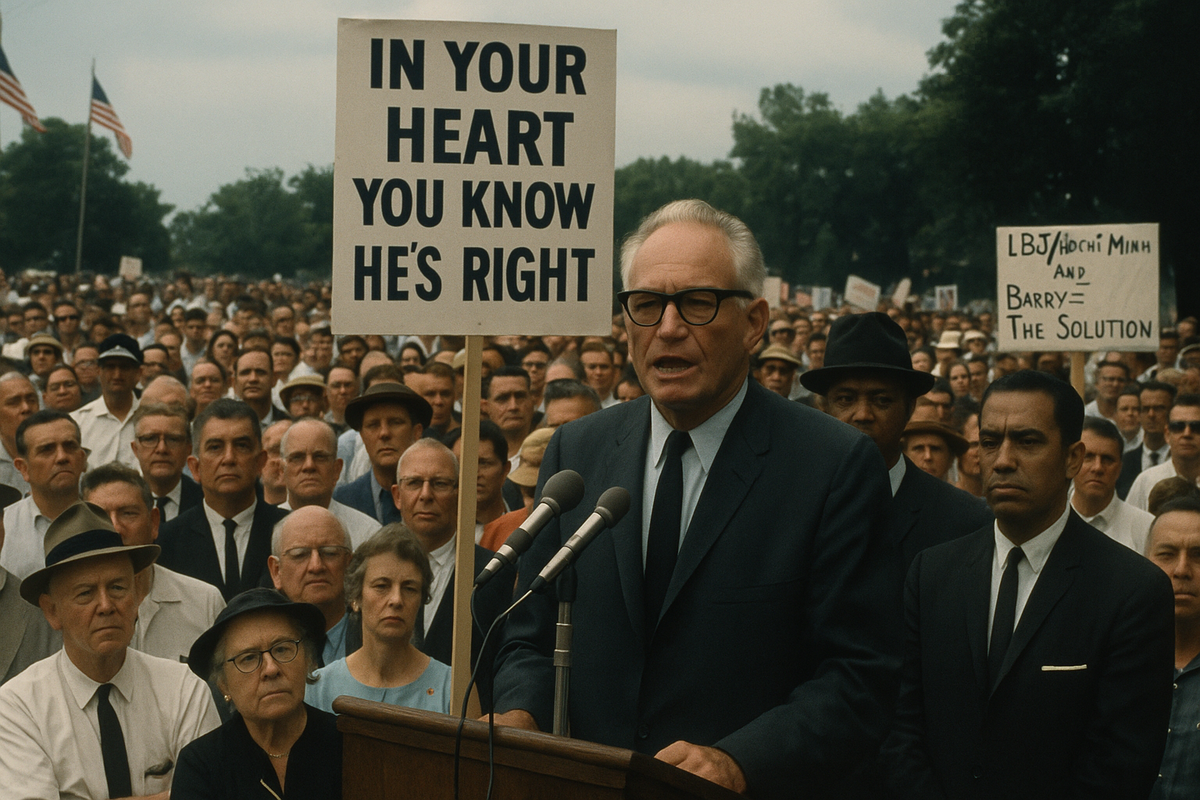
Buried between the cartoons and the theater reviews was A Reporter at Large: The Campaign: Goldwater—a piece of journalism that read less like campaign coverage and more like a field report from a country coming apart at the seams. Barry Goldwater's candidacy wasn't simply a challenge to Lyndon Johnson. It was an open rebellion against the Republican establishment, a rejection of New Deal consensus, and a bet that millions of Americans were ready to stop apologizing for conservatism.
The article didn't just document rallies and stump speeches. It captured the raw energy of Southern crowds, the unease of a nation watching its political center collapse, and the first tremors of a realignment that would define American politics for the next half-century. For readers in 1964, this wasn't history. It was happening now—and The New Yorker was there to make sense of it.
Archive Details
Historical Figure: Barry Goldwater, 1964 Republican Presidential Nominee
Issue Date: October 3, 1964
Featured Article: A Reporter at Large: The Campaign: Goldwater
Cover Artist: Arthur Getz
Archive Source: Original The New Yorker Magazine
The Collision of Two Americas
By the fall of 1964, the country had fractured into competing visions so incompatible they barely spoke the same language.
Lyndon Johnson's Great Society promised an expansive federal government capable of solving poverty, guaranteering civil rights, and reshaping American life through legislative will. His landslide victories after Kennedy's assassination had given him both the momentum and the mandate to push through reforms that would have been unthinkable a decade earlier.
Barry Goldwater represented the counterargument: that this federal expansion was not progress but overreach, that civil rights legislation trampled on states' rights, and that compromise with the Soviet Union was tantamount to surrender. Where Eisenhower-era Republicans had moderated and accommodated, Goldwater refused to soften his edges. His conservatism was unapologetic, ideological, and—to his supporters—long overdue.
The gap between these two visions wasn't just political. It was moral, regional, and generational. The 1964 election asked Americans to choose not just a president, but a country.
Reporting as Cultural Archaeology
The New Yorker in 1964 had no interest in breathless headline chasing. Its strength was never speed—it was depth. The magazine's writers didn't just cover events; they excavated their meaning.
A Reporter at Large: The Campaign: Goldwater exemplified this approach. The piece moved beyond policy positions and polling numbers to capture something harder to quantify: the atmosphere of Goldwater's Southern rallies, the cadence of his rhetoric, the demographics of his crowds. The reporting noted not just what Goldwater said, but who cheered loudest—and why.
This was journalism as anthropology. The writer observed the dissonance between Goldwater's libertarian principles and the segregationist enthusiasm his candidacy unleashed in the Deep South. The piece chronicled a candidate who opposed federal civil rights legislation on constitutional grounds while attracting voters who opposed it for uglier reasons. That tension—between ideology and base—would haunt conservative politics for generations.
The New Yorker didn't editorialize heavily. It didn't need to. The details spoke for themselves: the overheard remarks at campaign stops, the signs in the crowds, the coded language that signaled one thing to elites and another to the rank-and-file. For readers trying to understand what was happening to their country, the article offered clarity without condescension.
Arthur Getz and the Visual Language of Campaign Season
The cover of the October 3, 1964 issue featured an illustration by Arthur Getz: a motorcade flanked by police motorcycles, rendered in muted blues and modernist brushwork. The image evoked both the pageantry and the menace of campaign season—an era when political ambition moved through American streets under police escort.
Getz, who would create more than 200 covers for The New Yorker, understood that political art didn't need to scream to be effective. His motorcade was both celebratory and ominous, a visual metaphor for a democracy in motion but not necessarily under control.
Inside, the magazine maintained its signature mix: sharp political analysis alongside cartoons that skewered the absurdities of the moment. One drawing quipped, "If you weren't complaining about this, you'd be complaining about something else"—a line that could have been written yesterday. The juxtaposition of serious reporting with wry humor was The New Yorker's defining trait, a tonal balance that treated readers as intelligent enough to hold complexity in their heads.
What the Article Saw Coming
Reading the October 3, 1964 issue today is an exercise in watching the future take shape in real time.
The Southern Strategy Before It Had a Name
The article documented Goldwater's reception across the South, where his opposition to the Civil Rights Act gave him a foothold among white voters abandoning the Democratic Party. This wasn't yet called the "Southern Strategy," but the pieces were assembling on the board.
The Rise of Ideological Conservatism
Goldwater's refusal to moderate signaled a shift from Eisenhower's pragmatic Republicanism to something more militant and philosophical. He lost the election catastrophically—but he won the argument within his party.
The Crack-Up of the New Deal Coalition
The article captured the beginning of the end for the Democratic dominance that had defined American politics since FDR. White Southern Democrats were drifting away, and Goldwater's campaign showed Republicans where to find them.
The Power of Movement Politics
Goldwater energized a grassroots conservative movement that had been building for years, from National Review editorials to John Birch Society meetings. The campaign itself was less important than the infrastructure it activated.
None of this was obvious on Election Day, when Johnson buried Goldwater in one of the largest landslides in American history. But The New Yorker's reporting hinted at the deeper currents—the ones that would carry Richard Nixon to victory four years later and Ronald Reagan sixteen years after that.
Why Vintage Magazines Matter
Daily newspapers are designed to be disposable. The New Yorker was designed to last.
Each issue functioned as a curated artifact—art, literature, reporting, and commentary bound together as a coherent statement about American life. Unlike news that ages into irrelevance, The New Yorker's blend of analysis and cultural observation only becomes more valuable as the context recedes into history.
The October 3, 1964 issue sits at the intersection of political upheaval and journalistic excellence. It's both a document of its time and a lens for understanding ours.
Why This Issue Endures
The October 3, 1964 New Yorker is more than a magazine. It's a primary source document from one of the most consequential elections in American history.
Historical Precision
Published during the campaign itself, the issue captures the mood, language, and uncertainty of the moment before the outcome was known. This isn't retrospective analysis. It's real-time journalism from the eye of the storm.
Political Archaeology
For anyone studying the origins of modern conservatism, the Goldwater feature is essential reading. It documents the moment when the Republican Party stopped running away from ideology and started running toward it.
Arthur Getz's Cover Art
As one of The New Yorker's most prolific cover artists, Getz's work is highly collectible. This particular illustration captures the tension of 1964's political theater with economy and insight.
Cultural Time Capsule
Beyond politics, the issue preserves the visual language, editorial voice, and satirical humor of mid-1960s American intellectual life. The cartoons, the ads, even the typeface—everything situates you in a specific cultural moment.
For collectors of political history, this issue isn't ephemera. It's evidence.
Explore the Archive
The October 3, 1964 issue is one entry point into a larger collection spanning decades of American cultural and political history. From the Jazz Age through the Cold War, vintage New Yorker magazines offer an unfiltered view of how the country saw itself—its anxieties, ambitions, and contradictions—as events unfolded.
For historians, collectors, and anyone interested in the evolution of American thought, these issues aren't just reading material. They're primary sources.
Own a Piece of History
Browse thousands of original New Yorker magazines from the 1920s through the late 20th century—each one a time capsule of American culture, politics, and thought.
Browse The New Yorker Magazine CollectionThe Artifact in Your Hands
The October 3, 1964 New Yorker didn't just report on Barry Goldwater's campaign. It documented the moment when American conservatism stopped being a defensive posture and became an offensive strategy. That transformation—captured in real time by one of the country's most sophisticated editorial voices—makes this issue indispensable.
To hold it now is to hold a piece of the argument we're still having.