
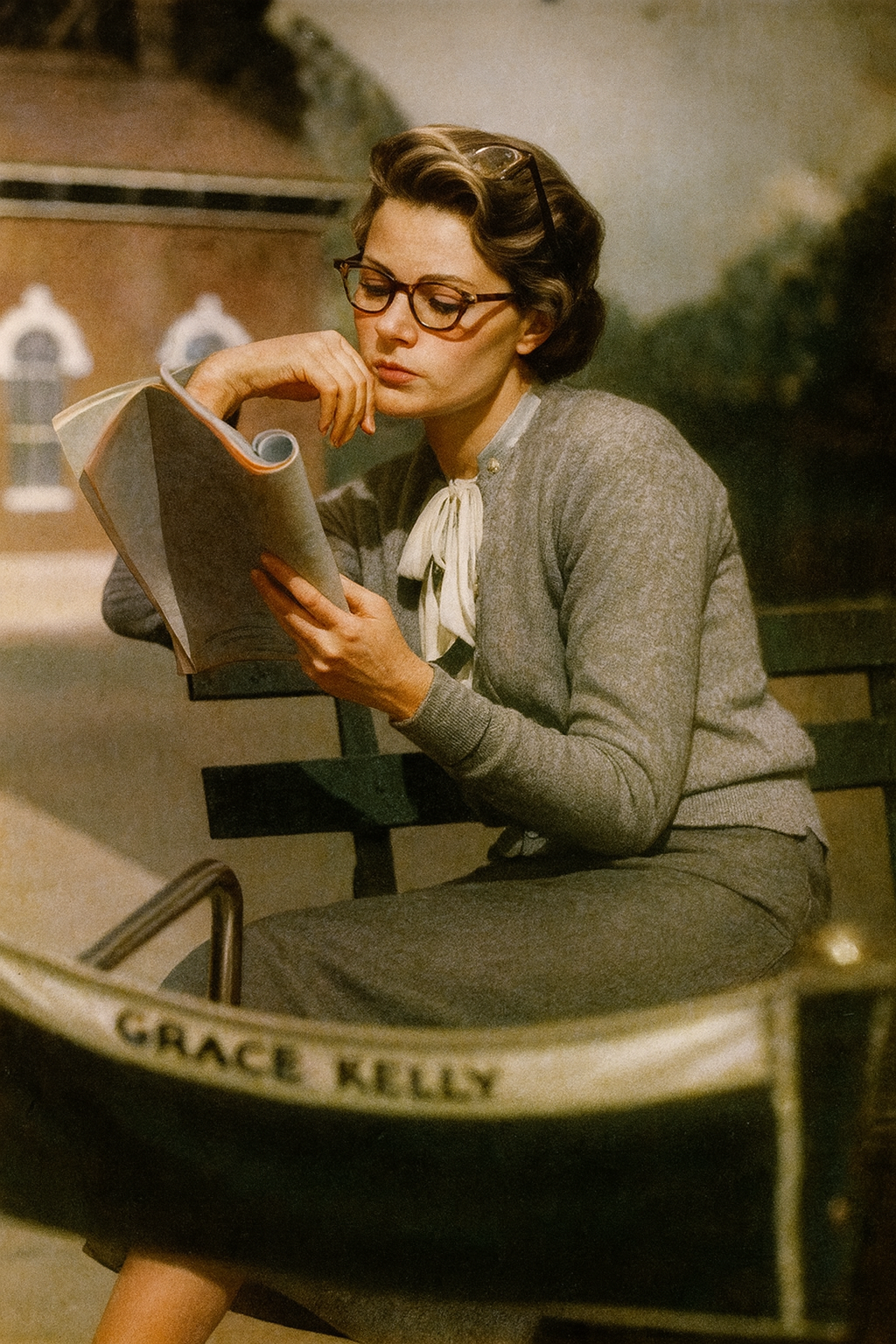
Grace Kelly, Hollywood's Cool Beauty, and the Making of a Screen Legend
How Life Magazine's April 26, 1954 issue captured the exact moment a twenty-four-year-old actress became inevitable
April 26, 1954. Across America, readers opened their mailboxes to find something extraordinary: a Life Magazine that would mark the exact moment Grace Kelly ceased being merely talented and became inevitable.
She was twenty-four years old. And she was about to own Hollywood.
This wasn't hyperbole—Life itself declared her "Hollywood's hottest property," a distinction the magazine didn't grant lightly. By spring 1954, Kelly had already filmed four major pictures with four of the industry's most bankable leading men. Studios were bidding $50,000 per picture for her services. An Oscar nomination was already in play. Within months, she would win it.
But the April 26th issue captured something rarer than mere success: the crystallization of a new archetype. Grace Kelly represented a fundamental shift in what American stardom could be—disciplined where others were wild, cool where others burned hot, patrician yet accessible. Life Magazine, at the height of its cultural authority, understood this instinctively. The issue didn't just profile an actress. It documented the birth of an icon.
Archive Details
Historical Figure: Grace Kelly
Issue Date: April 26, 1954
Archive Source: Life Magazine
Cultural Moment: Pre-Oscar Win, Mid-Century Hollywood Ascent
The Perfect Storm of Timing
Mid-century America was recalibrating. Television threatened to hollow out movie theaters. The Cold War cast its shadow over daily life. The studio system, once an unshakeable colossus, was beginning its slow fracture. Audiences wanted something different—stars who felt real yet aspirational, modern yet anchored in traditional values.
Grace Kelly arrived like an answer to a question Hollywood hadn't yet articulated.
Her credentials were impeccable before she ever stepped before a camera. Born into Philadelphia's Kelly dynasty—Olympic rowers, Pulitzer-winning playwrights, self-made millionaires—she carried achievement in her DNA. Broadway had already tested her mettle in demanding roles like Strindberg's The Father. When she came to Hollywood, she came prepared.
By the time Life's photographers arrived, Kelly had assembled a filmography that would be the capstone of most careers:
Dial M for Murder opposite Ray Milland
Rear Window with James Stewart under Hitchcock's direction
The Bridges at Toko-Ri alongside William Holden
The Country Girl with Bing Crosby—the performance that would win her the Academy Award
No other actress of her generation had accumulated such capital so quickly. Each role demonstrated range. Each leading man represented Hollywood royalty. The velocity was staggering.
Life's Mastery: Photography as Cultural Record
What separated Life Magazine from fan publications wasn't just production quality—it was editorial philosophy. Life's editors believed great photography could render a subject not just visible but knowable. With Kelly, they deployed this philosophy with surgical precision.
The photo-essay moved in strategic layers:
Lineage and Legacy
Images of the Kelly family—her Olympic champion father John B. Kelly, her playwright uncle George—established her not as a manufactured starlet but as the product of American excellence. These weren't glamour shots. They were genealogy.
The Working Actress
Candid photographs showed Kelly in reading glasses, studying scripts, rehearsing lines. Life was making an argument: this woman wasn't coasting on beauty. She was a craftsman.
Star Power Visualized
Full-page film stills placed Kelly alongside Milland, Stewart, Holden, and Crosby. Each image reinforced her versatility—thriller, war drama, musical drama. She wasn't being typecast. She was being tested.
The Private Person
Behind-the-scenes shots revealed someone simultaneously glamorous and grounded. Readers didn't just admire Grace Kelly. They felt they understood her.
This was Life's signature alchemy: merging journalistic rigor with visual storytelling to create something more permanent than mere celebrity coverage. They were building mythology in real time.
Inside the Issue: What Readers Discovered
The article delivered specific, memorable revelations that cemented Kelly's ascent:
A Price Tag on Stardom: At twenty-four, Kelly commanded $50,000 per picture—astronomical for someone barely three years into film work. Life presented this not as gossip but as market validation.
The Kelly Standard: Detailed coverage of her family background—Olympic medals, Pulitzer Prizes, business success—positioned her as American aristocracy. Her screen presence wasn't accidental. It was hereditary.
Oscar-Worthy Documentation: Photographs from The Country Girl showed Kelly stripped of glamour, playing a woman worn down by her husband's alcoholism. This was the performance that would win her the Academy Award. Life captured it first.
Hitchcock's Muse: Images from Rear Window crystallized Kelly's appeal—elegant, intelligent, moving through suspense with aristocratic composure. Hitchcock had found his ideal blonde, and Life made sure America knew it.
Clark Gable and Beyond: Stills from Mogambo reminded readers of Kelly's breakout alongside Hollywood's king. The trajectory was clear: newcomer to leading lady in record time.
The Serious Artist: That image of Kelly in eyeglasses, script in hand, became iconic in itself. It signaled something crucial: she studied. She prepared. She respected the craft.
The cumulative effect transcended celebrity journalism. Life was presenting Grace Kelly as both a product of American values and their perfect embodiment.
The Enduring Power of Mid-Century Journalism
Life Magazine succeeded because it refused to flatten its subjects. Grace Kelly emerged from these pages as complex—beautiful but hardworking, elegant but disciplined, privileged but driven. The magazine captured not just her image but her substance.
These mid-century issues function as time capsules precisely because they were never trying to be. Life documented culture as it happened, with photographic rigor and editorial clarity that created permanent records of temporary moments. The fashion, the studio system, the social values of postwar America—all preserved in newsprint and silver gelatin.
Why This Issue Endures: Collector Significance
For collectors of vintage Life magazines, the April 26, 1954 issue ranks among the most sought-after artifacts of the 1950s.
Historical Precision
Published mere weeks before Kelly's Oscar win, it captures Hollywood's recognition at the exact moment of transition. This isn't retrospective analysis. It's prophecy.
Dual Legacy
Within two years, Grace Kelly would become Princess Grace of Monaco, transforming from actress to royalty. This issue documents her at the apex of her film career, before the fairy tale became literal.
Photographic Excellence
The combination of glamorous studio portraits and intimate candids makes this issue a visual archive. These aren't just pictures of Grace Kelly. They're windows into 1950s Hollywood's working methods.
Market Resilience
Grace Kelly memorabilia commands consistent collector interest across generations. Original Life issues remain accessible entry points for serious collectors while retaining significant cultural value.
Owning this magazine means possessing a physical artifact from the moment American culture recognized greatness in real time.
Essential for Collectors and Historians
If you collect vintage Life magazines, study Hollywood's golden age, or research mid-century American culture, the April 26, 1954 issue is non-negotiable. It sits alongside milestone covers of Marilyn Monroe, Audrey Hepburn, and James Dean—those rare publications that captured stars at the exact inflection point between promise and legend.
This isn't hagiography. It's primary source material, photographed and written by journalists who witnessed history as it occurred.
Grace Kelly's Ascent, Preserved
Life Magazine's April 26, 1954 issue remains the definitive contemporary account of Grace Kelly's emergence as Hollywood's preeminent leading lady. Its synthesis of family heritage, professional discipline, and visual storytelling captured her transformation with a clarity that retrospective analysis cannot match.
For collectors and enthusiasts today, it offers something increasingly rare: an original artifact from the moment a cultural icon was made. These pages introduced Grace Kelly as Hollywood's cool beauty—the actress who would captivate an industry, marry a prince, and define elegance for generations.
The magazine is more than collectible ephemera. It's evidence. And evidence, properly preserved, becomes history.
Explore Our Archive
Discover our curated collection of original Life magazines and other vintage publications—
authentic artifacts from the moments that shaped culture.