
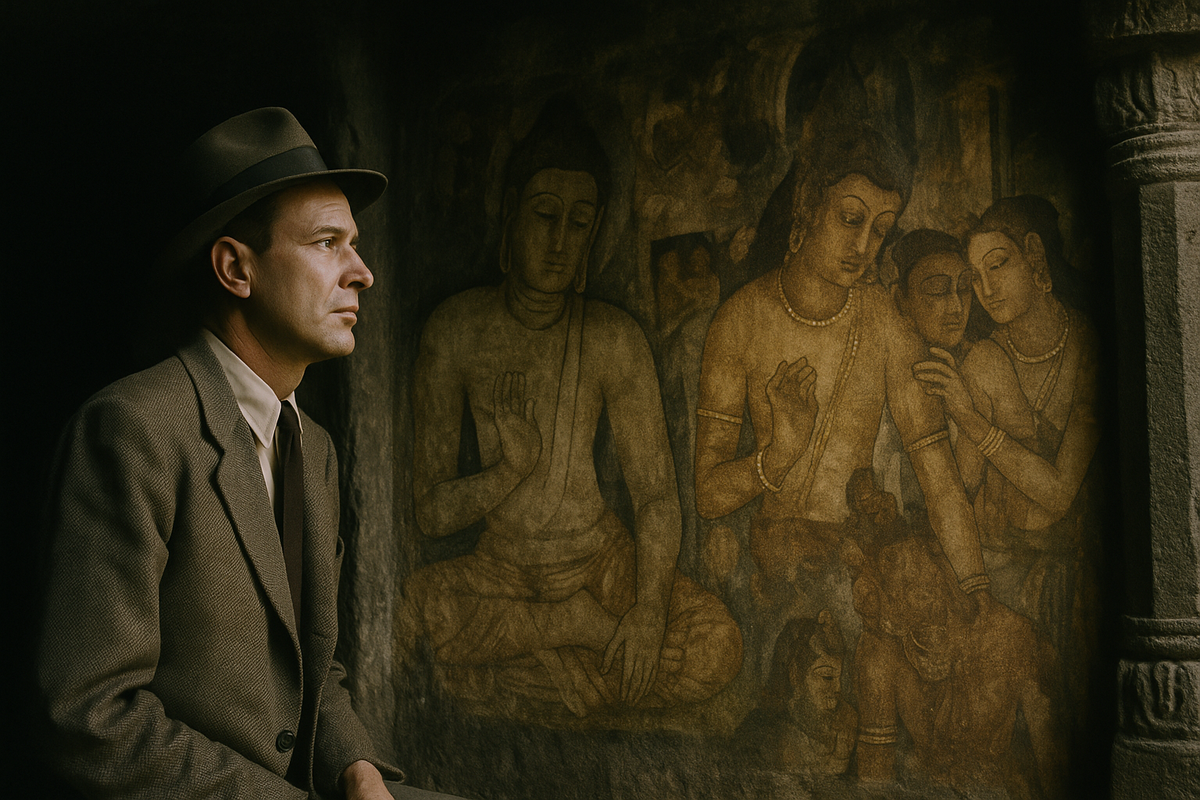
When Buddha Met Manhattan
The New Yorker's 1954 Journey to India's Hidden Caves
On May 1, 1954, readers who plucked The New Yorker from their newsstands found themselves staring at Peter Arno's wry illustration of women preening before mirrors—vintage Manhattan vanity, distilled. But turn past the cartoons and the advertising, and the magazine performed a different kind of magic: it transported its urbane audience 7,000 miles eastward, into the rock-carved sanctuaries of India's Ajanta Caves.
The feature, "A Reporter at Large: Lovers Upon the Walls," was no ordinary travelogue. It was a reckoning—with beauty, with history, with the unsettling realization that while America was barely a decade past victory in the Second World War, India had been creating transcendent art for two millennia.
For a magazine that prided itself on parsing the anxieties of midtown offices and Park Avenue cocktail parties, this was an act of profound intellectual ambition. And in the spring of 1954, with the Cold War calcifying and newly independent nations redrawing the world's power map, The New Yorker offered its readers something rare: a meditation on permanence in an age of flux.
Archive Details
Publication: The New Yorker
Issue Date: May 1, 1954
Featured Essay: "A Reporter at Large: Lovers Upon the Walls"
Cover Artist: Peter Arno
Historical Context: Published less than a decade after India's independence (1947) and during the height of Cold War cultural diplomacy
The Caves That Waited Centuries to Be Seen
The Ajanta Caves are not merely old—they are ancient. Carved into the volcanic basalt cliffs of Maharashtra between 200 B.C. and the 5th century A.D., these Buddhist sanctuaries were abandoned for over a thousand years. Jungle consumed them. Centuries passed. Empires rose and fell.
Then, in 1819, a British hunting party chasing a tiger stumbled upon something impossible: walls alive with color. Murals depicting the Buddha's life, courtly processions, celestial beings, and—most arrestingly—lovers entwined in gestures of eternal intimacy. The frescoes had survived not through care, but through obscurity.
By 1954, Ajanta had become a symbol. For India, recently liberated from colonial rule, the caves were proof of a cultural legacy that predated and transcended empire. For American readers, they were something else: a reminder that while the West was busy building atomic arsenals, other civilizations had been building something harder to destroy.
The New Yorker understood this. The essay didn't exoticize Ajanta—it elevated it. The prose was precise, almost reverential. Buddha appeared not as religious icon alone but as "sage and symbol." Elephants and kings paraded across stone "in eternal gesture." The magazine treated these murals as it would treat Michelangelo or Rembrandt: as works worthy of serious aesthetic and intellectual engagement.
Cold War Context, Timeless Art
The timing mattered. India had gained independence in 1947, and by the early 1950s, Washington was courting New Delhi as a counterweight to Communist China. Americans were being asked to think about Asia not as a battlefield or a market, but as a partner—one with its own profound cultural history.
The New Yorker met that moment with characteristic sophistication. Rather than frame Ajanta as a curiosity from the "Orient," the magazine positioned it within a larger narrative about human resilience. Civilizations collapse. Empires crumble. Wars devastate. Yet art endures.
This was not sentimental. The essay acknowledged the fragility of the murals themselves—how neglect and exposure threatened what centuries of darkness had preserved. Preservation, the piece suggested, was an act of cultural defense. In an era when Cold War rhetoric divided the world into ideological camps, here was a different argument: that beauty transcends borders, and its survival is a shared human responsibility.
The editorial juxtaposition was quintessential New Yorker. On one page, a cartoon mocked Wall Street traders fretting over gold prices—"Gold Is Up," "Gold Is Down"—a sardonic commentary on American materialism. On another, readers contemplated frescoes painted before the Roman Empire fell. The message was unstated but unmistakable: What will outlast us? Our stock portfolios or our art?
Key Themes of the Essay
The Rediscovery (1819)
British soldiers stumbled upon the caves during a tiger hunt, finding murals long hidden from the world—a moment that revealed India's artistic grandeur to the West.
Buddhist Narratives
Scenes of Buddha's life, courtly splendor, and sensual portrayals of lovers offered a panoramic vision of early Buddhist culture and philosophy.
Fragility of Beauty
The essay noted how the murals survived centuries in darkness but faced vulnerability to neglect and modern decay—an urgent call for preservation.
Cultural Force
Ajanta was framed not as archaeological treasure alone, but as part of India's ongoing cultural conversation after independence.
The New Yorker's Greatest Export: Intelligent Attention
What made The New Yorker essential in 1954—and what makes vintage issues valuable today—was not just the quality of its writing. It was the quality of its attention.
The magazine refused to flatten complexity. It trusted its readers to follow an argument, to appreciate nuance, to care about things that didn't directly affect their lives. The Ajanta essay assumed its audience would want to understand why Buddhist art mattered, why preservation was urgent, why beauty could be a form of resistance against forgetting.
That intellectual generosity is rare now. It was rare then. And it's why these issues remain more than nostalgia—they're blueprints for how journalism can elevate rather than merely inform.
Why This Issue Still Matters
Historical Timing
Published less than a decade after India's independence, this essay captures a specific instant when the West was learning to see Asia not as colony or battlefield, but as civilization.
Iconic Cover Art
Peter Arno's illustration is a masterclass in satirical minimalism—elegant, knowing, unmistakably New Yorker. His work is highly collectible in its own right.
Literary Ambition
The "Reporter at Large" series represented The New Yorker at its most intellectually ambitious—cultural criticism disguised as reportage.
Enduring Relevance
For scholars of art history, Buddhist studies, Cold War cultural diplomacy, or mid-century journalism, this issue is a primary source revealing how Americans encountered the world.
Owning this issue means owning a piece of that conversation—the moment when Manhattan met Maharashtra, when modern America confronted ancient India, and when one magazine dared to suggest that the most important stories weren't always happening in New York.
For Collectors and Seekers
Every vintage New Yorker tells a story. This one tells two: India's, and America's. Both are worth remembering.
Browse The New Yorker Magazine CollectionThe May 1, 1954 issue of The New Yorker stands as proof that great journalism doesn't age—it accrues meaning. For anyone who values art, history, or the belief that magazines can be more than products, this is essential reading. And essential keeping.