
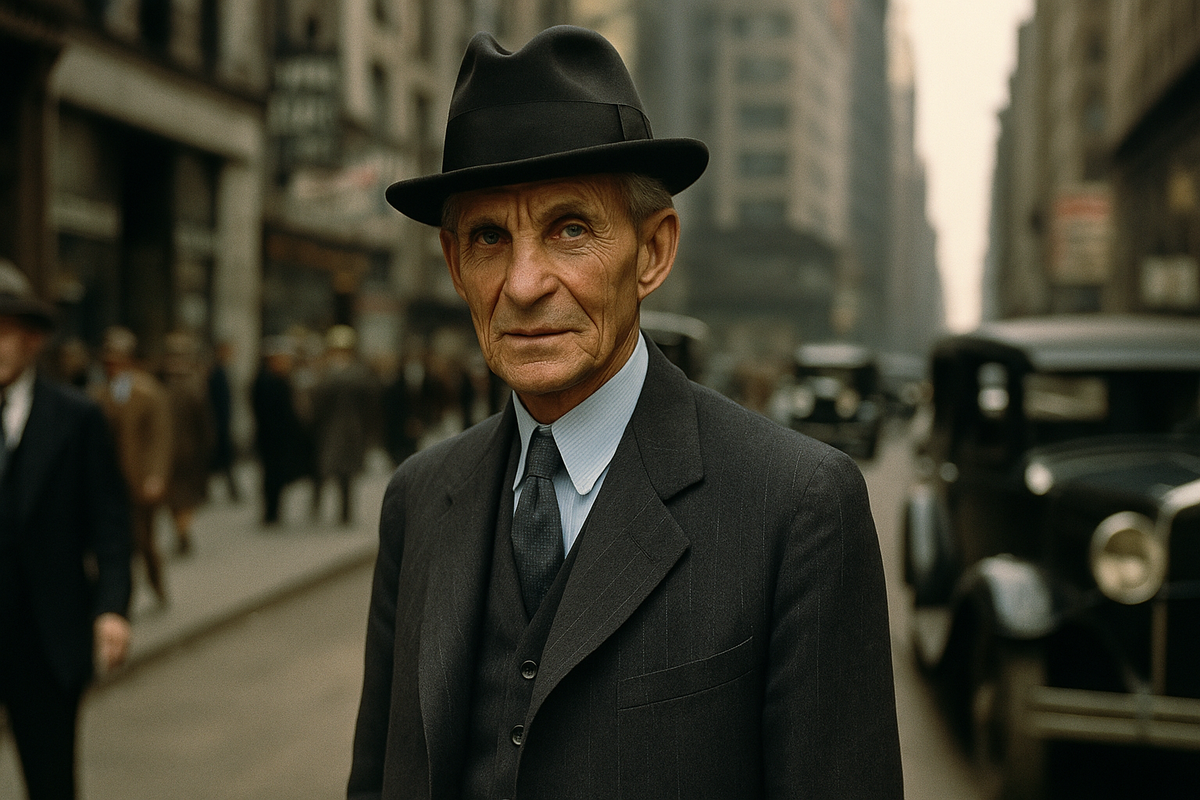
Henry Ford and the Contradictions of American Modernity
How The New Yorker's 1928 Profile Exposed the Man Who Built Modern America—And Its Darkest Prejudices
On March 10, 1928, readers who purchased The New Yorker carried home more than wit and cartoons. They carried home a reckoning.
Tucked inside that issue was a Profiles feature titled "Model T…II—The Peacemaker"—a forensic examination of Henry Ford that refused to choose between reverence and revulsion. It did both. Here was the man who had mechanized American life, whose assembly lines turned steel into mobility and mobility into freedom. And here, too, was the bigot, the fumbling political aspirant, the publisher of anti-Semitic screeds who believed himself a prophet.
For a nation drunk on prosperity, Ford was the ultimate paradox: proof that genius and intolerance could inhabit the same skull, that the architect of modernity could also be its greatest threat.
Archive Details
Historical Figure: Henry Ford, Industrialist & Publisher
Issue Date: March 10, 1928
Archive Source: The New Yorker
Profile Title: "Model T…II—The Peacemaker"
The Roaring Twenties at Full Throttle
By 1928, America had become unrecognizable from its pre-war self. Skyscrapers punctured the skyline. Jazz spilled from basement speakeasies. The Model T—Ford's triumph—had democratized the automobile, turning dirt roads into highways and Sunday drives into national ritual.
But the glitter concealed fractures. Anti-immigrant sentiment hardened into law with restrictive quotas. Anti-Semitism, far from fringe, infected mainstream discourse—and Ford's Dearborn Independent had spent years serializing The International Jew, a conspiracy tract that blamed global upheaval on Jewish machinations. Meanwhile, celebrity industrialists like Ford were floated as presidential material, their fame blurring the boundary between enterprise and governance.
The New Yorker arrived at this cultural crossroads with scalpel in hand. Its Ford profile wasn't hagiography. It was autopsy—performed while the patient still breathed.
The Magazine That Refused to Genuflect
Founded just three years earlier, The New Yorker had already carved out a reputation for refusing easy narratives. Its Profiles section specialized in dissection, not deification. Where other outlets treated Ford as an untouchable genius, The New Yorker saw him as raw material: a subject to be examined, contextualized, and—when necessary—indicted.
The profile rendered Ford in multiple exposures:
The Industrialist
A man who hoarded gold in Dearborn vaults, micromanaged production quotas, and rebuilt capitalism around the assembly line.
The Folk Character
Prone to practical jokes and blunt pronouncements, alternately admired for his plainspokenness and mocked for his crudeness.
The Demagogue
A publisher of hate, a peddler of conspiracy theories, a man whose political ambitions were matched only by his incompetence in pursuing them.
The Cultural Mirror
An embodiment of American contradiction—technological brilliance intertwined with social prejudice.
This wasn't journalism as stenography. It was journalism as literature—a cultural essay disguised as a business profile, sharp enough to draw blood.
A Cover for the Age of Velocity
The March 10, 1928 cover captured the contradiction perfectly: Times Square ablaze with neon, jammed with taxis and pedestrians, a riot of color and motion. Urban modernity at its most electric—powered, in no small part, by the cars Ford had put on those streets.
Inside, the magazine's editorial architecture mirrored its visual aesthetic:
Wit without cruelty. The piece mocked Ford's pretensions but acknowledged his achievements.
Literary craft over reportage. Sentences built to last, not just to inform.
Cultural courage. While competitors treated Ford as above reproach, The New Yorker exposed the rot beneath the reputation.
This synthesis of style and substance explains why The New Yorker became more than a magazine—it became an arbiter of American taste, a publication that could make or break reputations with a single Profile.
Four Portraits of a Complicated Man
The article constructed Ford as a figure of irreducible complexity:
Ford the Builder emerged through details of financial strategy—his gold reserves, his obsessive factory management, his genius for cost reduction. These were not accidents. They were the fruits of a mind built for optimization.
Ford the Public Figure stumbled through anecdotes of social awkwardness: clumsy meetings with President Wilson, tone-deaf political ventures, a man whose factory-floor brilliance evaporated in diplomatic settings.
Ford the Prejudiced could not be ignored or euphemized. The New Yorker confronted his anti-Semitism directly, noting how he weaponized bigotry to court populist resentment, how he turned conspiracy into circulation.
Ford the Symbol transcended biography. He became, in the magazine's telling, the embodiment of American contradiction—a nation that could engineer miracles while nursing ancient hatreds, that could democratize prosperity while demonizing scapegoats.
This was portraiture as verdict: Ford was not merely a man. He was a mirror, reflecting both the brilliance and the blindness of his age.
The Lesson That Persists
Nearly a century later, the Ford profile retains its sting. It reminds us that technological revolution does not confer moral authority. That the man who transforms industry can also poison culture. That genius unmoored from ethics becomes dangerous.
The New Yorker understood this in 1928, and its willingness to publish that understanding—at the height of Ford's fame—explains why it remains essential reading.
Why This Issue Endures
For collectors of vintage The New Yorker magazines, the March 10, 1928 issue occupies rarified territory. Its value stems from convergence:
Historical Timing
Published at Ford's zenith, just before the Great Depression shattered American certainty and exposed the fragility of industrial empires.
Cultural Audacity
Among the earliest mainstream publications to confront Ford's contradictions without flinching, offering a contemporaneous critique that most outlets avoided.
Iconic Visual Identity
The Times Square cover remains a defining image of 1920s New Yorker aesthetics—color, motion, urbanity.
Scholarly Necessity
For historians studying how the press negotiated power, fame, and prejudice, this issue is primary source material.
Owning it means possessing a document of transition—a snapshot of the moment when American optimism began to acknowledge its own shadows.
For Collectors and Historians
If you study the intersection of innovation, prejudice, and American identity, the March 10, 1928 issue of The New Yorker is not optional. It is foundational.
These are not artifacts preserved in amber. They are living documents—conversations across time, arguments that continue to matter, windows into the contradictions we have yet to resolve.
Browse The New Yorker Magazines CollectionThe March 10, 1928 issue stands as proof that great journalism does more than report the present. It anticipates the future. It asks the questions that outlive the moment.
Henry Ford reshaped the world. The New Yorker made sure we understood the cost.