
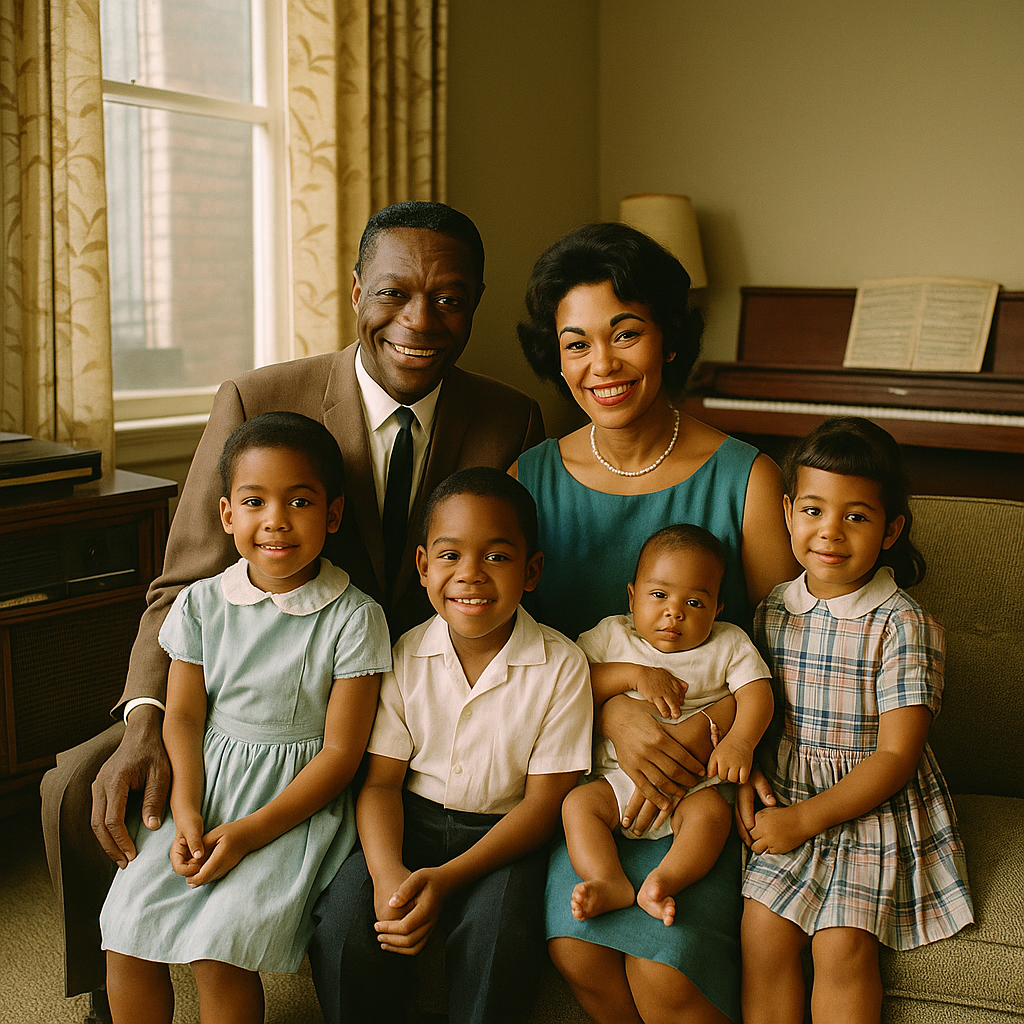
When Nat King Cole Opened His Home
The 1960 adoption story that redefined Black fatherhood in America
April 1960. Students were sitting in at Woolworth's counters across the South. The networks were covering racial unrest like breaking news. And on newsstands across America, Ebony magazine published something revolutionary—not because it was shocking, but because it was ordinary.
Nat King Cole, the man whose voice had soundtracked a generation, invited the world into his living room to meet his adopted son.
The article was titled "Why We Adopted Kelly." In it, Cole did something almost no Black celebrity had done in mainstream American media: he showed the country what Black fatherhood actually looked like. Not as a sociological problem. Not as a political statement. But as a man holding his baby boy, teaching his daughters kindness, and filling his home with what he called "peals of boyish laughter."
For Ebony's readers, the April 1960 issue wasn't just celebrity gossip. It was proof of life.
Archive Details
Historical Figure: Nat King Cole
Publication: Ebony Magazine
Issue Date: April 1960
Article Title: "Why We Adopted Kelly"
Archive Source: Original first-person account by Nat King Cole
The Magazine That Refused to Look Away
John H. Johnson launched Ebony in 1945 with a simple, radical premise: African Americans deserved to see themselves as whole human beings in print. Not as victims. Not as statistics. But as parents, professionals, lovers, and leaders.
By 1960, Ebony had become the most influential Black magazine in America, reaching millions of readers who were starved for images that reflected their dignity. Mainstream publications offered African Americans two options: invisibility or stereotype. Ebony offered a third choice—truth.
The Nat King Cole feature arrived at a flashpoint. Cole had already shattered barriers as the first Black man to host a network television variety show. But sponsors fled. The show was canceled after a single season. America, it seemed, could tolerate a Black man singing on TV, but not a Black man as the face of a program.
So when Cole opened his home to Ebony, he was doing more than sharing family news. He was claiming space. He was saying: We are here. We build families. We love our children. And you will see us.
"We Wanted Him. It's That Simple."
The article opens with disarming directness. No preamble. No apology.
Cole and his wife Maria already had two daughters—15-year-old Carol and 10-year-old Natalie, who would later become a Grammy-winning legend in her own right. They wanted a son. When Nat Kelly Cole entered their lives at just over five months old, the circle, as Nat put it, was complete.
But Cole refuses sentimentality. He won't let readers frame adoption as charity or rescue. "We didn't do anyone a favor," he writes. "He did us a favor by coming into our home."
This inversion matters. In 1960, adoption was often discussed in white media as an act of benevolence—wealthy families saving unfortunate children. Cole rejects that framework entirely. Kelly wasn't saved. He was chosen. Wanted. Celebrated.
The article moves through the mechanics of their family life with unflinching specificity. Cole describes Kelly's mischievousness, his apparent love of music even as an infant, his "lot of personality." He talks about discipline—not the harsh, punitive kind, but what he calls "discipline of the mind and heart." Each child, he insists, must be understood individually, not stamped out on an assembly line.
He also doesn't hide from the hardest truths. His daughters attended predominantly white schools. He knew Kelly would face racism. But Cole's strategy wasn't to shield his children from reality—it was to prepare them without letting that reality crush their spirits.
And then there's the baseball dream. Cole imagines Kelly in a Dodgers uniform, learning to love the game. It's a small detail, but it lands like a gut punch. Here is a Black father in 1960, dreaming the same modest, American dreams that white fathers took for granted.
Adoption as Love
Cole reframes adoption not as charity but as a deliberate act of love—choosing Kelly because they wanted him, not to rescue him.
Discipline Through Understanding
Cole emphasizes individualized parenting rooted in empathy, rejecting harsh punishment in favor of guidance tailored to each child.
Preparing for Racism
Cole acknowledges the reality of discrimination his children will face, choosing preparation over protection while nurturing their confidence.
Universal Fatherhood
His dreams for Kelly—baseball, music, laughter—mirror the ordinary hopes of fathers everywhere, claiming that normalcy as rightfully theirs.
The Photos That Told a Counter-Narrative
The cover of the April 1960 issue shows the Cole family together—Nat, Maria, Carol, Natalie, and baby Kelly. No Hollywood gloss. No artificial staging. Just a family.
Inside, the photo spread unfolds like a private album made public. Kelly in his high chair. Kelly taking his first steps under Nat's watchful eye. Kelly in matching cloth hats with his father. Kelly on the road, blending into the rhythm of a celebrity household that still made room for bedtime and bottles.
These images performed cultural work. They existed as proof against the absent-father stereotypes that white America used to pathologize Black families. Here was Nat King Cole—a man at the height of his career, constantly touring—making his son visible, present, central.
For Ebony's audience, the message was clear: This is us, too. Not the crisis. Not the exception. Just family.
The Endurance of Ebony's Vision
John H. Johnson understood something essential: humanization isn't a byproduct of political struggle. It's the foundation. Ebony didn't wait for white approval to print stories of Black love, ambition, and joy. It printed them because they were true.
Nat King Cole's article endures because it captures something rarely seen in 1960—a Black father writing tenderly, honestly, and without apology about his family. Not as a response to racism. Not as a rebuttal to stereotypes. Just as a man who loved his son.
That simplicity was, and remains, radical.
Why This Issue Still Commands Attention
Cultural Icon
Cole remains one of the defining voices of 20th-century American music. This is one of the few first-person narratives he published about his family life.
Primary Document
A firsthand account of Black family representation during the Civil Rights era, offering unfiltered insight into how African Americans claimed their narratives.
Photographic Archive
The issue contains rare, intimate photographs of the Cole family—visual documentation of Black fatherhood that countered prevailing stereotypes.
Collector Demand
Highly sought after by collectors of African American history, music memorabilia, and mid-century periodicals. Not just nostalgia—documentation.
Explore the Archive
If Nat King Cole's story resonates, the full Ebony archive holds decades of similar moments—cultural milestones, personal testimonies, and historical turning points captured in real time.
Browse Ebony Magazine CollectionFrom the 1940s through the 1970s, Ebony documented Black life as it happened. Each issue is a time capsule. Each story is a reclamation.
A Love Letter in Print
The April 1960 issue of Ebony wasn't a celebrity puff piece. It was a declaration. Nat King Cole opened his home and let America see what it had worked so hard to ignore: a Black family thriving, loving, and building a future.
By the time readers finished "Why We Adopted Kelly," they hadn't just learned about an adoption. They'd witnessed a father refusing to let his son be defined by the limitations the world tried to impose.
For collectors, this issue is a window into that refusal. For historians, it's evidence of how representation was fought for, frame by frame, story by story. For anyone who loves Nat King Cole, it's the moment he showed the world what mattered most—not the applause, but the laughter echoing through his home.
That laughter, frozen in ink and photo grain, still echoes today.