
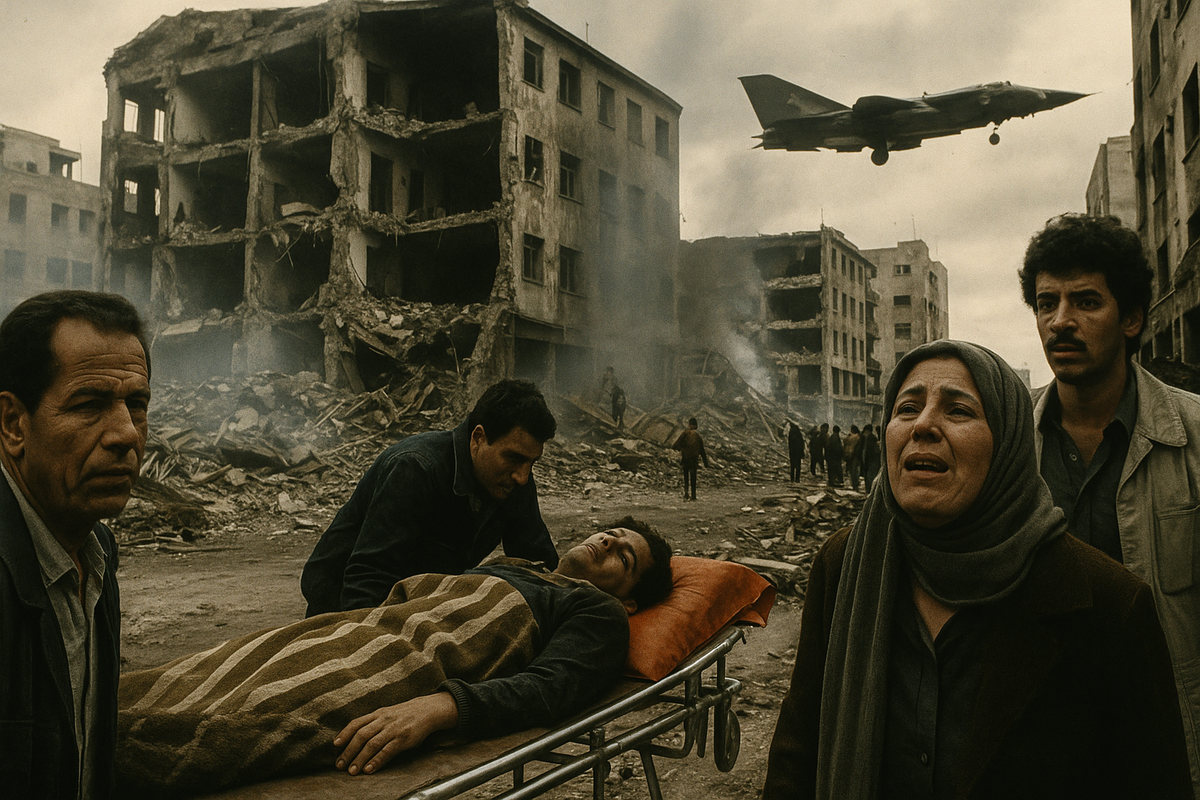
The Night America Bombed Gaddafi: Inside Time's April 28, 1986 War Report
When Reagan's F-111s struck Tripoli, Time Magazine captured the gamble that defined 1980s counterterrorism—and rewrote the rules of American military power.
The bombers took off from British airbases just after dark. Their target: Muammar Gaddafi's compound in Tripoli. Their route: a 2,400-mile detour around France and Spain, whose governments had refused American warplanes passage over their airspace. When the F-111s finally screamed over the Libyan coast and released their payload, Ronald Reagan's gamble became irreversible.
Days later, Americans opened their mailboxes to find Time Magazine's April 28, 1986 issue waiting—a document of that gamble and its consequences. The cover told the story before a single word was read: bombed-out Tripoli streets, rubble where buildings once stood, and the unmistakable message that the United States had crossed a line.
This wasn't commentary. This was the first draft of history, delivered while smoke still hung over North Africa.
Archive Details
Historical Figure: President Ronald Reagan
Issue Date: April 28, 1986
Archive Source: Time Magazine
Operation: El Dorado Canyon
Significance: First major U.S. military strike against state-sponsored terrorism
The Discotheque, the Dead, and the Decision
The chain of events moved with brutal speed. On April 5, 1986, a bomb tore through La Belle discotheque in West Berlin, a nightclub frequented by American servicemen. Two U.S. soldiers died. Dozens more were wounded. Within days, American intelligence traced the attack to Libyan agents operating under direct orders from Gaddafi's regime.
Reagan's response was swift and unambiguous. On April 15, Operation El Dorado Canyon commenced. U.S. Air Force F-111 bombers, launched from Britain and supported by Navy aircraft in the Mediterranean, struck military installations, terrorist training camps, and Gaddafi's personal compound in Tripoli and Benghazi.
The president's justification was equally direct: "When our citizens are attacked, we will respond."
But the cost was immediate and visible. Dozens of Libyans died in the raids, including civilians. Reports circulated that Gaddafi's adopted daughter was among the dead. The strikes achieved their tactical objectives, but the strategic consequences—diplomatic fractures across NATO, Arab fury, questions of proportionality—would reverberate for years.
Time Magazine captured all of it: the precision and the chaos, the resolve and the doubt.
What Readers Saw When They Opened the Magazine
Time in 1986 operated at the height of its cultural authority. As America's dominant newsweekly, it didn't just report events—it framed them. The April 28 issue demonstrated why.
The cover photography was unflinching: destroyed streets in Tripoli, wrecked vehicles, Libyan civilians standing amid the wreckage. These weren't sanitized images. They were evidence.
Inside, the magazine delivered what daily newspapers couldn't: context. The lead story dissected Reagan's calculus, weighing the strike's deterrent value against the risk of escalation. Time documented the fractures within NATO—Margaret Thatcher stood with Reagan, while France, Spain, and Italy balked. The refusal of overflight rights forced American bombers on that punishing 2,400-mile detour, a detail that underscored both U.S. determination and European resistance.
Photographs of Reagan huddled with Defense Secretary Caspar Weinberger and Secretary of State George Shultz brought readers into the Situation Room. The visual narrative was clear: this was not a decision made lightly.
Time also delivered what would become a hallmark of 1980s geopolitical coverage—the intersection of terrorism, oil politics, and superpower rivalry. For many Americans, this issue was their first sustained look at how state-sponsored terrorism would dominate U.S. foreign policy for decades. The magazine didn't just chronicle the strikes. It chronicled the beginning of an era.
The Details That Made It News
The La Belle discotheque attack wasn't random. U.S. intelligence intercepted communications proving Libyan involvement, giving Reagan the justification he needed.
France and Spain's refusal to allow U.S. aircraft into their airspace was more than logistical. It was a public rebuke, exposing fault lines in the Western alliance.
Time's reporting acknowledged what military briefings downplayed—Libyan families died in the raids. The question of proportionality dominated international reaction.
The strikes hit his compound, but Gaddafi himself escaped. Whether he was ever truly the target remained a matter of fierce debate.
Domestically, the president faced critics who feared the strikes would provoke more terrorism, not less. Time framed the operation as both bold leadership and dangerous precedent.
These weren't abstractions. They were the raw materials of history, captured and contextualized while the world was still reacting.
Why This Issue Endures
For collectors of vintage magazines, the April 28, 1986 Time occupies rare territory. It documents a pivot point—the moment American counterterrorism doctrine shifted from reactive defense to preemptive strike.
The issue's collectibility rests on several factors:
Collector Significance
Published within days of the raids, it captured the immediate American and global response. This wasn't retrospective analysis. It was real-time journalism under pressure.
The images—destruction in Tripoli, Reagan with his war cabinet, Libyan civilians surveying the damage—make this issue impossible to forget.
The magazine reflects the 1980s in full—terrorism as statecraft, NATO in tension, American military power deployed without apology.
For those who lived through the Reagan years, this issue is a physical artifact of a defining confrontation. It's not nostalgia. It's evidence.
Serious collectors recognize that magazines like this do more than inform. They preserve the temperature of their moment—the urgency, the uncertainty, the stakes.
Why We Keep These Pages
Digital archives can't replicate what holding this magazine delivers. The weight of the paper, the boldness of the layout, the advertisements for 1986 products—all of it anchors you in April of that year. You're not reading about the past. You're holding it.
The April 28, 1986 Time shows how journalism shaped public understanding of terrorism, presidential power, and international conflict. It also shows how the seeds of 21st-century U.S. military doctrine were planted decades earlier, in decisions made under Cold War pressure.
This is why vintage magazines matter. They're not collectibles because they're old. They're collectibles because they're irreplaceable.
For Collectors and Historians
If you study Cold War politics, presidential decision-making, or the origins of modern counterterrorism, this issue belongs in your collection. It's a primary source, a cultural artifact, and a reminder that history is written first in magazines like this—before the memoirs, before the declassified documents, before the retrospectives.
Browse Time Magazine CollectionFrom the 1930s through the 1980s, the collection traces history as it unfolded in real time. Each issue is more than paper. It's a preserved voice from a moment that won't return.
The Final Word
The April 28, 1986 Time Magazine remains a landmark in Cold War journalism. Its coverage of Reagan's airstrikes on Libya captured a turning point in U.S. foreign policy—the moment America chose direct military action over diplomatic pressure in the fight against terrorism. The photographs, reporting, and analysis gave readers not just information, but a framework for understanding a newly dangerous world.
To hold this issue today is to hold the moment when Reagan's America confronted Gaddafi's Libya head-on. For collectors, historians, and enthusiasts, it's proof that vintage magazines aren't just reading material. They're living records of when everything changed.