
The Magazine That Exposed Democracy's Capital as Segregation's Showroom
How Walter White's 1954 Saturday Evening Post article documented the color line in Washington, D.C.—weeks before Brown v. Board of Education changed America forever
On April 3, 1954, millions of Americans opened their mail to find the latest issue of The Saturday Evening Post. The cover promised its usual comforts: a Ben Prins illustration of a small-town fire department, all Americana charm and gentle humor. But turn past that cheerful facade, and readers encountered something else entirely—a reckoning.
"How Washington's Color Line Looks to Me" by Walter White landed like a judicial brief disguised as journalism. White, then executive secretary of the NAACP and architect of the legal strategy that would dismantle Jim Crow, had written something more dangerous than an exposé. He'd written an indictment. And the defendant was Washington, D.C. itself—the city that styled itself as freedom's capital while operating as segregation's showroom.
The timing was surgical. In less than two months, the Supreme Court would hand down Brown v. Board of Education. White knew it. The Post's editors knew it. And now, across kitchen tables in Des Moines and parlors in Atlanta, readers were holding the prelude to a revolution they didn't yet know was coming.
Archive Profile
Historical Figure: Walter White, Executive Secretary of the NAACP (1931-1955)
Issue Date: April 3, 1954
Archive Source: The Saturday Evening Post
Historical Context: Published seven weeks before the Supreme Court's landmark Brown v. Board of Education decision
The Capital's Cruel Paradox
White opened with the contradiction at democracy's heart: African diplomats from newly independent nations toured Washington as honored guests of the State Department, only to be refused service at lunch counters three blocks from the White House. Asian ministers attended congressional hearings on freedom, then couldn't find hotels that would rent them rooms.
The Soviet Union's propagandists didn't need to fabricate anything. They simply reprinted American newspaper stories.
This was Washington in 1954—a city where Black citizens comprised one-third of the population but lived under a system of casual apartheid. Public schools were segregated by law. Swimming pools flew racial flags: federal facilities admitted all comers, but District-operated pools remained white-only, a bureaucratic absurdity that White skewered with clinical precision. Even churches, those supposed sanctuaries of brotherhood, drew their own color lines.
White had fought this system for decades, but he'd never had a platform like the Post—a magazine that reached four million households, most of them white, most of them outside the South. If the civil rights movement needed to nationalize the conversation, this was the megaphone.
Why the Post Took the Risk
The Saturday Evening Post was not a radical publication. It trafficked in Norman Rockwell covers, serial fiction, and the reassuring rhythms of middle-class life. Its editorial stance leaned conservative. It celebrated Main Street values and small-town virtues.
Yet here it was, publishing one of the most unflinching critiques of American hypocrisy ever to appear in a mass-market magazine.
The decision revealed something about the Post's DNA that's easy to miss in retrospect. Yes, it was sentimental. Yes, it mythologized a certain vision of America. But it was also serious—a publication that understood its role as both mirror and witness. When Ben Hibbs took over as editor in 1942, he'd pushed the magazine toward harder journalism without abandoning its populist soul. The Post could run a frothy cover and a brutal truth in the same issue because it believed its readers could handle both.
The April 3, 1954 issue proved it. Readers who came for the comfort got the confrontation—and they kept reading.
White's Case, Frame by Frame
What made White's article devastating wasn't its anger—though the anger was there, banked like coals beneath every paragraph. It was his methodology. He built his case the way a prosecutor lays out evidence: specific, visual, irrefutable.
The Post supported this with photographs that functioned as trial exhibits:
Tennis courts at a public park: Black and white players sharing the same net, the same court. White called these "revolutionary changes," and for 1954 Washington, they were. Integration wasn't theoretical here—it was two people hitting a ball back and forth, proof that the sky didn't fall when the color line broke.
Slum housing in the Capitol's shadow: Families living in structures the city itself classified as substandard—sixty percent of them Black. The photographs placed decrepit row houses against the marble dome visible in the background, a composition that needed no caption.
The segregated pool controversy: Federal pools integrated. District pools closed rather than integrate. White explained the bureaucratic gymnastics required to maintain this idiocy, and the photos showed empty pools, monuments to official stupidity.
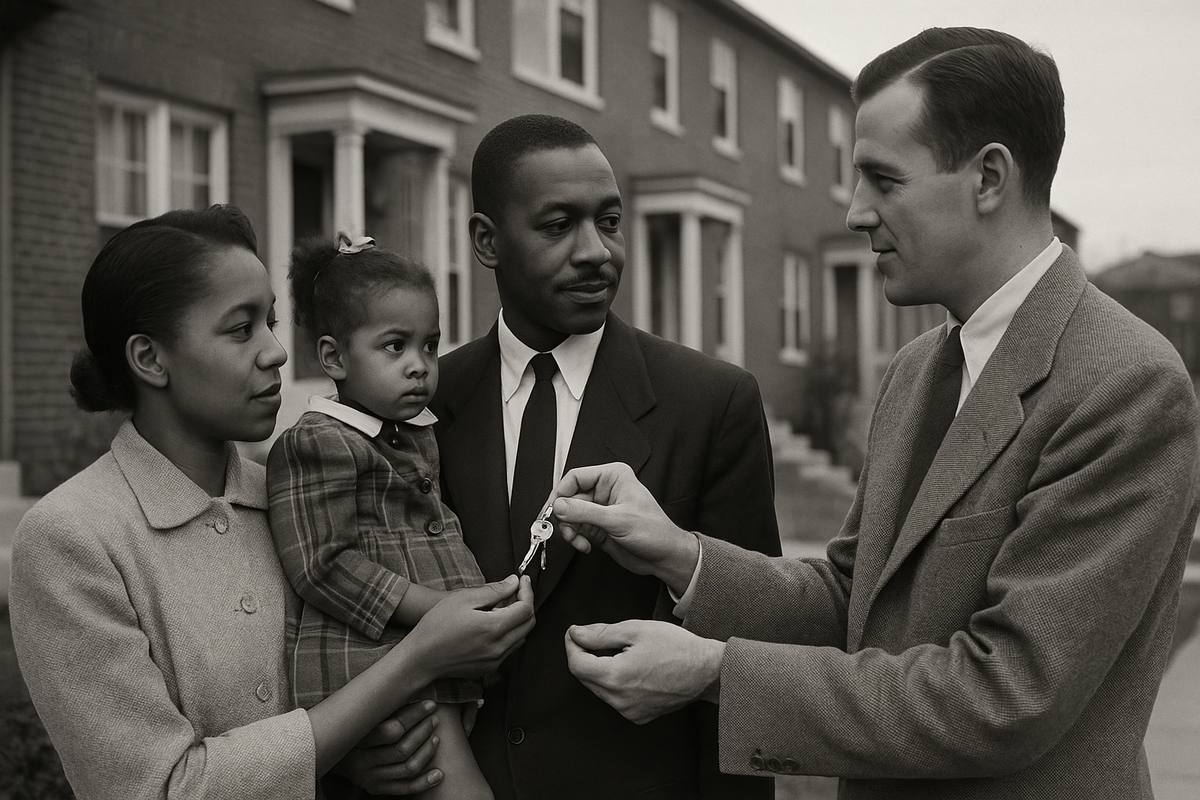
The James Smith family moving day: Furniture, boxes, hope. A Black family relocating to a better neighborhood, the kind of ordinary American aspiration that segregation had made extraordinary.
These weren't illustrations. They were documentation. The Post was creating a visual archive of segregation at the precise moment it began to crack.
Five Truths White Forced Into the Light
White structured his argument around interlocking failures, each one feeding the others:
The Showcase Problem
Every visiting dignitary saw the same contradiction. America preached democracy in conference rooms where the staff couldn't eat in the building's own cafeteria. The country's moral authority bled out with every snub, every closed door, every "whites only" sign within sight of the Lincoln Memorial.
Housing as Controlled Strangulation
Black families weren't just poor—they were geographically trapped. Restrictive covenants, redlining, and outright discrimination confined them to neighborhoods where landlords could charge whatever they wanted because their tenants had nowhere else to go. White noted that some of these neighborhoods sat close enough to the Capitol that residents could watch lawmakers debate "equality" from their front stoops.
Recreation as Reinforcement
Segregation didn't just limit where people could live or work—it dictated where they could swim, play, relax. Public leisure became a daily reminder of second-class status. Children absorbed the lesson at the pool gate: your presence pollutes.
The Government Job Paradox
Federal employment had expanded for Black workers during and after World War II, offering income and dignity rare in the private sector. These jobs mattered—they built a Black middle class and proved that integration could function. Yet employees who worked side by side in government offices couldn't share a meal in most downtown restaurants.
Cold War Propaganda Gold
The Soviets didn't need spies when they had American newspapers. Every lynching, every riot, every photo of police dogs and fire hoses became a weapon against U.S. credibility. White understood that civil rights wasn't just a moral imperative—it was a strategic necessity. America couldn't win the Cold War while losing the argument about human dignity.
White wasn't asking for sympathy. He was presenting evidence that the current system damaged everyone—Black citizens most directly, but also America's global standing, its democratic credibility, its capacity to lead.
The Post's Double Consciousness
The Saturday Evening Post was never just one thing. It sold an idealized America—small towns, traditional values, Rockwell's vision of citizens doing right by each other. But it also published John Steinbeck, William Faulkner, and C.S. Forester. It ran lighthearted serials alongside serious war correspondence.
This April 1954 issue crystallizes that duality. The magazine could celebrate American life and critique American failure in the same breath because it believed the country could handle the contradiction. Maybe it even believed the country needed the contradiction—that real patriotism meant loving your nation enough to see it clearly.
Walter White's article wasn't an attack on America. It was a challenge to America. Live up to the promise or admit the promise is a lie. The Post gave him the platform to pose that challenge to millions of readers who'd never thought about segregation in Washington, D.C., or who'd thought about it and looked away.
Why This Issue Matters to Collectors
Timing as Prophecy
Published weeks before Brown v. Board of Education, it documents the national conversation at the moment before everything changed. Collectors prize artifacts that sit on historical fault lines—this issue practically vibrates with what's coming.
Walter White's Stature
As NAACP executive secretary from 1931 to 1955, White orchestrated the legal dismantling of segregation. He recruited Thurgood Marshall. He coordinated the cases that became Brown. His byline alone makes this issue significant; his argument makes it essential.
Visual Documentation
These photographs exist in few other places. They show segregation not as an abstract evil but as a concrete, photographable reality in America's capital. For researchers and collectors focused on civil rights history, this is primary source material.
The Cover Contrast
That fire department illustration—wholesome, humorous, utterly disconnected from the article inside—reveals how most white Americans experienced the 1950s. They could choose which parts of their country to see. The Post made that choice harder.
Market Demand
Civil rights-era publications, particularly those from mainstream outlets covering segregation honestly, have appreciated steadily. Condition matters, but content matters more. This issue has both.
Start Your Collection
Thousands of original Saturday Evening Post magazines from the 1920s through the 1970s are available for collectors, historians, and anyone interested in American culture as it was lived and documented in real time.
Browse The Saturday Evening Post Magazine CollectionThe Artifact and the Argument
The April 3, 1954 Saturday Evening Post endures because Walter White's argument endures. America still wrestles with the gap between its ideals and its practices. Washington, D.C. still symbolizes both democracy's promise and its failures. And publications like the Post still matter because they show us how previous generations confronted these same contradictions.
White wrote his article for readers in 1954, but he was also writing for us. He knew the fight wouldn't end with one court decision or one legislative victory. He knew every generation would have to choose: look at the color line honestly, or pretend it isn't there.
The Post chose to look. That choice, preserved in four million copies of a magazine most people bought for the cover illustrations, is worth remembering—and worth collecting.