
The Last Christmas Before the Crash
Inside Electronic Games Magazine's December 1983 Gift Guide
The robot on the cover stands guard over a treasure hoard that no longer exists.
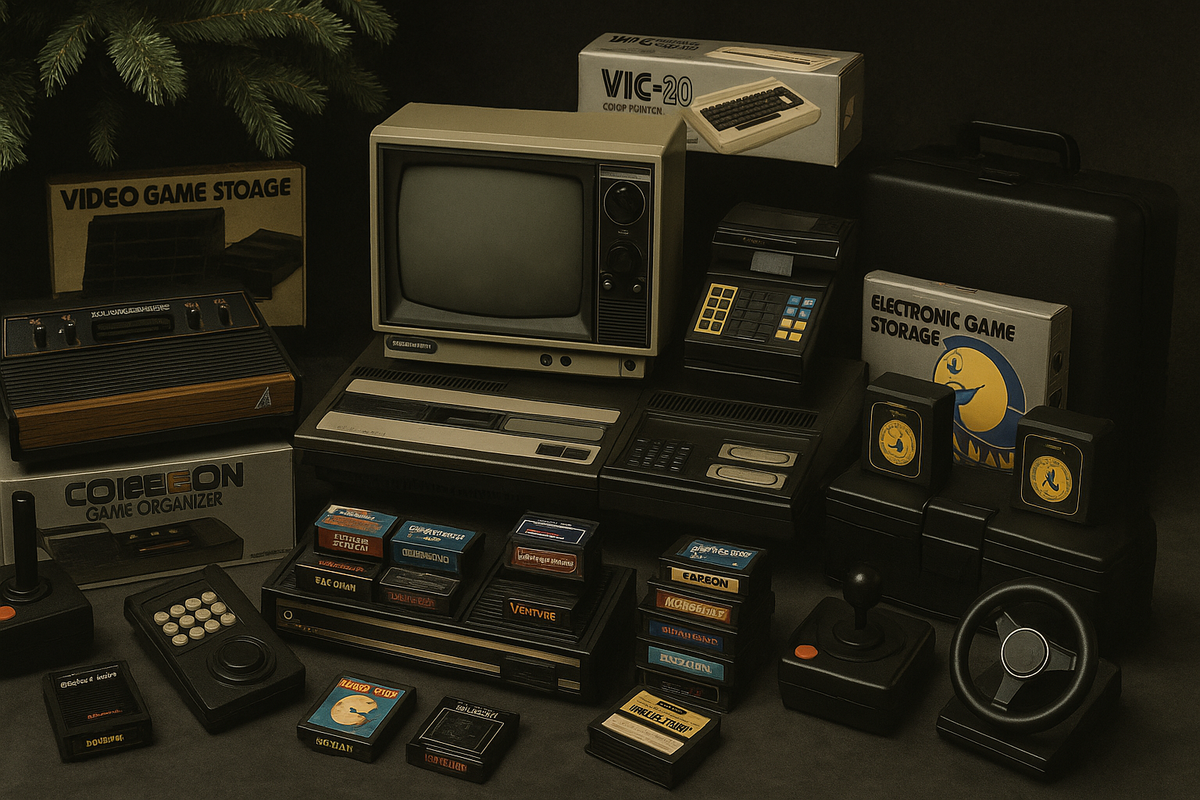
Stacked around its metallic feet: Atari 2600 cartridges, ColecoVision boxes, joysticks shaped like obelisks, and monitors promising arcade-perfect color. The December 1983 issue of Electronic Games Magazine hit newsstands as a holiday celebration—glossy pages packed with the Third Annual "Gifts for Gamers" guide, a buyer's map to the season's hottest consoles, gadgets, and gaming paraphernalia.
What readers didn't know: they were browsing a catalog of an industry already in free fall.
By the time families unwrapped these gifts on Christmas morning, the Video Game Crash of 1983 was well underway. Retailers sat on warehouses of unsold cartridges. Atari's stock had cratered. The boom was over. Yet here, frozen in print, is the optimism of an industry that believed the party would never end—and the excess that killed it.
Archive Details
Publication: Electronic Games Magazine
Issue Date: December 1983
Featured Content: Third Annual "Gifts for Gamers" Holiday Guide
Historical Context: Published during the Video Game Crash of 1983
The Magazine That Took Games Seriously
When Electronic Games launched in 1981, it did something radical: it treated video games as legitimate culture. Not as toys. Not as fads. As an entertainment medium worthy of serious journalism.
The magazine's pages combined industry reporting on hardware like the Commodore 64 and Vectrex, rigorous game reviews, strategy guides for arcade classics, and cultural commentary tracking gaming's influence on movies, toys, and youth identity. While mainstream press dismissed video games as novelties, Electronic Games was building the blueprint every gaming publication would follow—Nintendo Power, GamePro, EGM—they all owe their DNA to this magazine.
The December 1983 "Gifts for Gamers" issue represented the magazine's mission at its peak. Gaming wasn't fringe entertainment anymore. It had earned a place alongside music, electronics, and books in the holiday gift economy. This issue wasn't just a buying guide. It was a declaration.
What the Guide Revealed
The gift recommendations inside read like an archaeological dig through gaming's first golden age:
Gameline Master Module — A device that let Atari 2600 owners download games via telephone lines. Decades before Xbox Live or PlayStation Network, players could dial in and pull new titles directly to their consoles. Revolutionary. And almost immediately obsolete.
Pac-Man and Ms. Pac-Man clocks and watches — Proof that arcade mascots had transcended gaming. These weren't just characters. They were icons embedded in mainstream consumer culture.
Videoplexer cartridge organizers — Purpose-built storage for players drowning in game libraries. The magazine praised its utility, a small acknowledgment of how quickly casual players had become collectors.
Commodore 1701 monitor — Singled out as the best display for serious gamers, offering color clarity that standard TVs couldn't match.
Obelisk and Accuball joysticks — Early experiments in controller customization, showing that accessory manufacturers had already begun looking beyond Atari's standard stick.
Video Coin Holder by Nicoletii — A seemingly minor item with major cultural weight. Arcade players needed a way to carry quarters with style. The product's existence confirmed what the industry already knew: gamers were becoming a subculture with purchasing power.
Monty Plays Scrabble — An electronic board game computer, part of the early wave blurring the line between traditional and digital play.
These weren't just products. They were identity markers. Gamers weren't kids anymore—they were hobbyists, consumers, collectors. The guide recognized that shift.
The Industry on the Brink
By late 1983, the video game market was choking on its own success. The Atari 2600, ColecoVision, and Intellivision had brought gaming into millions of living rooms. Arcades remained cultural powerhouses with hits like Pac-Man, Donkey Kong, and Dragon's Lair still drawing crowds. Gaming had gone mainstream.
But the foundation was rotten. The market flooded with consoles and cartridges, many rushed to production with no quality control. E.T. the Extra-Terrestrial, released in late 1982, had become shorthand for consumer betrayal—a licensed cash grab so broken it poisoned trust in the entire medium. Retailers sat on mountains of unsold inventory. Manufacturers panicked.
The crash wasn't coming. It was already here.
The Video Game Crash of 1983 would wipe out companies, bankrupt developers, and send the industry into a years-long decline. Only Nintendo's arrival with the NES in 1985 would revive the corpse. Yet in December 1983, Electronic Games published a gift guide as if the boom would last forever. The disconnect makes this issue haunting—a snapshot of an industry that couldn't see the cliff until it had already gone over.
The Time Capsule Effect
Electronic Games didn't write history—it recorded it as it happened. These pages are time machines. The ads for cartridges that would never sell. The features on consoles that would be discontinued within months. The optimism radiating from every paragraph, unaware of the collapse already in motion.
This is why vintage gaming magazines matter more than blog posts or YouTube retrospectives ever will. They're not interpretations. They're evidence. Raw, unfiltered documentation of a culture at a turning point.
Why This Issue Matters to Collectors
Historical Timing
Published during the crash itself, it captures the final holiday season before the reset. It's the last gasp of the first console era.
Cultural Artifacts
The products featured—Gameline, Pac-Man watches, Videoplexers—are now retro treasures. Many fetch serious prices in collector markets, making the magazine a buyer's guide to items that have appreciated into valuable memorabilia.
Primary Source Material
Unlike retrospective histories, this magazine shows what people thought in the moment. Every advertisement, every recommendation, every editorial choice reveals the hopes and blind spots of an industry in denial.
Visual Legacy
The cover itself—a robot sentinel guarding stacks of gaming gear against a holiday backdrop—is iconic. It's colorful, strange, and oddly prescient. The robot guards a world about to vanish.
Owning this issue means owning a contradiction: a celebration published during a funeral.
For Collectors and Historians
If you study retro gaming, consumer culture, or media history, original Electronic Games magazines are indispensable. They're not reading material—they're artifacts.
Browse Electronic Games Magazine CollectionThese issues provide direct access to the technology, imagination, and consumer psychology that built modern gaming. Whether you're reliving childhood or researching an industry's evolution, they offer something no modern commentary can: the unedited voice of the past.
The Ghost in the Guide
The Third Annual "Gifts for Gamers" guide remains one of the most significant gaming publications ever printed—not despite the crash, but because of it.
It captured the holiday spirit at gaming's first cultural peak. It showcased the gadgets, accessories, and futuristic experiments that defined the era. And it stands as a monument to an industry's hubris, published just as oversaturation brought the market to its knees.
Holding this issue today means holding a warning and a dream in the same hand. The excitement of infinite possibility. The evidence of inevitable collapse.
For anyone serious about retro gaming or 20th-century consumer culture, this magazine isn't optional. It's essential—a reminder that video games were never just toys. They were, and remain, a cultural force powerful enough to build empires and burn them down.