
When Life Magazine Made Race Conflict Front-Page News
Sidney Poitier's Debut and the Film Hollywood Feared to Make
On September 4, 1950, Americans opened their mailboxes to find two wars staring back at them.
The cover of Life Magazine showed Marines unloading supplies in Korea—young men in fatigues, the machinery of conflict, the weight of another foreign entanglement. But inside, Life had buried a second battlefield: the American city itself, torn apart by race hatred, captured in the raw stills of a film called No Way Out.
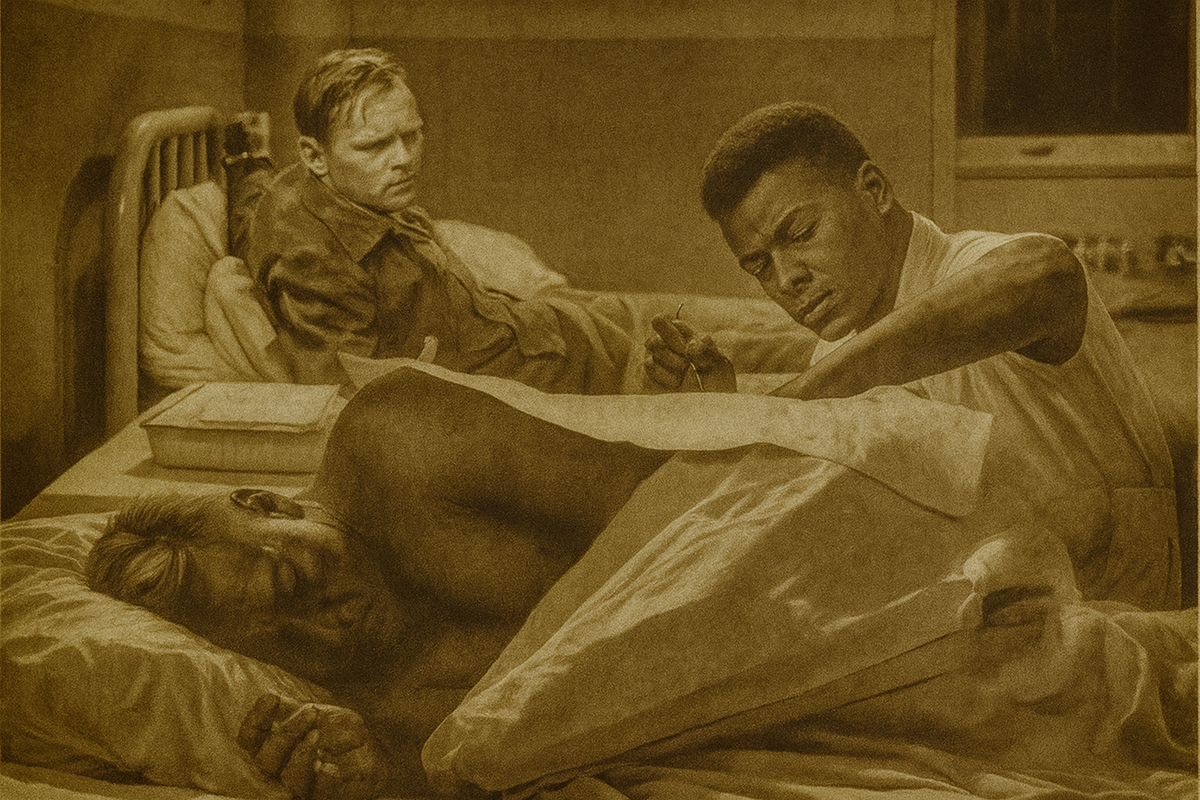
This was Sidney Poitier's screen debut. He played a young Black doctor facing down a violently racist patient in a hospital ward that became a powder keg. And Life—the nation's most powerful visual storyteller—had chosen to present this story not as entertainment but as frontline reportage.
For collectors of vintage Life magazines today, this issue is a Holy Grail. For historians of American cinema and civil rights, it is a turning point. For anyone studying how media shapes national consciousness, it is a masterclass in cultural courage.
Issue at a Glance
Historical Figure: Sidney Poitier (screen debut)
Issue Date: September 4, 1950
Archive Source: Life Magazine
Director Featured: Joseph L. Mankiewicz
Film: No Way Out (1950)
The Year America Stopped Looking Away
Nineteen-fifty was a year of reckoning postponed. Abroad, the Korean War had fractured the illusion of postwar peace. At home, McCarthyism tightened its paranoid grip. But beneath the Red Scare headlines, another American conflict—older, deeper, more combustible—was demanding attention.
Hollywood had long treated race as a subject too dangerous to touch. Black characters were sidekicks, servants, or comic relief. Serious drama about racial violence? Box office poison. Studio suicide.
Then came Joseph L. Mankiewicz.
The director, fresh off All About Eve, decided to adapt a screenplay that other studios had rejected as too incendiary. No Way Out told the story of Dr. Luther Brooks (Poitier), a Black physician whose white patient dies under his care. The patient's brother—a psychopathic racist played by Richard Widmark—refuses to believe the death was natural. What follows is a descent into urban warfare: riots, retribution, hospitals overrun with the wounded.
Life called it "Hollywood's roughest, rawest look to date at race conflict."
That wasn't marketing copy. That was fact.
The Photo-Essay That Made a Film Feel Like a Documentary
Life Magazine had perfected a formula by 1950: massive photographs, minimal text, maximum emotional impact. The publication didn't review films—it reported them. And in the case of No Way Out, Life presented the story as though Poitier's fictional hospital were an actual battleground.
"Birth of the Riot": The caption beneath a photograph of Poitier treating a white hoodlum. Across the room, another man glares. The frame crackles with inevitability.
"Result of the Riot": Hospital wards packed with the wounded. Mothers wailing. Nurses moving through chaos. The images were staged for a film, but Life stripped away the Hollywood artifice. Readers saw suffering, not cinema.
"The Hoodlum's Girl": Linda Darnell, caught between loyalty and conscience, her face a map of moral collapse.
Life's editors understood something profound: in 1950 America, the line between fiction and reality was thinner than anyone wanted to admit. These images of race riots weren't speculative. They were plausible. They were recognizable.
That was the genius—and the danger—of the feature.
Sidney Poitier: The Man Who Arrived Fully Formed
Life introduced Poitier to mainstream America with admiration bordering on awe. His performance was described as "earnest and vigorous," but those words don't capture what the photographs reveal: a young actor who brought quiet authority to a role that could have been reduced to victimhood.
Poitier's Dr. Brooks doesn't beg for dignity. He inhabits it. When Richard Widmark's character spits venom, Poitier's response is professionalism so steady it becomes an act of defiance.
This was not a supporting role. This was not a token appearance. This was a leading man—Black, unapologetic, competent—standing at the center of a Hollywood film in 1950.
Life knew what it was witnessing. So did America. Sidney Poitier's debut wasn't just a career launch. It was a cultural detonation.
The Risk Joseph Mankiewicz Took (And Why Chicago Banned the Film)
Mankiewicz didn't stumble into controversy. He walked into it deliberately.
Life profiled the director at work—coaching Poitier, blocking scenes with Stephen McNally, orchestrating the film's brutal riot sequences. The magazine framed him as a filmmaker steering Hollywood into "troubled waters," risking censorship, boycotts, and box office failure.
The risk was real. Chicago banned No Way Out temporarily, citing concerns about inciting violence. Other cities debated whether to allow it. The film's unflinching portrayal of white racism—not as individual prejudice but as systemic, murderous rage—was too much for some audiences.
But Mankiewicz held firm. And Life held up a mirror.
The magazine's coverage didn't soft-pedal the film's brutality. It amplified it. Stills of guns drawn, fists raised, mothers spitting hatred—all presented with the same gravity Life reserved for war photography. The message was clear: this conflict matters. This story must be told.
Why Life Magazine's Coverage Was Revolutionary
Other publications reviewed No Way Out. Life turned it into a cultural event.
The magazine's approach was three-pronged:
Visual Authority
The photo-essay format gave the film the weight of documentary truth. Readers didn't see promotional stills—they saw evidence.
Editorial Courage
In 1950, most mainstream publications avoided race conflict or treated it obliquely. Life made it unavoidable. The juxtaposition of Korea on the cover and race riots inside suggested a dual crisis: America was fighting enemies abroad while ignoring the one at home.
National Reach
Life's circulation in 1950 was over 5 million. No other publication could deliver this subject to so many American living rooms with such impact.
Cultural Legitimacy
The feature didn't just document a film. It legitimized a conversation. Life was one of the few publications with the reach and authority to bring such imagery into mainstream discussion.
What Makes This Issue a Collector's Prize
Sidney Poitier's First Appearance
Before The Defiant Ones, before In the Heat of the Night, before the Oscar—this is where it began. For film historians, this issue is ground zero.
Hollywood's Turning Point
No Way Out is now recognized as one of the first postwar films to confront American racism head-on. This Life feature is the primary contemporary document of its reception.
Dual Crises Captured
The cover (Korea) and the feature (race) together form a snapshot of America in 1950—at war abroad, at war with itself.
Life's Peak Cultural Power
This is the magazine at its zenith, when it could make or break cultural debates with a single photo-essay.
Archival Completeness
Beyond the main feature, the issue includes ads, fashion spreads, and product pages that offer a time capsule of daily American life—aspirin, kitchen appliances, the textures of mid-century consumer culture.
Historical Provenance
Condition matters, but provenance matters more. This isn't just paper. This is evidence.
The Artifact America Tried to Forget—And Couldn't
The September 4, 1950 issue endures because it refused to look away.
It gave America Sidney Poitier when Hollywood was still casting Black actors as janitors.
It gave Joseph Mankiewicz the platform he needed to prove that serious films about race could be serious art.
And it gave Life's millions of readers permission to confront a question the country had been avoiding: What happens when prejudice becomes violence? And who pays the price?
More than seven decades later, the issue remains urgent. The photographs still shock. The stakes still resonate.
Because the struggle it documented—the courage required to tell the truth about race, the role of art in that truth-telling—is unfinished.
Explore the Archive
This issue is part of a larger continuum. From the 1930s through the 1970s, Life Magazine chronicled America's wars, its cultural upheavals, its moments of triumph and shame. Each issue is an original artifact—not a reprint, not a digital scan, but the physical object that once sat on a coffee table in Omaha or Savannah or Detroit.
Browse Life Magazine CollectionFinal Word
The September 4, 1950 issue of Life Magazine is remembered for two things: the war America was entering and the war America was already fighting.
Sidney Poitier's debut in No Way Out gave the latter a face, a voice, and a moral clarity Hollywood had been afraid to touch. Life's coverage turned that debut into a national event.
For collectors, this issue is not just rare—it is vital. It captures the precise moment when American cinema, American media, and American conscience collided.
Hold this issue in your hands, and you hold that collision.