
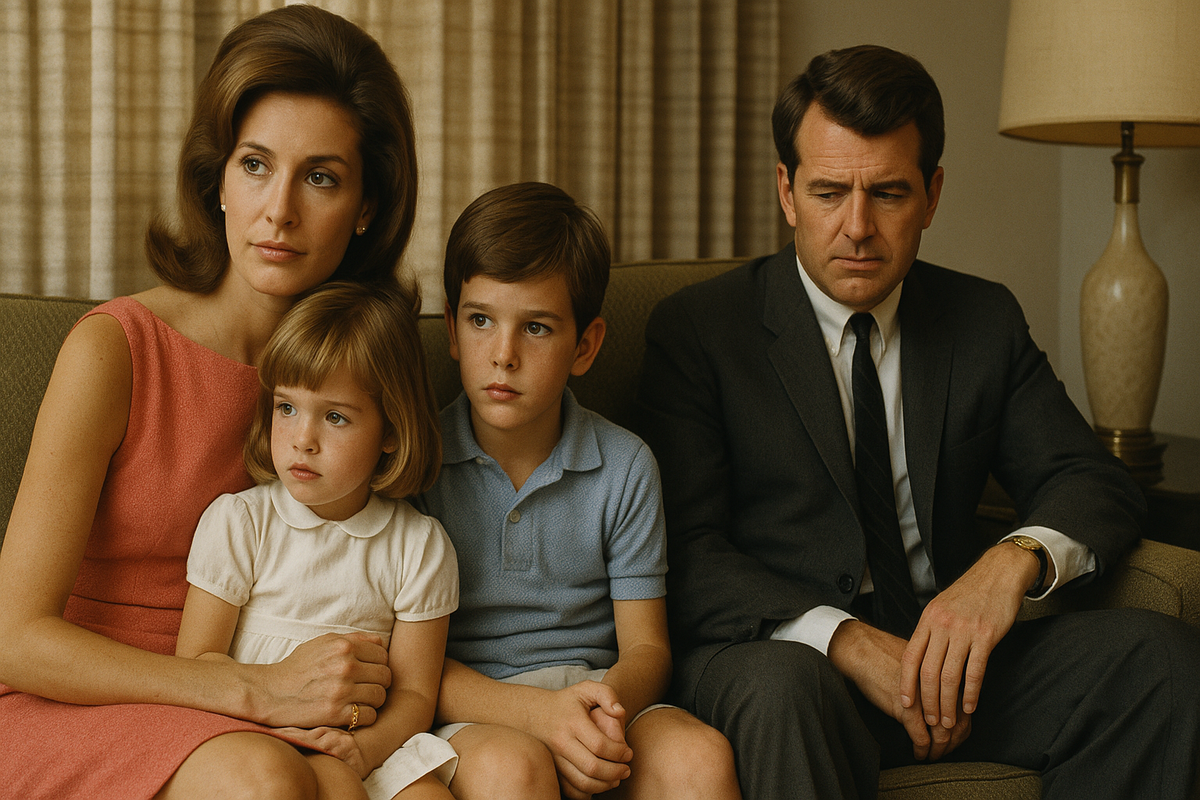
The Kennedys Under Guard: When Ladies' Home Journal Documented Fear in 1968
How a household magazine captured the impossible calculus of survival facing America's most famous family
The Secret Service agents appeared without warning.
They shadowed the Kennedy children to school, stood watch at playdates, and turned family outings into security operations. Ted Kennedy hadn't requested them. He hadn't been consulted. When he discovered the detail assigned to protect his sons and daughter, he was furious—not at the agents, but at what their presence confirmed: his family was no longer safe in America.
Three months after Robert F. Kennedy's assassination, Ladies' Home Journal published what would become one of the most haunting domestic profiles of the 1960s. "The Ted Kennedys Conquer Fear," written by Maxine Cheshire for the September 1968 issue, brought readers behind the iron gates of Hyannis Port and into the private calculus of survival facing the last Kennedy brother in public life.
This wasn't political journalism. It was something stranger and more intimate—a study of how a mother and father raise children when violence has become the family business.
Archive Details
Publication: Ladies' Home Journal
Issue Date: September 1968
Feature Article: "The Ted Kennedys Conquer Fear" by Maxine Cheshire
Historical Context: Published three months after Robert F. Kennedy's assassination
Primary Figures: Senator Edward "Ted" Kennedy, Joan Kennedy, and their children
September 1968: The Month America Held Its Breath
To understand why this article mattered, you must first understand the wreckage of 1968.
Martin Luther King Jr. had been murdered in April. Robert Kennedy fell in June, shot in the kitchen of the Ambassador Hotel just after winning the California primary. Vietnam was tearing the country apart. Cities burned. The Democratic National Convention would soon devolve into chaos in Chicago.
And Ted Kennedy—just 36 years old, grieving his second brother in five years—was being asked to carry the torch.
The nation wanted resilience. The Democratic Party wanted a candidate. But what did the Kennedy family want? What did Joan Kennedy tell her children when they asked why men with earpieces followed them everywhere?
Ladies' Home Journal understood that its four million readers didn't need another political analysis. They needed to see how a family survived when history kept pulling it under.
The Magazine That Made Tragedy Domestic
Ladies' Home Journal was never mistaken for hard news. Its pages mixed homemaking advice, fashion spreads, and earnest moral guidance for the American housewife. But in September 1968, it did something extraordinary: it placed the Kennedy family's grief inside the same domestic universe its readers inhabited.
The Cheshire profile appeared alongside advertisements for Carter's baby clothes, Sears raincoats, and Dan River bed linens. This juxtaposition wasn't careless—it was deliberate. The message was clear: even families touched by national tragedy must still dress children, buy groceries, and move through ordinary life. The Kennedys weren't untouchable icons. They were a mother and father trying to protect their kids in a country that kept killing its leaders.
Joan Kennedy became the article's emotional center. She was photographed with her children—glamorous, composed, yet visibly carrying the strain of sudden public scrutiny. The text revealed her shopping sales at Peck & Peck, sharing maternity clothes with her sister-in-law Ethel, navigating the impossible balance between privacy and duty. She embodied what the magazine's readers understood intimately: the work of holding a household together when the world outside feels uncontrollable.
The photographs told their own story. Ted appeared in formal headshots, the weight of leadership etched into every frame. The children played outdoors—swimming, laughing—but always with Secret Service agents visible at the edges, men in suits standing watch over childhood itself.
"The Word Has Never Passed Between Them"
Congressman John Tunney, a close friend of the Kennedys, offered the most chilling detail in the entire piece: the word "fear" had never been spoken between Ted and Joan since Robert's death.
Not once.
This silence was its own form of armor. If they didn't name it, perhaps they could outrun it. Ted reportedly dismissed the idea of living paralyzed by threats, insisting his family would continue their lives as normally as possible. But "normal" now meant armed guards trailing his children. "Normal" meant weighing every public appearance against the possibility of violence. "Normal" meant Joan Kennedy standing in department stores, shopping for her kids while cameras followed her every move.
The article captured this tension without resolving it. Cheshire didn't offer easy comfort or false optimism. She simply documented what resilience looked like when it was forced, not chosen—when "conquering fear" meant waking up each morning and pretending the danger wasn't real.
A Dynasty Raising Children in Public
The cruelty of the Kennedy children's position was impossible to escape: they were expected to be both ordinary kids and symbols of American endurance.
How do you raise a child normally when their last name is a political statement? When their birthday parties require security clearances? When their father might be the next president—or the next casualty?
The article didn't sentimentalize this burden. It showed Joan and Ted trying to carve out space for family dinners, neighborhood friendships, and bedtime routines, even as the machinery of political expectation closed in around them. The children weren't just grieving their uncle; they were learning that being a Kennedy meant living with a target on your back.
For Ladies' Home Journal readers—many of them mothers navigating their own anxieties about Vietnam, racial unrest, and a fracturing nation—this was profoundly relatable. The scale was different, but the fear was the same: how do you protect your children in a world that feels increasingly violent and unpredictable?
The Legacy of September 1968
What makes "The Ted Kennedys Conquer Fear" unforgettable is its refusal to offer closure. The article ends without resolution because there was none to offer. Joan and Ted couldn't conquer fear—they could only live alongside it, day after day, in full view of a country that demanded both their service and their suffering.
Ladies' Home Journal gave its readers permission to witness this without needing to fix it. In doing so, it performed an act of profound editorial empathy: it said that sometimes survival, not triumph, is the story.
Today, holding this issue means holding a piece of 1968—a year when America confronted its capacity for violence and asked whether hope could survive it. The answer, embodied in Joan Kennedy's steady gaze and her children's guarded play, was ambiguous. But the question itself, preserved in aging newsprint and fading photographs, remains achingly relevant.
Why This Issue Endures
Historical Proximity
Published just months after RFK's assassination, it captures the raw, unprocessed grief of 1968—before the decade had been mythologized, before the Kennedys became a brand. This is primary source material, preserving the emotions of the moment in real time.
The Domestic Lens on Political Trauma
Unlike Time, Newsweek, or Life, which approached the Kennedys through politics and photojournalism, Ladies' Home Journal used the vocabulary of homemaking and family life. This makes it invaluable to scholars studying how women processed national tragedy.
Cultural Artifact of Women's Media
The issue represents a high-water mark for women's magazines as serious cultural commentators. It proves that publications dismissed as "lightweight" were doing sophisticated work—translating public trauma into the private language of family, fear, and resilience.
Preservation of Ephemera
Many copies were read, discarded, or damaged over time. Surviving issues in good condition are increasingly rare, particularly with intact advertisements and photo spreads that provide context for the era's material culture.
For collectors of Kennedy memorabilia, 1960s Americana, or women's publishing history, this issue is essential. It's not just a magazine—it's a window into how a nation processed loss when the news kept getting worse.
Explore the Archive
If you're drawn to this intersection of history, domesticity, and cultural memory, original Ladies' Home Journal magazines offer unparalleled access to how American families understood their own lives across decades of transformation.
Browse Ladies' Home Journal Magazine CollectionThese aren't reproductions or digital scans—they're the actual artifacts that sat on coffee tables, were passed between neighbors, and shaped how millions of women saw themselves and their world.