
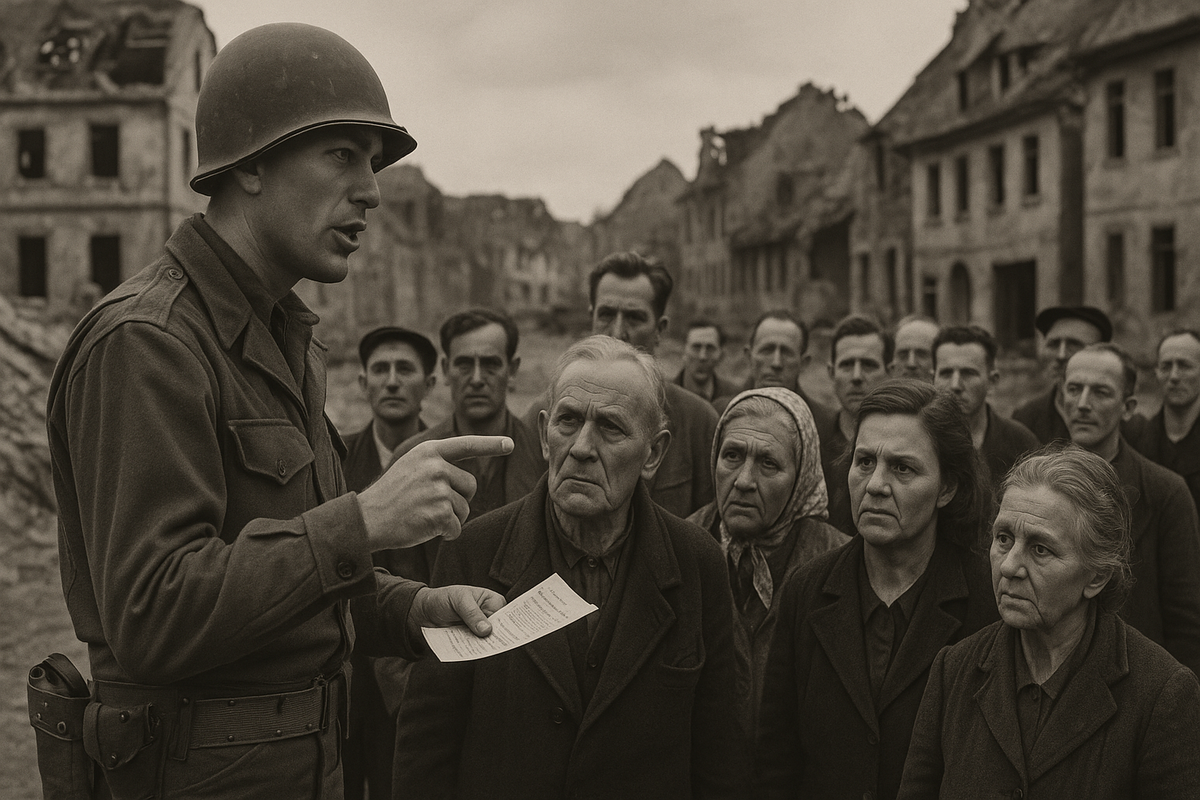
How Will We Govern Our Slice of Germany?
Two days after Franklin Roosevelt died, Americans opened their mailboxes to find a question waiting for them.
The April 14, 1945 issue of The Saturday Evening Post arrived with impeccable timing and terrible weight. Inside, Demaree Bess had written the article the nation didn't yet know it needed: "How Will We Govern Our Slice of Germany?" Roosevelt was gone. Hitler's Reich was collapsing. And for the first time in American history, U.S. soldiers would not simply defeat an enemy—they would rule one.
This wasn't policy analysis. It was a reckoning.
Victory Without a Treaty
Spring 1945 marked the edge of a new world. Allied armies pushed deeper into Germany, liberating concentration camps and crushing the Wehrmacht's final defenses. At home, the shock of Roosevelt's death on April 12 left Americans unmoored at the very moment they needed clarity most.
Unlike 1918, there would be no armistice, no negotiation, no functioning German government to hand over the keys. Germany lay shattered—cities reduced to ash, millions starving, infrastructure obliterated. The Allies would assume direct control. No intermediaries. No fig leaf of sovereignty.
The United States, Britain, and the Soviet Union would govern Germany themselves. The question was how—and whether their alliance would survive the answer.
Archive Details
Publication: The Saturday Evening Post
Issue Date: April 14, 1945
Featured Article: "How Will We Govern Our Slice of Germany?" by Demaree Bess
Historical Context: Published two days after FDR's death, weeks before Germany's surrender
Archive Source: Original vintage magazine collection
The Magazine That Held a Mirror to America
By 1945, The Saturday Evening Post had become more than a magazine. It was the voice in America's living room—the publication that balanced Norman Rockwell's idealism with hard reporting on the world as it actually was. Fiction, consumer ads, and serious journalism coexisted in a single issue, making the Post the closest thing to a national conversation the country had.
The April 14 issue opened with a photograph from Yalta: Roosevelt in his black cape, leaning toward Secretary of State Edward Stettinius, while Joseph Stalin watched from the side—patient, skeptical, already calculating. The image announced what was coming: an alliance fraying even before victory arrived.
Bess's article did what few other publications attempted. He walked readers through the machinery of occupation step by step, making the abstract concrete. American soldiers—many of them barely out of high school—would soon govern German towns. They would ration bread, staff schools, purge Nazi officials, and decide which factories could reopen. The boys who had fought their way across Europe would now become administrators, judges, and policemen in a country they had been trained to destroy.
For readers, this was disorienting. War made sense. Occupation did not.
What Bess Revealed
Rooting out Nazi ideology from every institution—schools, newspapers, courts, police forces. But how do you distinguish a true believer from someone who joined the party to keep his job?
Dismantling the Wehrmacht and ensuring Germany could never wage war again. Yet the Allies themselves disagreed on what that meant. Should Germany retain any industrial capacity? Or should it be reduced to an agrarian state, as Treasury Secretary Henry Morgenthau proposed?
Can you teach democracy to a nation that had embraced totalitarianism? American officers would oversee the rewriting of textbooks, the reopening of universities, the formation of civic institutions. But the U.S. had fewer experts on German culture than Britain or the Soviet Union.
Morgenthau's plan called for stripping Germany of its industrial base—turning it into a pastoral economy incapable of rearmament. Others argued this would destabilize all of Europe. Without a functioning German economy, who would trade with France?
Millions of Germans faced starvation. The Allies would control food distribution, which meant American taxpayers would feed the enemy. How would that sit with families who had lost sons in the Ardennes?
War criminals would face tribunals, but what about the millions of ordinary Germans who had supported the regime? Collective guilt was tempting but unworkable. Forgiveness seemed unthinkable but necessary.
Soviet "reeducation" programs looked nothing like American ideals of free elections and independent courts. Stalin's vision for Eastern Europe was already clear at Yalta. Germany would become the fault line.
Young officers trained for combat were now responsible for civil administration, legal judgments, and economic policy. The Army had prepared them to take territory, not to govern it.
In 1919, the Allies negotiated terms with a defeated but intact German government. In 1945, there was no government. The Allies were the government. This was not a treaty. It was a takeover.
Even as Bess wrote, the seeds of the next conflict were visible. The article captured the moment when wartime allies became postwar rivals, when cooperation turned to suspicion.
Why This Issue Endures
The April 14, 1945 Saturday Evening Post survives as more than a collectible. It is a primary document of American transition—published between Roosevelt's death and Germany's surrender, between total war and uneasy peace.
Historians value it for Bess's clear-eyed journalism, one of the most accessible explanations of occupation policy written for a general audience. Collectors prize it for its timing, its cultural weight, and its role in shaping how Americans understood their new responsibilities. The issue itself—complete with period advertisements for Marsh stencil machines, Sanford ink, and Massagic shoes—offers a layered view of 1940s life, where everyday commerce coexisted with world-historical events.
These magazines were not written for posterity. They were written for the moment. That immediacy gives them power. Reading Bess's article now is reading Americans confronting the future in real time, without hindsight, without knowing how it would end.
Victory Was Just the Beginning
"How Will We Govern Our Slice of Germany?" asked a question that would define the next fifty years. The occupation succeeded, though not in the way anyone predicted. Germany divided. The Cold War arrived. America never left.
Holding the April 14, 1945 issue is holding the pivot point—the moment when victory stopped being the goal and became the starting line. The responsibilities America assumed that spring would reshape the world order, split Europe, and establish the United States as the guarantor of the West.
Collector Significance
Historical Timing
Published just after Roosevelt's death and weeks before Germany's surrender, this issue captures America in transition at a critical historical moment.
Cultural Artifact
The Post balanced fiction, consumer culture, and world affairs in one package, making it the voice of mainstream America during the war years.
Unique Journalism
Demaree Bess's article remains one of the clearest explanations of America's postwar responsibilities written for the general public.
Time Capsule
Period advertisements for Marsh stencil machines, Sanford ink, Eno salts, and Massagic shoes add layers of everyday 1940s life to this historical document.
Explore the Archive
For collectors, cultural historians, and anyone who understands that history lives in original documents, vintage Saturday Evening Post magazines offer something irreplaceable: the chance to experience the past as it was first written, before anyone knew what came next.
Browse The Saturday Evening Post Magazine Collection