
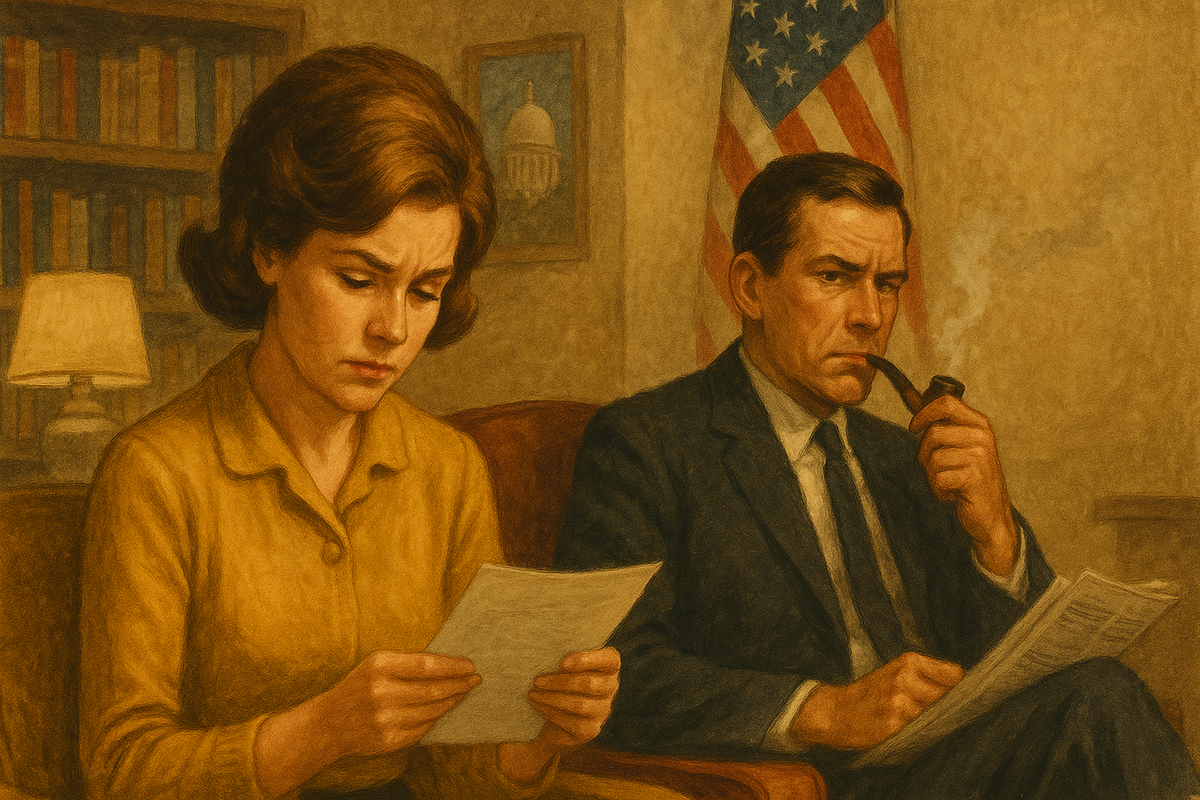
If I Could Only Change My Husband
Wives' Voices and the Quiet Revolution in 1968 America
February 1968. American wives opened their mailboxes to find the latest Ladies' Home Journal—and buried between the recipes and fashion spreads was a question that had never been asked so publicly: What would you change about your husband if you could?
The answers they gave would expose the fault lines running beneath millions of American marriages.
This wasn't a fluffy survey. It was a confessional—printed, analyzed, and distributed to millions of subscribers at the exact moment when the rules governing marriage, family, and womanhood were beginning to crack. What these wives said in 1968, before the women's liberation movement exploded into the mainstream, reads today like a preview of every marital conflict that would define the next fifty years.
The Context: 1968 and the Unraveling of Domestic Certainty
The late 1960s burned with protest. Civil rights marches. Vietnam. Campus uprisings. But inside American homes, a different kind of unrest was building—quieter, but no less consequential.
The 1950s housewife ideal—apron-clad, cheerfully domestic, devoted to husband and children—had begun to suffocate the women living inside it. Betty Friedan's The Feminine Mystique (1963) had named "the problem that has no name": the deep dissatisfaction of educated women confined to domestic roles. More women were entering college, joining the workforce, and questioning why marriage seemed to demand their silence.
Ladies' Home Journal understood this tension. With millions of subscribers, it was one of the most influential women's magazines in America—a publication that sold the dream of domestic perfection while simultaneously allowing women to question it. The "Voice of Women" poll was the Journal's gamble: give wives permission to speak honestly about their marriages, in print, and see what happens.
What happened was revelation.
Archive Details
Publication: Ladies' Home Journal
Issue Date: February 1968
Feature: "The Journal 'Voice of Women' Poll: If I Could Only Change My Husband"
Historical Context: Published during one of the most turbulent years in American history, months before the assassinations of Martin Luther King Jr. and Robert Kennedy
The Magazine That Gave Women a Microphone
By 1968, Ladies' Home Journal was more than a magazine—it was a national forum. Its editors knew their readers craved more than decorating tips and casserole recipes. They wanted honesty. They wanted to see their private frustrations acknowledged in public.
The "If I Could Only Change My Husband" poll delivered exactly that. Wives' complaints weren't dismissed as nagging or trivialized as domestic squabbles. They were quoted, categorized, and treated as serious data about the state of American marriage. The tone was frank—even humorous at times—but the underlying message was unmistakable: these women were pointing to structural problems in how marriage functioned.
And here's the perfect irony: the poll appeared alongside full-page advertisements for appliances, beauty products, and roasts—the very symbols of domestic femininity the wives were critiquing. The Journal was selling the dream while simultaneously publishing its breakdown. That contradiction was its power.
What Wives Wanted to Change: A Portrait of 1968 Marriage
The survey asked wives to rank their complaints. The results were startlingly modern.
Health Habits Topped the List
The number one complaint: quit smoking, drink less, lose weight. In an era when cigarettes were still marketed as glamorous and masculine, wives were already sounding the alarm about their husbands' health. These women weren't worried about aesthetics—they were worried about widowhood.
Household Responsibilities
Wives wanted husbands to help with the children. To do more around the house. This was 1968—years before "shared parenting" entered the national vocabulary, yet the demand was already there. Women were exhausted, and they were naming it.
Money and Financial Responsibility
Complaints about reckless spending and poor financial planning filled the responses. Wives wanted partners who budgeted, saved, and planned for the future. Financial anxiety wasn't abstract—it was daily, and it landed squarely on women managing stretched household budgets.
Romance and Attention
Wives craved tenderness. Dates. Time together. They wanted to be seen, not taken for granted. The complaint wasn't about grand gestures—it was about being noticed at all.
Overwork and Emotional Absence: Many husbands worked too much or brought home nothing but exhaustion. The phrase "work-life balance" didn't exist yet, but the problem already did. Wives were living with men who were physically present but emotionally gone.
What makes this poll extraordinary is its restraint. These women weren't calling for divorce or escape. They wanted improvement—better health, more help, deeper connection. The survey captures something fragile and essential: wives who loved their husbands but refused to pretend everything was fine.
Why This Poll Mattered Then—and Matters Now
This wasn't just a magazine feature. It was an act of cultural documentation.
The poll validated women's voices at a time when their complaints were routinely dismissed as trivial or hysterical. It gave wives permission to critique marriage without being accused of destroying it.
It exposed the politics of private life—showing how smoking, drinking, workaholism, and neglect weren't just personal failings but family crises that wives were left to manage alone.
It foreshadowed the feminist demands of the 1970s—for shared domestic labor, equal parenting, and marriages built on partnership rather than hierarchy—before those demands had a movement behind them.
And it preserved the emotional reality of 1968 marriage in a way few other sources did. Court records and census data can tell you how many people married or divorced. This poll tells you what it felt like to be married.
The Endurance of Ladies' Home Journal as Historical Record
Ladies' Home Journal endured for more than a century because it was never about just one thing. It was a mirror of women's lives across decades—recipes next to essays on marriage, beauty advice alongside cultural commentary. It gave women tools for daily survival and a voice in national conversations.
Today, vintage Ladies' Home Journal issues function as time capsules. They remind us that history wasn't just made in boardrooms and battlefields—it was made at kitchen tables, in conversations between women, in the small revolutions of expectation that preceded the large ones.
The permanence of print matters here. These weren't fleeting blog posts or social media threads. They were magazines women saved, shared, returned to. That tactile presence—the weight of the paper, the smell of old ink—makes them irreplaceable as historical sources.
Why Collectors Prize the February 1968 Issue
For collectors and historians, this issue is a primary source of uncommon value.
Historical Timing
Published during one of the most turbulent years in American history—Martin Luther King Jr. and Robert Kennedy would both be assassinated within months—the poll captured the private upheaval happening inside homes while the nation convulsed in public.
Cultural Significance
The poll offers researchers a rare window into gender dynamics before second-wave feminism reshaped the language of marriage. It's the "before" snapshot that makes the "after" comprehensible.
Visual and Material Appeal
The issue embodies late-1960s graphic design—bold typography, vibrant color ads, the aesthetic confidence of mid-century print culture. It's beautiful as an object, invaluable as a document.
Enduring Relevance
The questions wives asked in 1968—about health, housework, money, attention—remain unresolved in many marriages today. Reading their words is unsettling precisely because they sound so familiar.
Owning this issue means holding a cultural artifact that bridges eras: the last gasp of 1950s domesticity and the first breath of women's liberation.
Where to Find Original Ladies' Home Journal Issues
Thousands of original Ladies' Home Journal magazines are available to collectors and researchers. From the suffrage-era editions of the early 1900s through the cultural upheavals of the 1960s, you can trace the entire arc of women's history through its pages.
Browse Ladies' Home Journal Magazine CollectionWhether you're a serious collector, an academic researcher, or simply curious about how women lived and thought across the twentieth century, these magazines offer something rare: history as it was first recorded, in the voices of the women who lived it.
The Voices That Refused to Stay Quiet
The February 1968 "Voice of Women" poll in Ladies' Home Journal was more than a quirky survey about husbands. It was evidence of a seismic shift—proof that wives were no longer willing to stay silent about what marriage cost them.
Just as LIFE magazine's wartime photography captured battles abroad, the Journal captured battles at home: the struggle for health, respect, partnership, and presence inside American marriages. These weren't loud revolutions. They were quiet insurrections, voiced in print, filed away in magazine racks, but never forgotten.
Holding this issue today means holding a moment when ordinary women began saying, in public, what they had always thought in private. Their words—preserved in the glossy pages of a mass-market women's magazine—still echo more than half a century later.
For anyone who values history, vintage Ladies' Home Journal issues aren't just reading material. They're living artifacts. And through them, the voices of women past continue to speak directly to us—demanding, as they always have, to be heard.