
When Forbes Bet on Human Ingenuity Over Apocalypse
The 1990 Issue That Redefined Immigration and Challenged America's Fear of Growth
In the spring of 1990, Julian Simon sat for a photograph in his living room—sleeves rolled, expression serene—while the world outside burned with anxiety. The Berlin Wall had crumbled. NAFTA loomed. And America was asking itself a question it still can't answer: Are we being overrun, or are we being renewed?
The April 2, 1990 issue of Forbes Magazine didn't just cover this debate. It weaponized it.
In a feature titled "The More the Merrier," Simon—economist, optimist, intellectual brawler—made the case that would enrage environmentalists and embolden free-market hawks for decades: immigration wasn't America's liability. It was the ultimate asset. Not despite population growth, but because of it.
For collectors, this issue is more than a magazine. It's the artifact of a bet Forbes placed on human potential at the exact moment the Cold War ended and globalization began. And thirty-five years later, we're still living inside that wager.
The Collision: Ehrlich's Bomb vs. Simon's Abundance
By 1990, Paul Ehrlich's The Population Bomb (1968) had spent two decades haunting the American psyche. Mass starvation. Ecological collapse. A planet choking on its own fertility. Ehrlich's predictions hadn't materialized—no one was eating Soylent Green—but the dread persisted. Environmentalists, policymakers, and pundits still warned that more people meant less prosperity.
Julian Simon called this madness.
An economist at the University of Maryland, Simon had built his career dismantling Malthusian panic. His argument was elegant and infuriating: people aren't mouths to feed—they're minds that innovate. Every immigrant, every child, every new entrant to the labor force expanded the economy's capacity to solve problems. Population growth didn't drain resources; it created them.
Forbes gave him the megaphone. And the magazine didn't soft-pedal the stakes.
Archive Details
Featured Economist: Julian L. Simon, University of Maryland
Issue Date: April 2, 1990
Feature Title: "The More the Merrier"
Historical Context: Published 5 months after the fall of the Berlin Wall
Archive Source: Original Forbes Magazine Collection
The Visuals That Made It Visceral
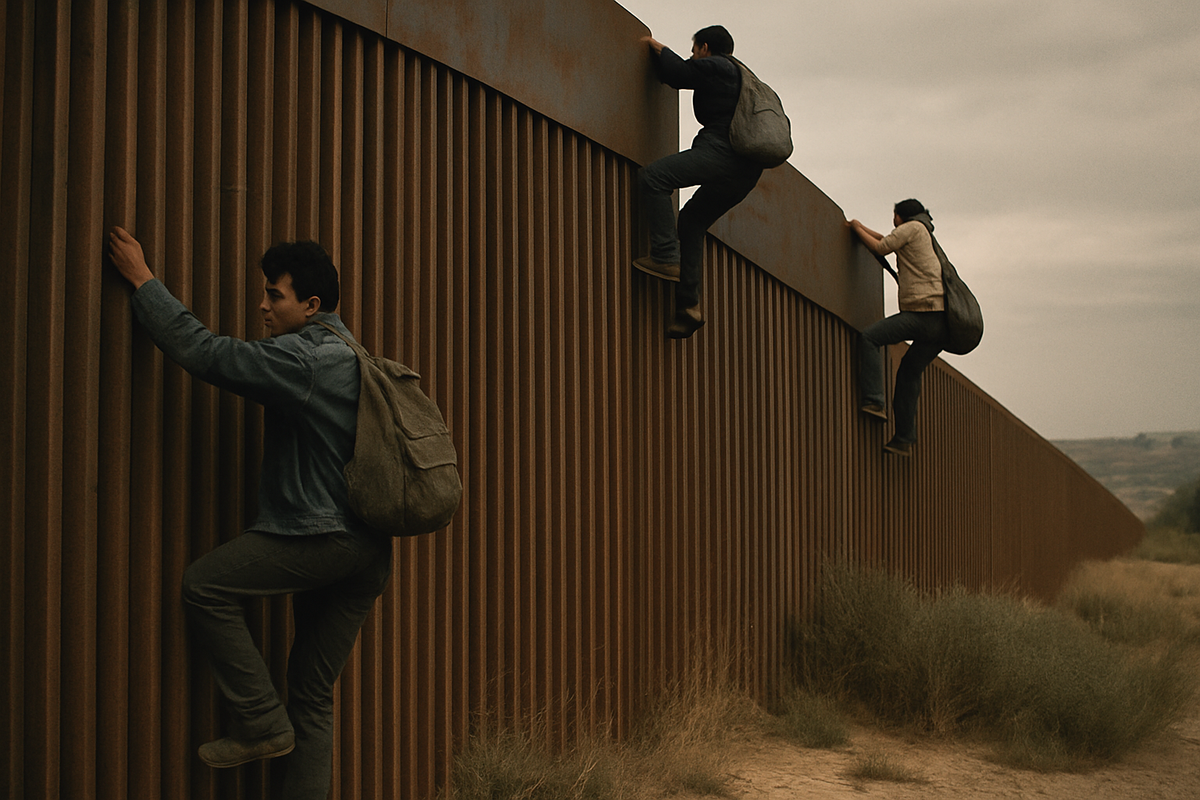
Forbes understood something critical: immigration debates aren't won with spreadsheets. They're won with images that lodge in the brain.
The April 2, 1990 issue delivered three:
1. Julian Simon at home, projecting the calm certainty of a man who'd done the math and knew he was right.
2. Immigrants scaling the Rio Grande border fence, bodies in motion against steel—a raw reminder that this wasn't theory. It was survival.
3. Farm workers in California's San Joaquin Valley, framed by a caption that cut to the bone: "Taking American jobs or making them?"
That last image wasn't neutral. It was a provocation. Forbes was daring readers to decide whether those hands in the dirt were a threat or the reason their grocery bills stayed low.
Simon's Five Counterattacks Against the Doomsayers
Simon didn't just defend immigration. He systematically dismantled every fear anchoring the restrictionist case:
Immigrants Complement, Not Replace
Low-skilled immigrants took jobs Americans wouldn't touch. High-skilled immigrants—engineers, doctors, entrepreneurs—built the industries that created jobs. The zero-sum fallacy collapsed under scrutiny.
Assimilation Isn't a Fantasy—It's History
Italians, Poles, Irish—once viewed as unassimilable threats to Anglo-Saxon purity—had become the backbone of American civic life. The same arc, Simon argued, awaited Asians and Latinos.
Open Economies Win
Simon pointed to Hong Kong: dense, immigrant-fueled, economically ferocious. Closed systems stagnate. Open ones adapt, innovate, and dominate.
Population Growth = Human Capital Expansion
More people didn't mean scarcity. It meant more inventors, more problem-solvers, more capacity to generate wealth. "The ultimate resource," Simon insisted, wasn't oil or land. It was human creativity.
The Cultural Erosion Myth
Fears that immigration would corrode American values? Simon dismissed them as ahistorical noise. Institutions don't crumble under demographic pressure—they evolve.
Each point was a scalpel. And Forbes let them cut.
Why This Issue Still Matters—And Why Collectors Hunt It
For anyone tracking the intellectual lineage of today's immigration wars, the April 2, 1990 Forbes is ground zero.
Historic Weight: The Ehrlich-Simon clash wasn't just an academic spat—it defined how a generation thought about limits, growth, and human value. This issue captured that fight at its peak.
Symbolic Timing: Published months after the Cold War's symbolic end, it reflects a nation caught between triumphalism and existential doubt. Would America lead the new global order, or retreat into fortress isolationism?
Enduring Relevance: Open any newspaper. Turn on any cable news panel. The arguments haven't changed—only the accents and the presidents. This magazine preserves the ur-text.
Archival Rarity: Unlike sanitized digital archives, the original issue gives you the texture: the ad layouts, the paper stock, the editorial swagger of Malcolm Forbes's empire. You're not reading about 1990—you're holding it.
Forbes as Oracle: Why the Magazine Got It Right
Forbes in 1990 wasn't trying to be neutral. It was trying to be correct.
While other publications churned out anxious trend pieces about Japan's economic dominance or Silicon Valley's fragility, Forbes placed a different bet: that markets, innovation, and demographic vitality would outpace every catastrophist prediction. The magazine's editorial voice—brash, data-driven, allergic to hand-wringing—gave Simon the perfect platform.
This wasn't just reporting. It was positioning. Forbes knew its readers—executives, investors, entrepreneurs—needed to understand that the future wouldn't belong to nations that hoarded resources, but to those that unleashed human potential.
And they were right.
Collecting the Debate: Why Original Issues Trump Digital Facsimiles
You can find this article on microfilm. You can pull up a PDF. But neither gives you what the original magazine does: context.
The ads for IBM mainframes and Rolex Datejusts. The adjacent profiles of leveraged buyout kings and retail magnates. The typeface, the photo grain, the tactile authority of a publication that moved markets and shaped policy.
When you hold the April 2, 1990 issue, you're not just reading Simon's argument. You're experiencing how Forbes readers encountered it—sandwiched between coverage of Donald Trump's casino debt and Honda's assault on Detroit. That adjacency matters. It shows you what the business elite cared about in 1990: competitiveness, disruption, and the unglamorous truth that prosperity requires welcoming the world's hungry and ambitious.
Collector Significance
Historic Debate
The Ehrlich-Simon clash defined a generation of economic and environmental thought. This issue captures the intellectual battle at its most consequential moment.
Striking Imagery
From border crossings to farm labor, the photographs capture a raw, unfiltered snapshot of 1990 America grappling with its identity.
Enduring Relevance
Immigration remains one of the most debated topics in U.S. politics. This issue preserves the intellectual roots of arguments still used today.
Global Turning Point
Published months after the Cold War's symbolic end, it reflects the uncertainty and opportunity of a world entering globalization.
The Lasting Provocation
Julian Simon died in 1998, eight years after this issue hit newsstands. But his argument outlived him.
Every time a politician claims immigrants "take our jobs," they're arguing with Simon. Every time an economist models the fiscal impact of immigration, they're walking terrain Simon mapped. Every time a tech founder attributes their success to America's openness, they're proving his thesis.
The April 2, 1990 Forbes isn't just a magazine. It's the record of a man who looked at a planet of seven billion people and saw not catastrophe, but potential. It's the moment a major business publication told its readers that growth—demographic, economic, intellectual—was the only rational bet.
And it's a collector's piece that asks you, the reader, a question Simon would have loved:
Do you believe in limits, or do you believe in people?
For those who choose the latter, this issue isn't nostalgia. It's a blueprint.
Explore the Archive
From the corporate empires of the 1980s to the technological revolutions of the 1990s, Forbes documented it all. Each issue is a time capsule of business history, waiting to be rediscovered.
Browse Forbes Magazine Collection